

On this page
Riding a bike gives teenagers a sense of independence and freedom, but getting stranded miles from home with a flat tire can quickly ruin a weekend trip. Taking the time to teach your teenager how to patch a tube and oil a chain gives them the confidence to solve mechanical problems on their own. Beyond building practical life skills, maintaining a bicycle provides a hands-on opportunity to talk about physics and mechanical engineering in the real world.
How do you fix a puncture?
When you teach your teenager to fix a flat tire, it helps to break the process down into a reliable, repeatable script. It ensures they will not panic when they have to do it alone by the side of the road.
Remove the wheel: Start by shifting the bike into the hardest gear (the smallest cog at the back). This gives the chain maximum slack, making it much easier to slide the rear wheel out of the frame.
Unseat the tire: Deflate the tube completely if it is not already flat. Use plastic tire levers to pry one side of the tire bead over the edge of the rim, working your way around until the tube can be pulled out.
Find the leak: Inflate the damaged tube slightly so it holds its shape. Hold it close to your ear and listen for the hiss, or pass it near your lips to feel the escaping air. In a workshop, you can submerge the tube in a basin of water and look for escaping bubbles.
Patch it: Scuff the area around the hole with a piece of sandpaper. Apply a thin layer of vulcanising fluid, wait a minute for it to get tacky, and press the rubber patch firmly over the hole.
Check the tire casing: Before putting the tube back in, always run your fingers carefully inside the tire casing to find the thorn, wire or shard of glass that caused the flat in the first place.
As they inflate the repaired tire with a hand pump, you can explain the concept of pressure. Pressure is defined as force per unit area. Road bikes run at very high pressures to reduce rolling resistance on the tarmac, which means the trapped air particles are colliding with the inside of the tube with much greater force and frequency.
How does oiling a chain improve drivetrain efficiency?
A squeaky bicycle chain is a highly inefficient one. According to Wikipedia, a well-maintained derailleur system can achieve 93 to 95% efficiency. When a chain is dry and covered in road dirt, metal grinds against metal. This creates friction, which turns the rider's kinetic energy into wasted heat instead of forward motion. Keeping the drivetrain clean is a simple lesson in energy conservation.
Clean first: Never apply fresh oil over old grime. Apply a citrus degreaser to a clean rag, wrap it around the lower span of the chain, and pedal backward to wipe away the black sludge.
Apply lube: Place one small drop of bicycle-specific oil on every single chain link roller. Do not spray it everywhere; precision matters.
Wipe off the excess: The oil belongs inside the pins and rollers where the metal parts articulate. Any oil left on the outside plates will only attract more grit and accelerate wear.
What is the simple physics behind gears?
A bicycle's drivetrain is an everyday example of mechanical advantage. When a teenager shifts gears, they are not just making it "easier" or "harder" to pedal—they are changing the physics of how their leg force translates to the rear wheel.
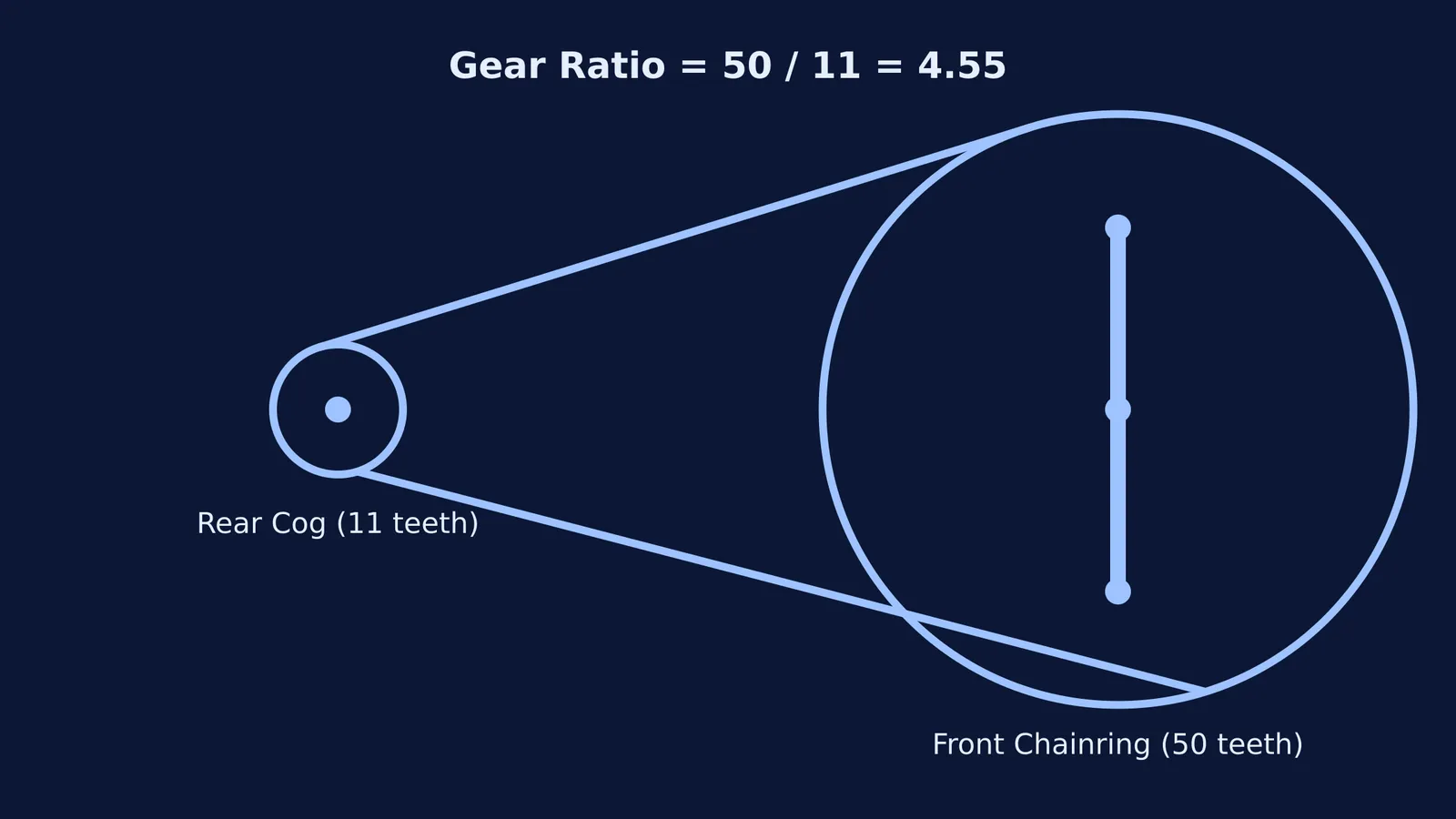
The gear ratio is the number of teeth on the front chainring divided by the number of teeth on the rear cog. If the front chainring has 50 teeth and the rear cog has 11 teeth, the gear ratio is 50/11, or 4.55. This means for every single full turn of the pedals, the rear wheel rotates 4.55 times. According to Wikipedia, this speed multiplier comes with an unavoidable trade-off in force.
High gear (small cog at the back): The rider covers a large distance per pedal stroke, which is ideal for achieving high speeds on flat ground. However, because of the fundamental law of conservation of energy, that high speed output requires a much larger input force from the rider's legs to overcome the torque at the wheel.
Low gear (large cog at the back): When shifted to the largest cog, the gear ratio approaches 1:1. The rear wheel turns fewer times per pedal stroke, but the mechanical torque is multiplied. This makes it significantly easier to pedal uphill against the force of gravity.
If your teenager struggles to picture how torque and force balance out across different ratios, the Fermi Simulation Lab provides interactive simulations for the ideas that are easier to see than to read. You can also explore how these principles of force and energy apply to other systems in the Fermi Concept Library, where every concept in physics, chemistry, biology, mathematics and computing has its own lesson and its place in the map.
By blending a Saturday afternoon chore with some simple mechanics, you help your teenager see that physics is not just a theoretical classroom subject—it is the machinery that gets them home. If you want to help them build better habits outside the garage, you can read more about setting up routines that help the whole family or how they can build a study routine that lasts longer than a week.


