

On this page
Few social rituals are as fraught for a teenager as a family gathering during exam season. Whether at a festival dinner, a wedding, or a weekend visit, well-meaning relatives often turn the table into an impromptu report card review. Questions like "What was your pre-board score?" or "Your cousin joined a top batch, why haven't you?" turn a warm evening into an interrogation.
When relatives compare your child with cousins, your first instinct may be to counter with achievements or sit in silence. Yet unmanaged comparisons carry real psychological costs. Responding effectively requires a shared strategy: agreeing on privacy beforehand, deflecting comparisons calmly in real time, and debriefing together at home.
Why do relatives compare children at family gatherings?
In close-knit families, relatives often treat academic milestones as conversational small talk, rarely intending distress. However, intent does not soften the psychological impact.
Leon Festinger's foundational theory of social comparison established that individuals evaluate themselves through comparison with similar peers, such as classmates or cousins (Festinger, 1954). When adults introduce comparisons, they create a forced upward comparison that frames the cousin as a flawless benchmark.
The psychological toll is clear. A study of 640 high school students in *Children and Youth Services Review* found that parents' forced social comparison directly fosters socially prescribed perfectionism and academic inferiority, which mediate depression and aggression (Lee et al., 2020). In *Frontiers in Psychology*, an empirical study of 576 adolescents confirmed that upward social comparison directly reduces self-esteem (β = −0.151), though optimism acts as a buffer: the drop in self-esteem is β = −0.336 for students with low optimism versus β = −0.072 for those with high optimism (Liu et al., 2025).
In India, competitive exams deepen this strain. In a 2024 survey of 570 pre-university students published in the *Journal of Education and Health Promotion*, 87.0% of students reported high perceived parental pressure and 86.0% experienced high academic stress (Pienyu et al., 2024). Unsolicited cousin comparisons compound an existing emotional load.
How should you prepare your child before a family event?
Shielding your child starts before you arrive. Having a clear plan creates psychological safety:
Establish a privacy baseline. Decide together which academic details remain private. Marks, mock test percentiles, and revision schedules are family matters, not dinner entertainment.
Rehearse a graceful exit. Agree on a discreet signal or phrase—such as offering to help in the kitchen—that lets your teenager step away if cornered by intrusive questions.
Reiterate process over rank. Remind your child that test scores do not determine worth. Anchoring praise on method rather than rank is essential for praising effort rather than fixed ability.
When teenagers feel confident in parental support, external commentary loses its power.
What should you say when relatives compare your child to a cousin?
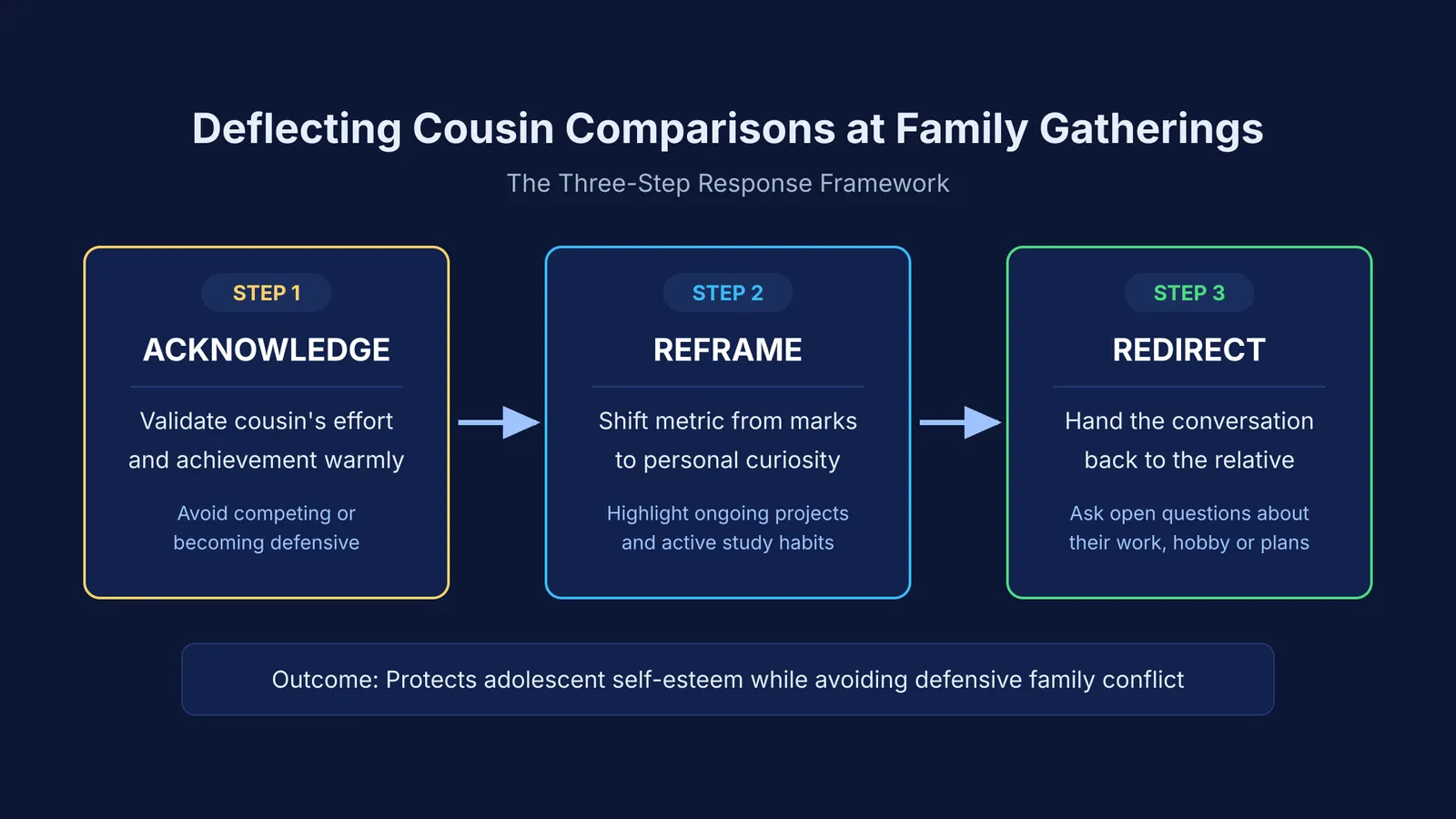
When comparisons arise, do not leave your teenager to deflect them alone. Use the three-step "Acknowledge, Reframe, Redirect" framework:
Acknowledge without competing. Validate the cousin's milestone warmly so you avoid appearing defensive.
Reframe toward personal effort. Shift the focus from comparative marks to personal curiosity and active projects.
Redirect to the relative. Turn the spotlight back on the speaker by asking about their work, hobby, or plans.
Practical scripts to adapt:
When an uncle compares test scores: "Rohan worked hard and we are proud of him. Kabir is really enjoying his physics projects right now. Uncle, how is your new solar installation working out?"
When an aunt questions career paths: "Different fields suit different strengths, and Neha has chosen subjects that excite her curiosity. Auntie, didn't you recently complete your garden project?"
When your teenager is asked directly: "Rohan is doing wonderfully. I'm focusing on my daily study routine right now—please excuse me, I promised Mom I'd help in the kitchen."
If a relative persists: "We don't compare the children on test scores; each child thrives on their own timeline. Let's enjoy the evening."
How should you debrief with your child on the journey home?
What you say on the way home matters as much as your dinner deflections. Unaddressed comments allow an adolescent's inner critic to turn casual remarks into self-doubt.
Start with an open check-in: "I noticed Uncle Ramesh kept bringing up your cousin's mock scores. How did that feel?" Validate their reaction without dismissal. Acknowledging that unsolicited scrutiny hurts confirms that their discomfort is justified.
Remind them that learning is personal and independent of social comparisons. These conversations are key to protecting students from academic perfectionism and help parents in recognising and managing adolescent exam stress.
When students want to focus on mastering difficult concepts without the noise of competitive comparison, Fermi's AI tutor works out what a student already knows and builds a plan for the session, teaching step by step while keeping notes and progress in their private library.
By establishing boundaries, deflecting comparisons calmly, and debriefing afterwards, you show your child that family connection never requires enduring public evaluation.


