

On this page
High school science students preparing for entrance tests face the same weekday dilemma: do you solve the coaching Daily Practice Problem (DPP) or complete the school physics notebook due tomorrow? When school demands neat diagrams, long-form derivations, and lab files, while coaching assigns dozens of complex numericals, attempting to finish everything every evening leads directly to exhaustion.
Prioritizing your workload is not about abandoning one institution. It is about matching the cognitive demands of each assignment to your mental energy while protecting non-negotiable board eligibility requirements.
Which homework should you do first on a weekday?
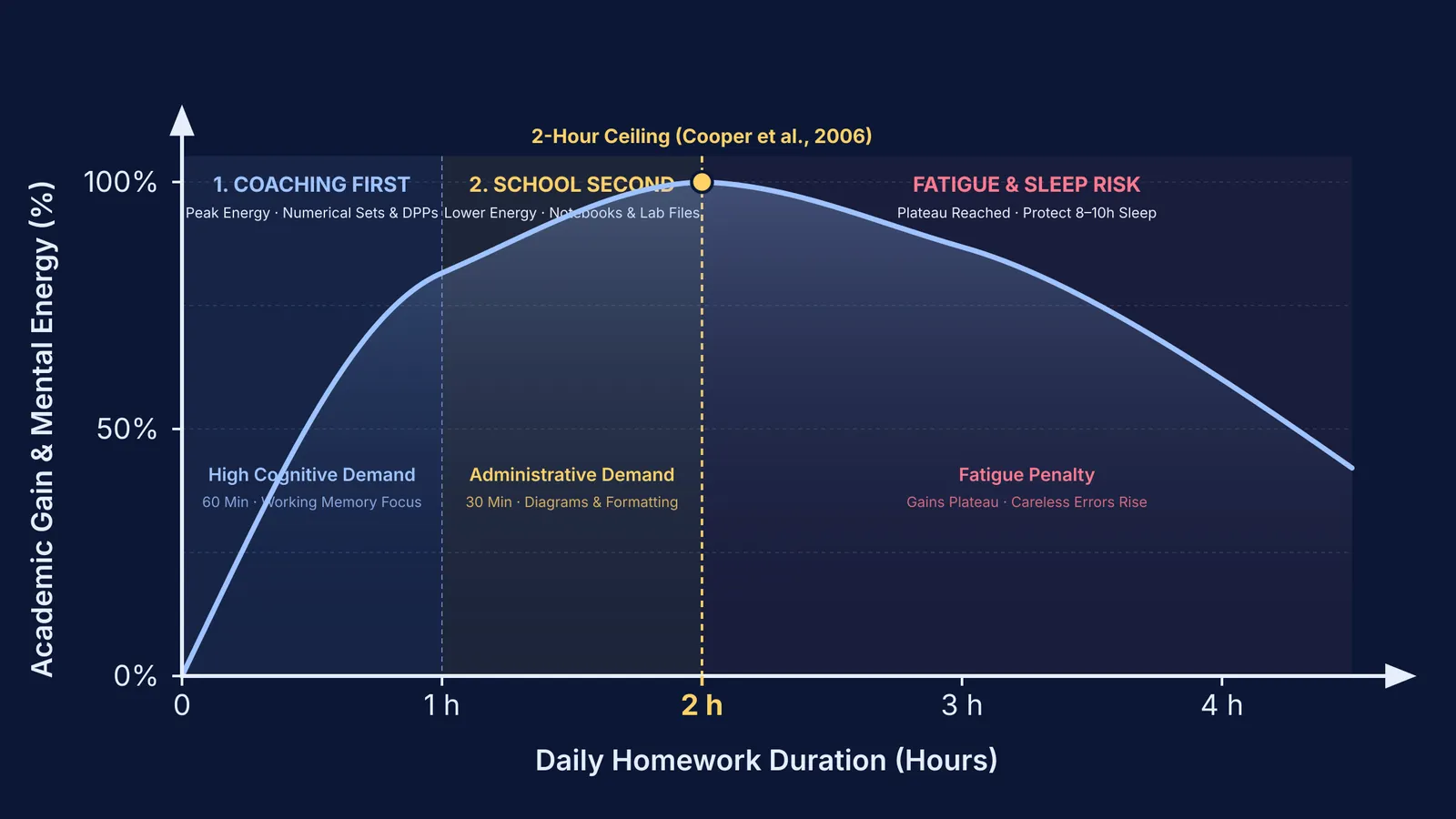
On standard weekdays, tackle high-cognitive coaching assignments before mechanical school work. Solving multi-concept numericals in mechanics or organic mechanisms requires sharp focus and working memory. Postponing tough coaching problem sheets until late at night after hours of copying school notes leads to careless errors and slow calculation.
A homework synthesis by Harris Cooper and colleagues in the Review of Educational Research found that while homework positively correlates with achievement in grades 7 to 12, academic gains plateau after approximately 2 hours per night. For age-specific workload thresholds, see how much homework helps by age.
To work within this two-hour ceiling, divide evening study by cognitive demand:
High-cognitive problem solving: Spend your first 60 minutes on challenging coaching numericals while mental alertness is highest.
Low-cognitive administrative work: Reserve the final 30 minutes for copying verified lab observations, drawing diagrams, or formatting school notebooks.
If an advanced problem stalls your progress, avoid wasting 40 minutes staring at a blank page. The Fermi Problem Library provides worked problems with a step-by-step solver that explains the reasoning rather than printing an answer, letting you grasp the underlying principle without breaking your study rhythm.
Why does ignoring school assignments backfire?
Skipping school homework to focus entirely on entrance coaching carries severe penalties. Rule 13 of the CBSE Examination Bye-Laws mandates a minimum of 75% attendance in theory and laboratory classes to sit for the annual board examination.
Moreover, practical exams and internal assessments contribute 30 marks out of 100 in Class 12 physics, chemistry, and biology, and 20 marks out of 100 in mathematics, under the official CBSE curriculum rules. Incomplete practical journals directly jeopardize internal marks. For engineering aspirants, entering National Institutes of Technology (NITs) and Indian Institutes of Information Technology (IIITs) requires securing at least 75% aggregate marks in Class 12 boards.
School assignments also preserve written derivation skills. While entrance coaching emphasizes speed and multiple-choice elimination, board papers demand structured proofs, stated assumptions, and standard notation. The Fermi Concept Library contains every concept in physics, chemistry, biology, mathematics and computing, each with its own lesson and its place in the map, allowing students to verify board derivations alongside entrance topics. For holistic planning, read our guide on balancing Class 12 board exams with JEE preparation.
How can you schedule coaching and school tasks in a single week?
Balancing both streams requires an organized weekly plan. Research by John Dunlosky and colleagues in Psychological Science in the Public Interest demonstrated that distributed practice and practice testing offer high educational utility, whereas massed cramming yields poor retention.
Follow this four-step planning rhythm:
Sync overlapping syllabi: When school and coaching teach the same unit, use coaching problems for conceptual mastery, then write out two standard textbook derivations for school requirements.
Batch administrative chores: Avoid daily handwriting sessions by consolidating lab manuals and notebook formatting into a single 90-minute block on the weekend.
Distribute coaching question sets: Divide weekly coaching modules into daily batches of 15 to 20 numericals rather than rushing through 70 questions before class.
Block study windows: Establish fixed start and end times for tasks, as explained in our guide on weekly time blocking for students.
What should parents say when workloads clash?
When school unit tests and coaching modules overlap, students often cut sleep. A consensus statement led by Dr. Shalini Paruthi in the Journal of Clinical Sleep Medicine recommends that adolescents aged 13 to 18 years obtain 8 to 10 hours of sleep per 24 hours. Chronic sleep restriction degrades working memory and exam accuracy.
Parents can help students defuse deadline pressure using direct communication:
To school teachers: Explain that your child has completed textbook numericals and will submit the formal handwritten record on Friday after weekend practical hours.
To coaching tutors: Clarify that the student solved core concept questions and will complete remaining practice problems during weekend revision because school pre-boards are underway.
When a student feels overwhelmed by competing assignments, Fermi's AI tutor works out what they already know and builds a plan for the session. If study stress triggers acute anxiety or emotional exhaustion, families should consult a counselor or reach India's mental health helpline, Tele MANAS, at 14416.


