

On this page
It used to be that you only found out your child was skipping class when the term report arrived. Today, you know before the first period is over. With coaching centres and schools rapidly adopting digital check-ins, a single missed punch on a biometric scanner triggers an instant SMS to your phone. But while the technology gives you real-time data, it does not give you the reason.
Is my child really attending coaching?
Over the last few years, attendance tracking has moved from paper registers to facial recognition and RFID cards. The push is not just from private coaching institutes wanting to keep parents informed; governments are also stepping in to regulate attendance. In January 2024, the Maharashtra state education department announced a ₹100 crore initiative to install biometric attendance machines across approximately 9,500 junior colleges to enforce the 75% attendance rule and curb "dummy schools" where students skip regular classes to attend entrance exam coaching (Times of India, 2024).
Because of the Digital Personal Data Protection (DPDP) Act, institutes must now get explicit written consent from parents before logging a student's sensitive biometric data. Once that consent is given, the system is automatic: punch in, or your parents get a text. This eliminates proxy attendance and gives parents a transparent log of their child's daily schedule.
Why do students skip coaching classes?
When your phone lights up with an absenteeism alert, it is easy to assume your child is simply slacking off. But academic pressure is complex. Often, a student skips coaching not because they do not care, but because they are stuck and overwhelmed.
In a class of a hundred students, falling behind on a concept in physics or chemistry can make the next lecture feel pointless. Rather than sit through two hours of confusion, some students choose to avoid the classroom entirely.
If your child is missing classes because they are lost in the syllabus, they might need a different kind of support before deciding between coaching, online classes or self-study for JEE. The Fermi Problem Library provides worked problems with a step-by-step solver that explains the reasoning rather than printing an answer. If they feel entirely lost on a topic, Fermi's AI tutor can work out what they already know and build a plan for the session, so they sit down to a clear next step instead of skipping class out of frustration.
How should parents handle a missed class?
Tracking attendance is only the first step. What you do with that information determines whether your child leans on you or hides from you.
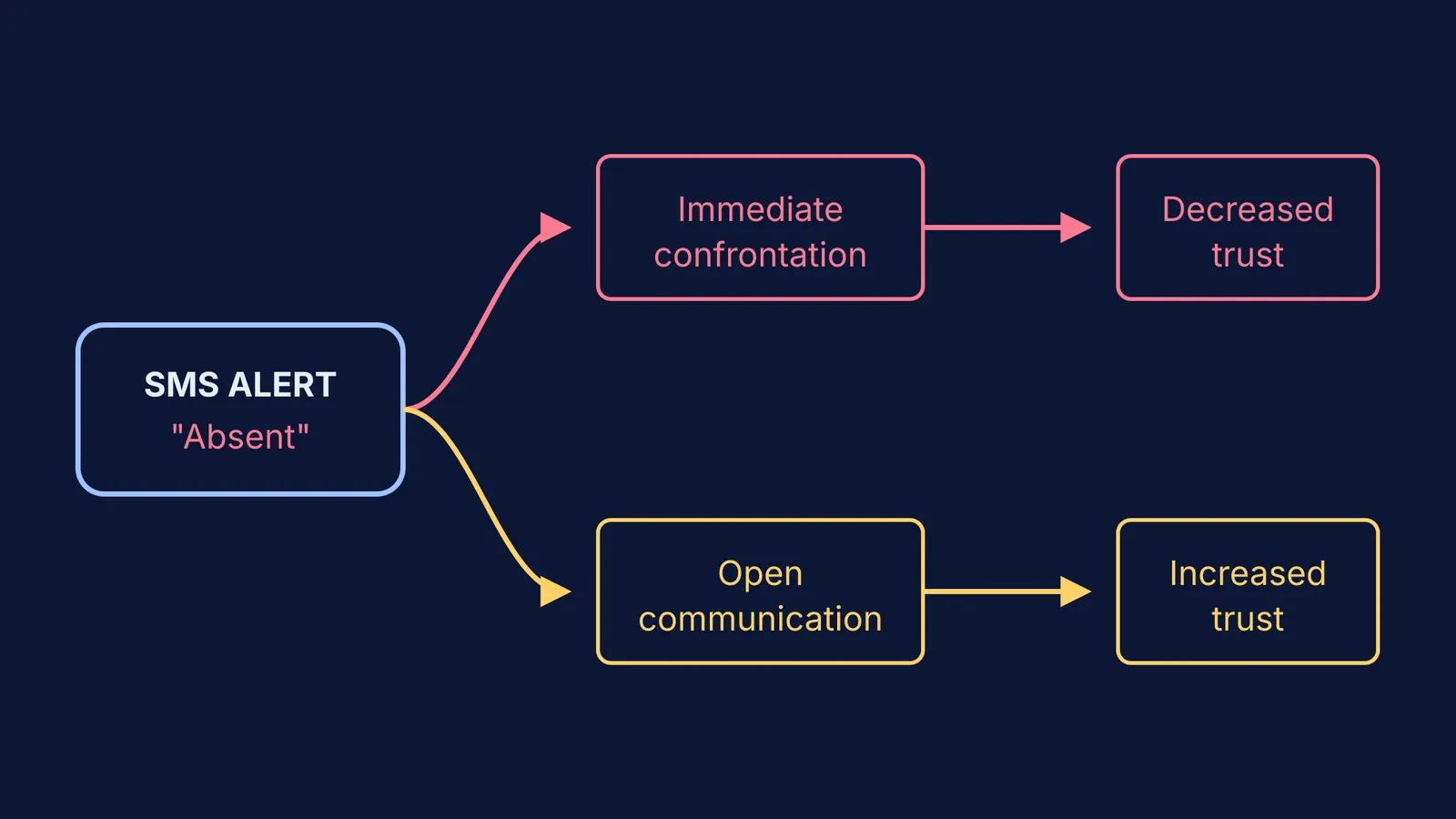
A 2015 study of 3,349 adolescents published in *PLOS ONE* found that parental monitoring does not automatically create trust. Instead, its positive effect is indirect: monitoring leads to better parent-adolescent communication, which in turn fosters trust (Ying et al., 2015). When parents monitor their children in a way that encourages dialogue rather than just control, it strengthens the adolescent's belief in their parents' dependability. This aligns with approaches for parenting that builds real motivation—offering support rather than mere surveillance.
A script for open communication
If you receive an SMS alert that your child has missed coaching, use it as a prompt for a conversation, not an accusation. Here is a simple, practical framework for what to say when they get home:
Pause before reacting: Do not call them immediately while you are angry. Wait until you can speak calmly in person.
State the fact neutrally: "I got an automated SMS from the coaching centre that you were marked absent today."
Ask an open question: "Is everything okay? Did you feel like you needed a break, or is the pace getting too fast?"
Listen without interrupting: They might confess that they are struggling with a specific subject, exhausted, or simply forgot to punch in.
Make a plan together: If the issue is academic burnout or confusion, discuss whether they need a lighter schedule or a different learning method, such as the interactive simulations in the Fermi Simulation Lab for ideas that are easier to see than to read.
Real-time tracking is a powerful tool. Used correctly, an absent alert is not a sign of failure—it is an early warning system that your child might need a hand. By prioritizing open communication over immediate discipline, you can help them navigate the intense pressure of competitive exams while keeping your relationship strong and supportive.


