On this page
For eight years your child has done sums: a question, a method, an answer you can check at the back of the book. Then Class 9 geometry asks them to prove that two angles are equal when anyone can see it in the figure. Here is why that feels strange, a layout that helps, and questions you can ask at every line even if you've forgotten the theorems.
Why do geometry proofs feel so hard after years of sums?
A sum ends in a number you didn't know. A proof ends in a sentence you were told at the start, so all the work is in the chain between. Many students find this hard.
Sharon Senk tested 1,520 students in 74 classes from 11 schools in five US states in 1981, according to a summary by Michelle Cirillo of the University of Delaware and colleagues. Only about 30% of students in full-year geometry courses that covered proof reached 75% mastery of proof. Senk published the work as How Well Do Students Write Geometry Proofs? in The Mathematics Teacher in 1985.
On the theorem that the diagonals of a rectangle are equal, a common error was citing the theorem inside its own proof, which is circular reasoning (Cirillo and colleagues). You can catch that mistake without knowing any geometry.
Three shifts trip students up:
The figure is not evidence. An angle that looks like 90 degrees is not one until a given fact or a reason says so.
Every line needs a reason, not just a result.
The goal is stated in advance. The skill is finding the route, not the destination.
What layout should a Class 9 proof follow?
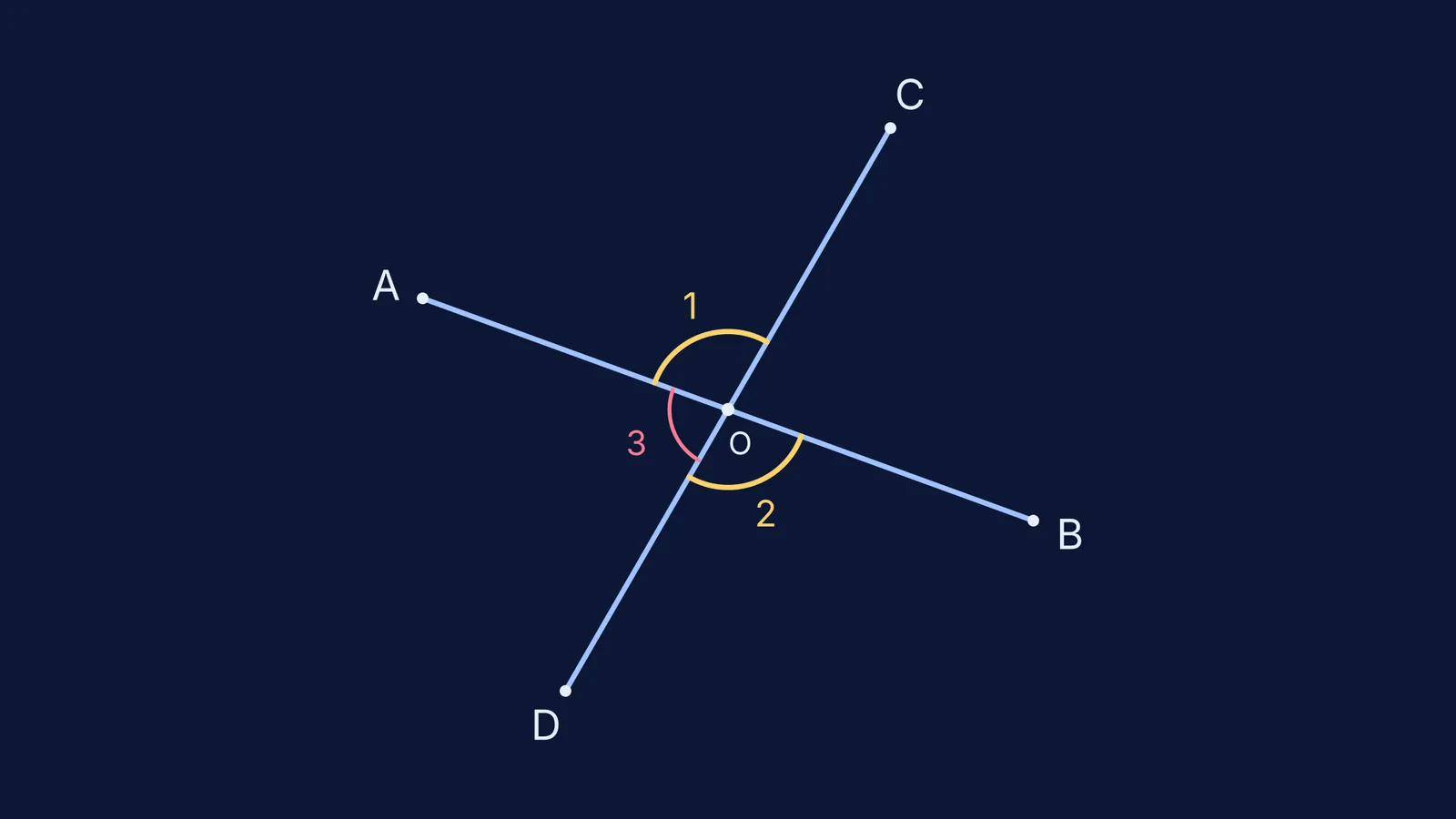
Ask your child to write every proof in four parts: Given (what the question tells you), To prove (the exact statement), Construction (any added line, if needed), and Proof (numbered statements, each with its reason in brackets). This example's figure is at the top of the page.
Theorem: if two lines intersect, the vertically opposite angles are equal.
Given: lines AB and CD intersect at O.
To prove: angle AOC = angle BOD.
Proof:
Angle AOC + angle AOD = 180 degrees (ray OA stands on line CD, so they form a linear pair).
Angle AOD + angle BOD = 180 degrees (ray OD stands on line AB, a linear pair again).
So angle AOC + angle AOD = angle AOD + angle BOD (both equal 180 degrees, from 1 and 2).
Angle AOC = angle BOD (subtract angle AOD from both sides). Hence proved.
No line says "they look equal". Every reason is a given, a definition, an axiom or something proved earlier. If the school uses another style, keep theirs.
How can I help with proofs if I don't know the theorem?
You are not checking the geometry; you are checking that every step has a reason. In a 1994 study by Michelene Chi and colleagues, 14 eighth-grade students were asked to explain to themselves after reading each line of a passage on the circulatory system, and they gained more from pre-test to post-test than 10 students who just read it twice. A 2013 review by John Dunlosky and colleagues rated self-explanation and asking "why" questions as of moderate use, because evidence from real classrooms was limited. Treat it as a sensible habit.
A script you can use at the table:
"What are you given? Point to it on the figure."
"What do you have to prove? Say it in your own words."
At each line: "Why is this true? Is it given, a definition, or something you proved before?"
"Does any reason use the thing you are trying to prove?"
"Which given haven't you used yet?"
At the end: "Can you explain the whole proof to me in three sentences?"
Ask, don't correct. If the answer is "because it's obvious", reply "obvious from which fact?" and wait. Our guide to helping with maths you've forgotten uses the same question-first approach.
What can we practise at home each week?
A reasons page. One notebook page listing every axiom, definition and theorem the class has covered so far. Start with Euclid's axioms and postulates in Class 9, then add rules such as the SAS, ASA, SSS and RHS congruence tests.
Two proofs aloud. Ten minutes, twice a week, your child explains a proof using the script above.
Blank-page re-proof. The day after a theorem is taught, ask them to rebuild it from Given and To prove without the book.
When a step's reason still won't come, the Fermi Problem Library has worked problems with a step-by-step solver that explains the reasoning rather than printing an answer, so your child can compare their chain of reasons with a complete one.
Tonight, pick one proof from the textbook and ask just one question at each line: why is this true?