

On this page
In Class 6, the familiar, integrated subject of Environmental Studies (EVS) splits into history, geography, and civics. For many children, this transition is jarring. Suddenly, they are asked to memorise dates of ancient empires, the latitudes of continents, and the structure of local government. When these concepts remain trapped on the textbook page, homework quickly becomes a chore.
The key to helping your child is making the abstract concrete. By bringing history into your living room and geography into your neighbourhood, you can help them build a spatial and personal understanding of the world.
How do family stories make history easier to remember?
When a child reads about the 1970s or 1990s, the decades can feel as distant as the Harappan civilisation. You can bridge this gap by connecting historical eras to your own family's timeline.
Research supports the power of personal narrative. A 2008 study by researchers at Emory University developed the 20-question "Do You Know?" scale (Duke et al., 2008), measuring how much children knew about their family history, and found that high scores correlated with higher self-esteem and resilience. When children see themselves as part of a larger, ongoing story, they engage more deeply with the past.
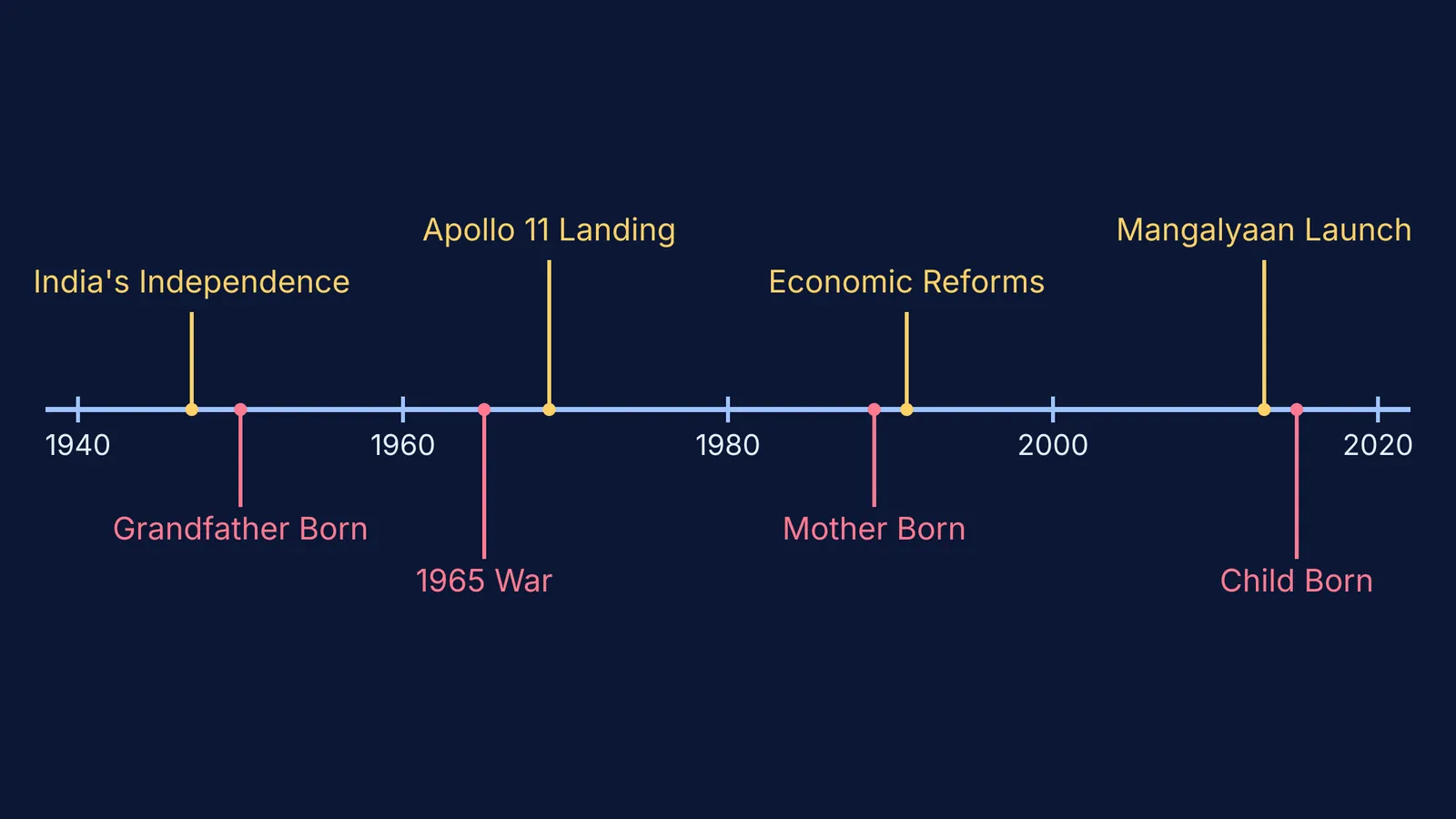
Try drawing a dual timeline on a large sheet of paper. On the top half, plot the major historical events your child is studying—such as India's independence, the moon landing, or the Green Revolution. On the bottom half, plot family milestones: when their grandparents were born, when their parents moved cities, or when they started school. Seeing that their grandfather was a teenager during the 1965 war, or that their mother was born just before the economic reforms, turns history from a list of facts into a lived experience.
How to make geography spatial and real?
Geography in Class 6 introduces the globe, latitudes, longitudes, and physical features. Merely reading definitions is rarely enough to build a mental map of the world.
Active spatial training makes a measurable difference. A 2013 meta-analysis of 217 studies in the *Psychological Bulletin* (Uttal et al., 2013) found that spatial skills training, such as reading and drawing maps, improves spatial thinking with an average effect size of Hedges's g = 0.47. This indicates a moderate but reliable boost to learning and retention.
Instead of just pointing to a map in a book, make geography a hands-on task:
Trace the route: If you are planning a trip or reading a news story about a distant country, have your child find the location on a physical globe or a digital map.
Draw the neighbourhood: Start small by asking them to draw a map of their route to school, including landmarks and cardinal directions.
Use interactive tools: When studying physical geography like the solar system or Earth's rotation, interactive tools are invaluable. For example, the Fermi Simulation Lab allows students to manipulate variables to see how orbits or planetary tilt actually work, rather than just reading a static description.
How to connect civics to daily life?
Civics, or Social and Political Life, deals with community, local government, and public services. Because these systems are invisible to most children, the subject can seem irrelevant.
You can make civics tangible by pointing out how it operates in your daily life. When the garbage collector arrives, when you pay a property tax bill, or when you notice a new road being paved, discuss it with your child. Ask them which level of government—local, state, or central—is responsible for the work.
Reading the newspaper together is another excellent habit. Pick one local news story each week—perhaps a debate in the municipal corporation or a new community initiative—and discuss how it relates to the chapters in their civics textbook. You can also explore When to help with homework and when to step back to ensure you are guiding these discussions without taking over their assignments.
A weekly plan for social science homework
To keep these subjects interesting without overwhelming your child, try this simple weekly rotation:
Map Monday: Spend ten minutes finding all the places mentioned in this week's chapters on a physical map.
Timeline Tuesday: Add any new historical dates to your ongoing family-and-history timeline.
Civics Saturday: Find one local news story that connects to their current Social and Political Life chapter and discuss it over breakfast.
By integrating these practices, you are encouraging curiosity at home and helping your child see that social science is not just a school subject, but the story of their own world.


