

On this page
When parents move a child from a regional medium to an English-medium school, they often expect a brief settling-in period followed by smooth sailing. However, the academic reality is usually much steeper. The child is not just learning a new language; they are trying to learn complex subjects *through* a new language.
According to the 2023 Annual Status of Education Report (ASER) "Beyond Basics", only 57.3% of youth aged 14 to 18 in rural India can read simple sentences in English. Even among those who can read, comprehension is a barrier: only 73.5% of those readers can tell you what the sentences mean. This gap between reading and understanding is the silent struggle in many English-medium classrooms.
Why is my child struggling in English medium?
When a child switches languages, they often develop social fluency first. They can ask questions in class, chat with friends, and follow basic instructions. Parents and teachers might see this and assume the language barrier is crossed.
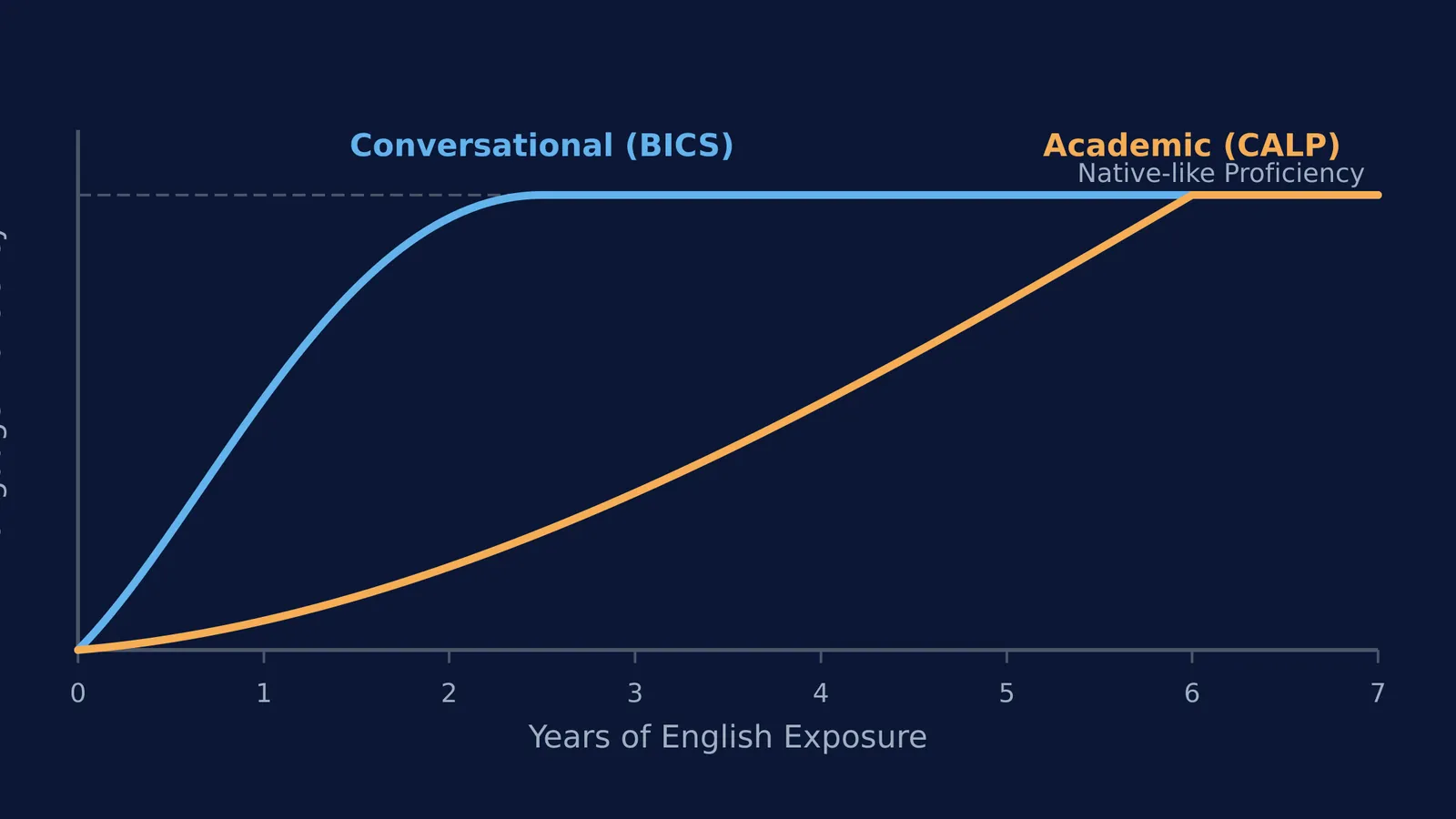
However, academic language is entirely different. Words like "differentiate," "velocity," or "respiration" are cognitively demanding. The linguist Jim Cummins calls this the gap between Basic Interpersonal Communication Skills (BICS) and Cognitive Academic Language Proficiency (CALP). Because academic language lacks the context of a casual conversation—like gestures or visual cues—the student has to rely entirely on words they have just started learning.
When the vocabulary is overwhelming, children often resort to rote memorisation. They learn to recite paragraphs to pass exams, but without the underlying concept, their foundation cracks when they reach higher classes where application matters more than memory.
How long does it take to learn English medium instruction?
The timeline for true fluency is much longer than a single school year. Cummins' research found that while basic, conversational English takes about two to three years to master, the deep academic language (CALP) needed to thrive in science and mathematics takes five to seven years.
This means a child who switches to English medium in Class 6 might still be translating dense science texts in their head when they face their Class 10 board exams. Knowing this timeline is vital. It shifts the expectation from "Why aren't they getting this yet?" to "How can we support the next five years of learning?" For more on how early language foundations matter, see Home language and learning: what NEP 2020 and research say.
How can parents help without knowing English?
Many parents face a "double bind": they want the opportunities of English-medium education for their children but feel they cannot help with homework because they only speak the regional language. You do not need to be fluent in English to be highly effective in your child's education.
Discuss concepts in the mother tongue: Language is just a vehicle for thought. A child needs to understand *why* a magnet attracts iron or *how* a plant makes food. If they learn the concept in their mother tongue at home, they only have to map the English words to it at school, rather than trying to learn the concept and the language at the same time.
Lean on visual and interactive tools: If reading the textbook is the bottleneck, remove the text. Interactive simulations bypass the language barrier by letting a student see the physics or chemistry in action. For example, the Fermi Simulation Lab provides interactive simulations for the ideas that are easier to see than to read, allowing a student to grasp the mechanics before they attempt the English chapter.
Find explanations, not just answers: When a child is stuck on homework, giving them the answer teaches them nothing. They need a teacher who can step through the reasoning in a way they understand. If a human tutor isn't available, Fermi's AI tutor can fill the gap. When a student brings a problem set, the tutor works out what they already know and teaches through it—writing on a board, drawing the figure, and checking understanding as it goes. Because it holds a line of reasoning across a whole session, it ensures the child actually learns the concept instead of memorising a solution. This approach aligns well with How parents can help children learn without adding pressure.
Switching mediums is a marathon. By keeping the home language alive for intellectual discussions and using smart tools to decode the school curriculum, you can give your child the confidence to succeed.


