

On this page
What does a B.Pharm degree actually cover?
The four-year Bachelor of Pharmacy (B.Pharm) degree bridges the gap between laboratory science and healthcare. It is not just about dispensing medicines across a pharmacy counter; it is about understanding how drugs are formulated, how they act on the human body, and how they are manufactured safely at scale. Throughout the eight semesters, students dive deep into the chemical structure of medicines and their biological impact on various bodily systems.
The Pharmacy Council of India (PCI) has announced an overhaul of the approved B.Pharm syllabus to align with the National Education Policy, starting from the 2026–27 academic session (Pharmacy Council of India). The traditional focus on core subjects like pharmacology, medicinal chemistry, and pharmacognosy remains strong. However, the new curriculum introduces modern skills such as artificial intelligence, data analytics, and green chemistry to prepare graduates for the future of pharmaceutical sciences. Students will also be required to complete mandatory clinical and community pharmacy internships to gain practical exposure.
If your child needs to strengthen their foundation, the Fermi Concept Library covers every concept in chemistry and biology, each with its own lesson and its place in the map. This helps them grasp topics like naming carbon compounds in Class 10 before they tackle complex pharmaceutical chemistry and advanced reaction mechanisms.
What are the eligibility and admission routes?
To be eligible for a B.Pharm program in India, candidates must complete their 10+2 education with Physics and Chemistry as compulsory subjects, alongside either Mathematics or Biology (PCM or PCB) (Collegedunia). Most recognized institutes require a minimum aggregate of 45% to 50% in these core subjects to qualify for admission, though reserved categories may receive slight relaxations.
Admission into top pharmacy colleges typically depends on performance in national or state-level entrance exams:
National exams: CUET (UG) is widely accepted for Central Universities, while NEET is another major gateway. Though NEET is primarily intended for medical and dental courses, many pharmacy colleges use its competitive ranks for their admission process. Students studying for these challenging exams must master topics like opioids, cannabinoids and coca alkaloids to secure a good rank.
State exams: State-level engineering and pharmacy tests like MHT-CET in Maharashtra, WBJEE in West Bengal, and KCET in Karnataka are standard pathways for state university admissions.
University exams: Leading private institutions such as BITS Pilani (BITSAT) and Manipal Academy of Higher Education (MET) conduct their own independent online tests.
Is pharmacy a good career in India?
The scale of the industry makes pharmacy a highly stable and rewarding career path. The Indian pharmaceutical sector is the third largest globally by volume, acting as a major supplier of generic medicines worldwide. It recorded an annual turnover of approximately ₹4,17,345 crore for the 2023–24 financial year (Department of Pharmaceuticals).
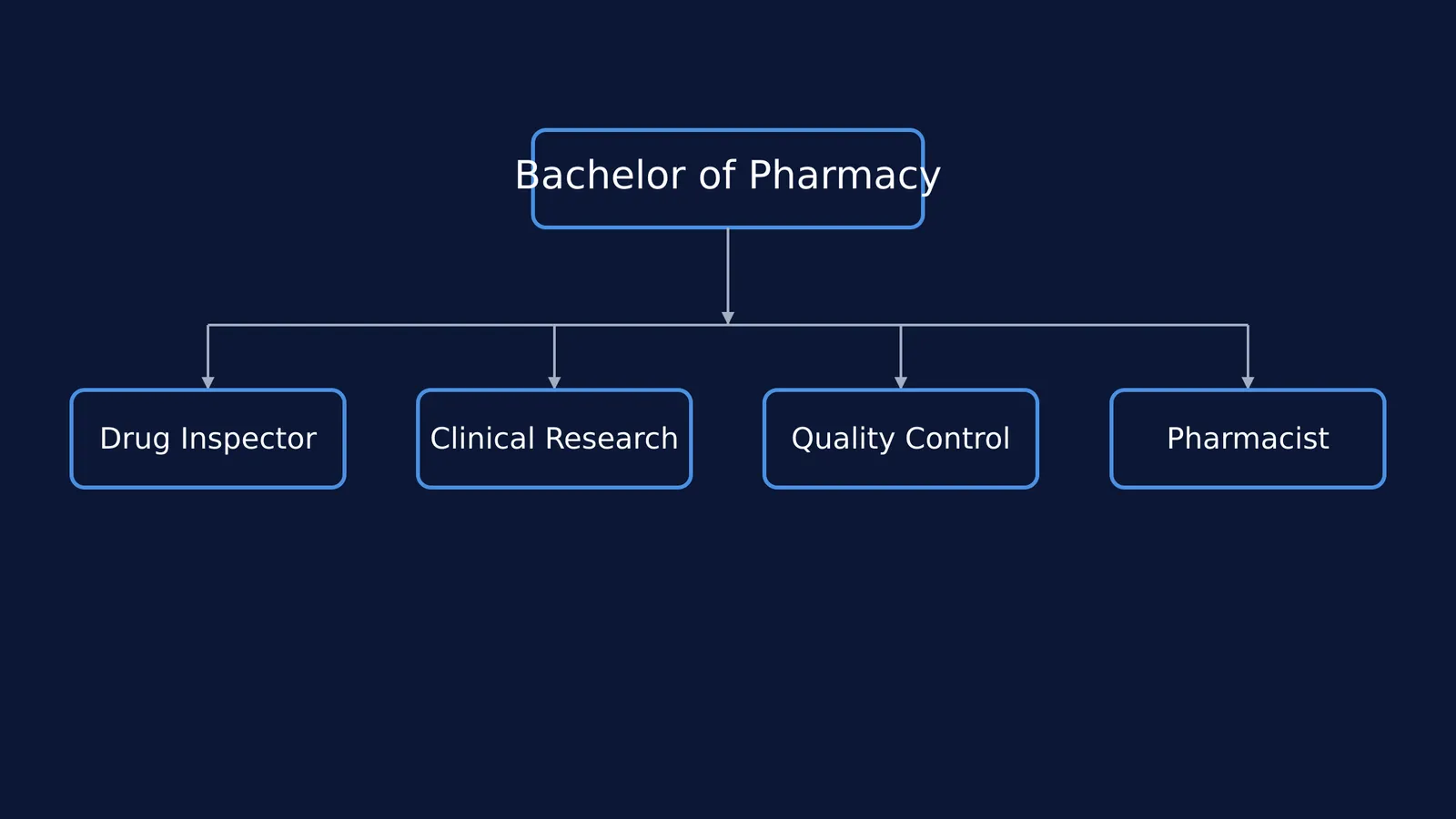
There are approximately 1.6 million registered pharmacists in India as of 2023 (Pharmacy Council of India). A B.Pharm graduate can choose from several distinct paths across manufacturing, regulation, and research (Collegedunia):
Drug Inspector: A respected government role ensuring the safety and quality of medicines at manufacturing plants and pharmacies, with starting salaries often ranging from ₹5.0 to ₹8.0 LPA.
Clinical Research Associate: Managing and monitoring clinical trials for new drugs, ensuring ethical standards are met, typically starting between ₹3.5 and ₹6.0 LPA.
Quality Control Associate: Ensuring pharmaceutical products meet strict quality standards before they reach the market, starting at ₹3.0 to ₹5.5 LPA. A deep understanding of the six enzyme classes and chemical properties is essential for running these laboratory assays.
Pharmacist: Working directly with patients in hospital or retail settings to dispense medications safely, which usually offers starting salaries around ₹2.0 to ₹4.0 LPA.
Is your child a good fit?
If you and your child are weighing this option, it helps to sit down and discuss these practical questions before making a final decision:
"Do you enjoy hands-on laboratory work?" Pharmacy students spend hundreds of hours in labs synthesizing chemical compounds, checking purity, and running detailed analytical tests.
"Are you interested in healthcare without the clinical pressure?" Pharmacy is ideal for students who want to improve patient health through rigorous science rather than direct bedside care or dealing with medical emergencies.
"Are you comfortable with strict rules?" The pharmaceutical industry is heavily regulated by local and international bodies, requiring high attention to detail and zero tolerance for measurement errors.
Discuss these questions with your child today to help them decide if a pharmacy degree is the right path.


