

On this page
Many students dream of joining the armed forces as commissioned officers straight after school. The National Defence Academy (NDA) path offers this exact opportunity. However, it requires a careful balancing act between Class 12 board preparation, a highly competitive entrance exam, and strict physical and medical standards.
If your child is aiming for the NDA, understanding the timeline, the exam structure, and how you can support their preparation is the first step.
What is the NDA eligibility criteria?
The Union Public Service Commission (UPSC) conducts the NDA and Naval Academy (NA) examination twice a year. The first hurdle is simply qualifying to take the test.
The age window is strict: candidates must be unmarried and typically between 15.5 and 18.5 years old when applying. For example, for the NDA II 2024 cycle, candidates had to be born between 2 January 2006 and 1 January 2009 (UPSC).
Academically, a student must have passed or be appearing in their Class 12 exams. For the Army wing, any stream is acceptable. However, for the Air Force and Naval wings, candidates must be taking Physics, Chemistry, and Mathematics (PCM) in their 10+2 pattern (UPSC). This means that while a humanities student can join the Army, flying a fighter jet or navigating a submarine requires a firm grounding in science. For more on subject choices, read our guide on the NDA exam for science students.
How is the NDA exam structured?
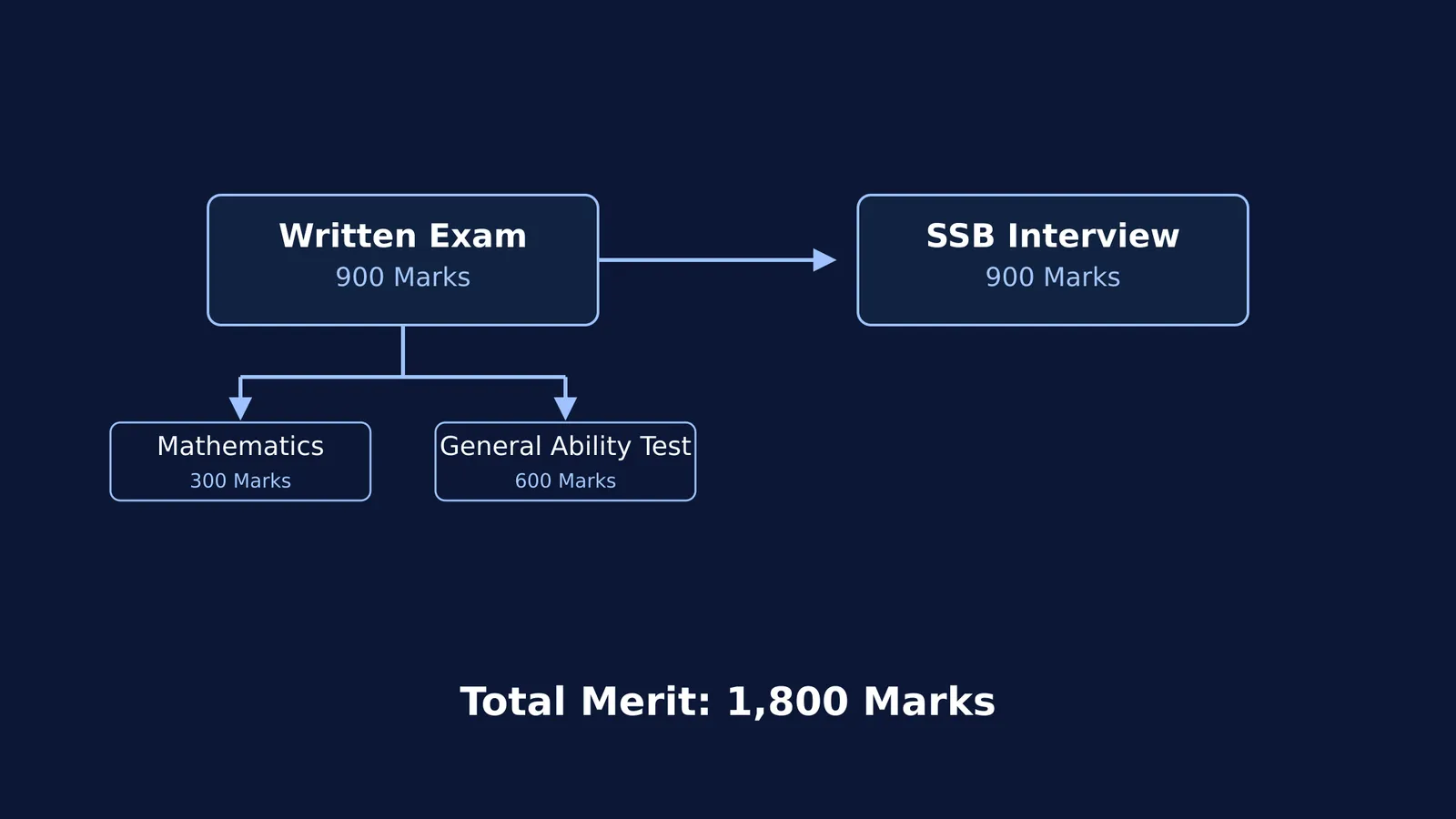
The selection process evaluates both intellect and personality, split equally across 1,800 total marks (UPSC).
The first stage is the written examination, which carries 900 marks (UPSC). This is divided into two papers taken on the same day:
Mathematics: 300 marks (2.5 hours).
General Ability Test (GAT): 600 marks (2.5 hours).
The GAT paper is broad, covering English (200 marks), physics, chemistry, general science, history, geography, and current events (400 marks).
Candidates who clear the written cutoff move to the Services Selection Board (SSB) interview, which carries another 900 marks (UPSC). The SSB is a multi-day process involving intelligence and personality tests, group tasks, and a personal interview. It is conducted over five days. Stage I comprises Officer Intelligence Rating (OIR) tests and a Picture Perception & Description Test (PP&DT). Stage II involves psychological tests, Group Testing Officer (GTO) tasks, an interview, and a conference. Finally, recommended candidates must pass a rigorous medical examination.
How can families support the preparation?
Preparing for the NDA requires discipline. While general parental involvement is always beneficial, research suggests that setting clear expectations and showing the value of education is more effective than hovering over homework. A 2026 study on the impact of parental involvement found a significant positive relationship between parental involvement and a student's academic performance (Mumtaz & Saeed, 2026).
Here is a practical framework to support your child:
1. Audit their mathematics foundation The 300-mark mathematics paper is heavily weighted towards Class 11 and 12 concepts, from calculus to vector algebra, trigonometry, and statistics (UPSC). Because the exam contains 120 questions to be solved in just 2.5 hours, speed and accuracy are paramount. This immense time pressure often induces stress, especially if parents themselves suffer from parents' maths anxiety and inadvertently pass that tension down to their child. Instead of trying to teach it yourself and risking a cycle of frustration, provide the right tools. For instance, the Fermi Problem Library has worked problems with a step-by-step solver that explains the reasoning rather than printing an answer, helping students fix their wrong-method mistakes before they become ingrained habits.
2. Build a dual-track schedule Your child will be juggling board exams and NDA prep. Sit down and create a timetable that allocates dedicated hours for the GAT subjects, which might not be covered in their regular school curriculum. Since the GAT includes 200 marks of English proficiency alongside a broad 400-mark science and general knowledge section, consistent daily revision is essential. If they struggle to visualise complex physics concepts required for the GAT, the interactive simulations in the Fermi Simulation Lab can help clarify ideas that are easier to see than read.
3. Start physical conditioning early The SSB interview and the academy training demand high physical fitness. Encourage a daily routine of running, push-ups, and outdoor sports. Building stamina over several months is far more effective than a sudden crash-course in fitness right before the SSB. This consistent exercise habit also helps reduce exam anxiety and keeps their mind sharp during long study sessions.
4. Prepare for the SSB from day one The SSB looks for Officer Like Qualities (OLQs). Encourage public speaking, reading the daily newspaper, and discussing current affairs at the dinner table. If they don't know where to start a study session, Fermi's AI tutor works out what they already know and builds a plan for the session, so they sit down to a clear next step instead of a blank page.
The NDA path is long, but with structured preparation and the right support system, your child can confidently navigate both their board exams and the defence selection process.


