On this page
When a student finishes first year and announces they want to leave college, families often react with alarm. Parents worry about lost coaching months, paid tuition, and resume gaps. Yet first-year friction is a common inflection point in higher education. Stepping back allows families to diagnose what is broken—whether it is academic pacing, subject choice, or campus isolation.
Why do students want to leave college after their first year?
Undergraduate departures rarely stem from sudden apathy; they emerge from accumulated friction during the transition to higher education. In his seminal synthesis of student attrition in the *Review of Educational Research*, Vincent Tinto showed that persistence requires both academic integration (intellectual fit and competence) and social integration (peer belonging and community). When either pillar collapses, the urge to depart rises quickly.
This dynamic appears across premier institutions. Data presented to Parliament by the Ministry of Education revealed that 34,035 students withdrew from central higher education institutions between 2019 and 2023, including 8,139 students from Indian Institutes of Technology (IITs) and 5,623 from National Institutes of Technology (NITs). At the undergraduate level, the Ministry cited course mismatch, academic pressure, and personal adjustment as primary drivers. For students leaving rigid school routines for unstructured lectures, disorientation is common, as discussed in our guide on navigating the academic jump in your first semester at college.
How does credit transfer work under the Academic Bank of Credits?
Leaving an Indian university after first year no longer means losing completed coursework. Under the National Education Policy 2020 and University Grants Commission guidelines, student mobility is managed through the Academic Bank of Credits (ABC). Under this system, students who complete two semesters and clear between 36 and 40 academic credits have those credits digitally deposited in their ABC account.
Students exiting after Year 1 can claim an Undergraduate Certificate after completing a 4-credit vocational internship during the summer. These credits remain valid for up to 7 years. This validity allows students to seek lateral entry directly into the second year at another recognized university, provided the receiving college approves course equivalence and has vacant seats.
Should your child drop out, transfer, or retake entrance exams?
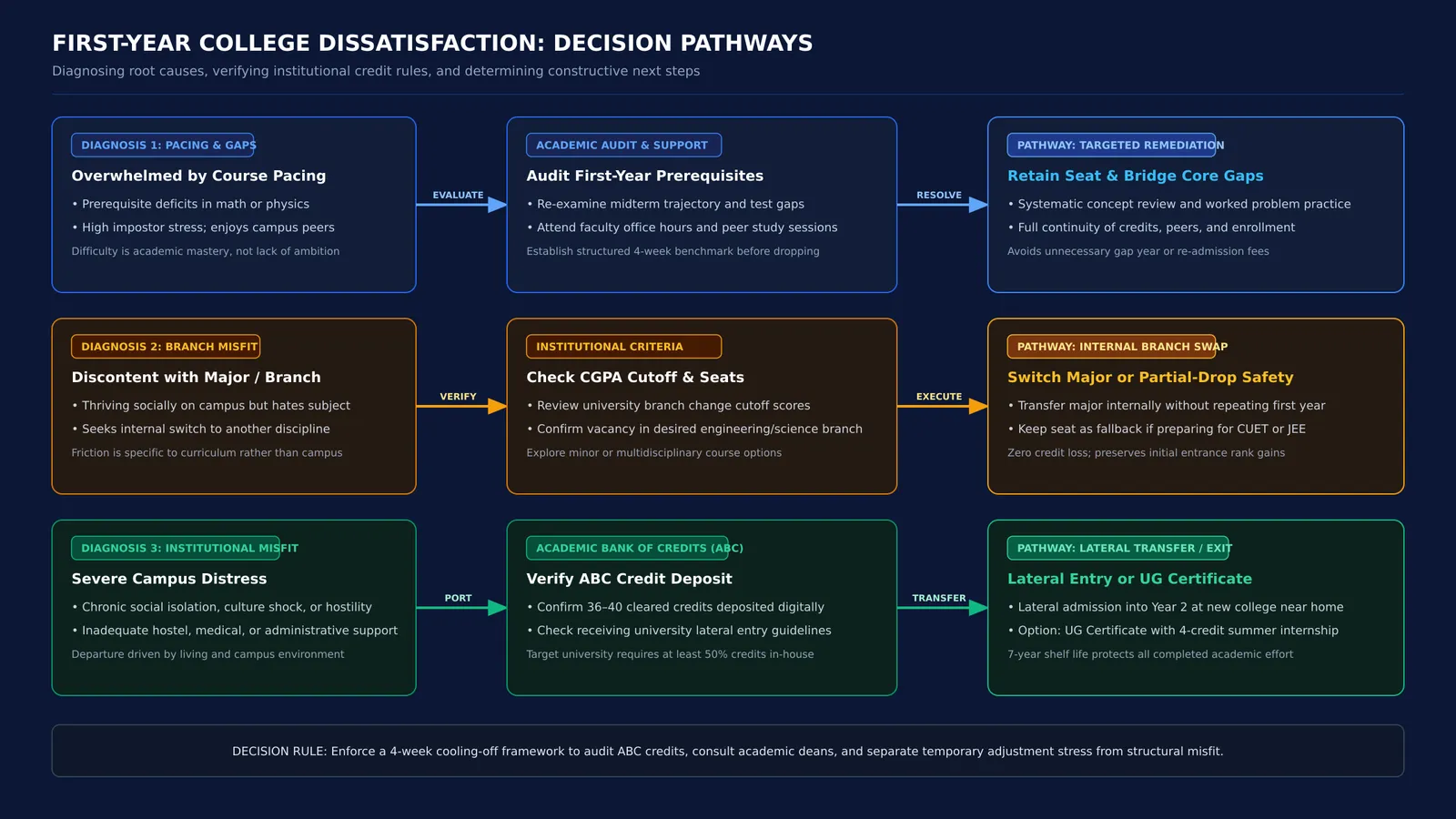
Before filing withdrawal forms, families should evaluate three practical alternatives:
Internal branch change: Many colleges permit top first-year students to switch majors based on their Cumulative Grade Point Average (CGPA). If your child dislikes their branch but likes the campus, this avoids lost time and new admission fees.
Lateral credit transfer: If the challenge is institutional—such as punitive grading or poor facilities—transferring via the ABC portal to a university near home preserves earned credits while resetting the environment.
Partial drop and re-entrance: If your child wants to switch disciplines entirely, such as moving from engineering to pure sciences, they can prepare for entrance exams like CUET-UG or JEE Main while retaining their current seat as a safety net.
When academic friction stems from weak foundational mastery in first-year mathematics, physics, or computing, targeted concept revision often solves the issue without switching colleges. Undergraduates can review prerequisite course topics using the Fermi Concept Library, which provides structured lessons across STEM subjects. For students practicing difficult assignments or preparing to re-attempt competitive entrance exams, the Fermi Problem Library offers worked problems with a step-by-step solver that explains the reasoning rather than printing an answer.
How can parents talk through the decision without conflict?
When conversations turn adversarial, students retreat into defensiveness. A meta-analysis in *Educational Psychology Review* by Ariana C. Vasquez and colleagues examined parental autonomy support across 36 studies (doi:10.1007/s10648-015-9329-z). The authors found that when parents listen to their child's perspective, explain rationales, and support volitional choice rather than applying pressure, students show higher academic engagement, greater persistence, and lower anxiety.
Families can explore practicing autonomy-supportive parenting to support healthy independence. When career goals diverge from parental expectations, our guide on when a child's career choice differs from family expectations offers concrete communication strategies.
Open discussions by asking targeted diagnostic questions:
"Which specific classes or hours of the week feel manageable, and which feel overwhelming?"
"Is the difficulty about the subject material, the grading culture, or feeling isolated on campus?"
"If you could change your branch or your living arrangement, would you still want to leave?"
Next, agree on a four-week cooling-off framework before making irreversible decisions:
Audit credits: Log in to the Academic Bank of Credits portal to confirm that all first-year credits are deposited.
Consult the dean: Verify branch change cutoffs, leave rules, and summer certificate options.
Check target colleges: Obtain written confirmation of credit recognition and lateral seat availability.
Set a decision date: Agree on a calendar deadline 30 days out to decide once initial stress has settled.