

On this page
When a child announces they want to be a doctor, parents often wonder what to do next. Should you buy extra science books? Start looking at NEET or JEE coaching early?
The short answer is to encourage their curiosity without turning it into a high-pressure academic track. At this age, a child's aspirations are still forming, and the best way to support them is by building a broad, practical foundation.
Is it normal for a 10-year-old to want to be a doctor?
Yes, it is one of the most common career choices for children of this age.
In the 2018 "Drawing the Future" report by the charity Education and Employers, researchers asked over 20,000 primary school children aged 7 to 11 to draw the job they wanted when they grew up. The study found that "doctor" consistently ranked as one of the top career aspirations for both boys and girls globally.
Children often base this choice on personal experience, such as visiting a clinic or watching a doctor on television, rather than a deep understanding of the profession. Because they are rarely exposed to the vast diversity of modern careers, they gravitate toward highly visible, respected roles. This means their interest is real, but it is also broad and likely to change as they encounter new fields.
What is "science capital" and why does it matter?
If your child eventually wants to pursue medicine, they will need a strong foundation in science. However, a 2020 report from the ASPIRES 2 longitudinal study by the UCL Institute of Education highlights a critical gap. The study, which tracked students from age 10 to 19, found that while 70% to 80% of young people find school science interesting, only around 16% actually aspire to become scientists.
The researchers emphasise the importance of "Science Capital"—a measure of a person's science-related resources. This includes what they know about science, how they think about the world, whether they talk about science at home, and if they know anyone working in a science-related field. Children with high science capital are significantly more likely to stick with STEM subjects as they get older. Building this capital early is far more important than early test scores.
How to encourage a 10-year-old who wants to be a doctor?
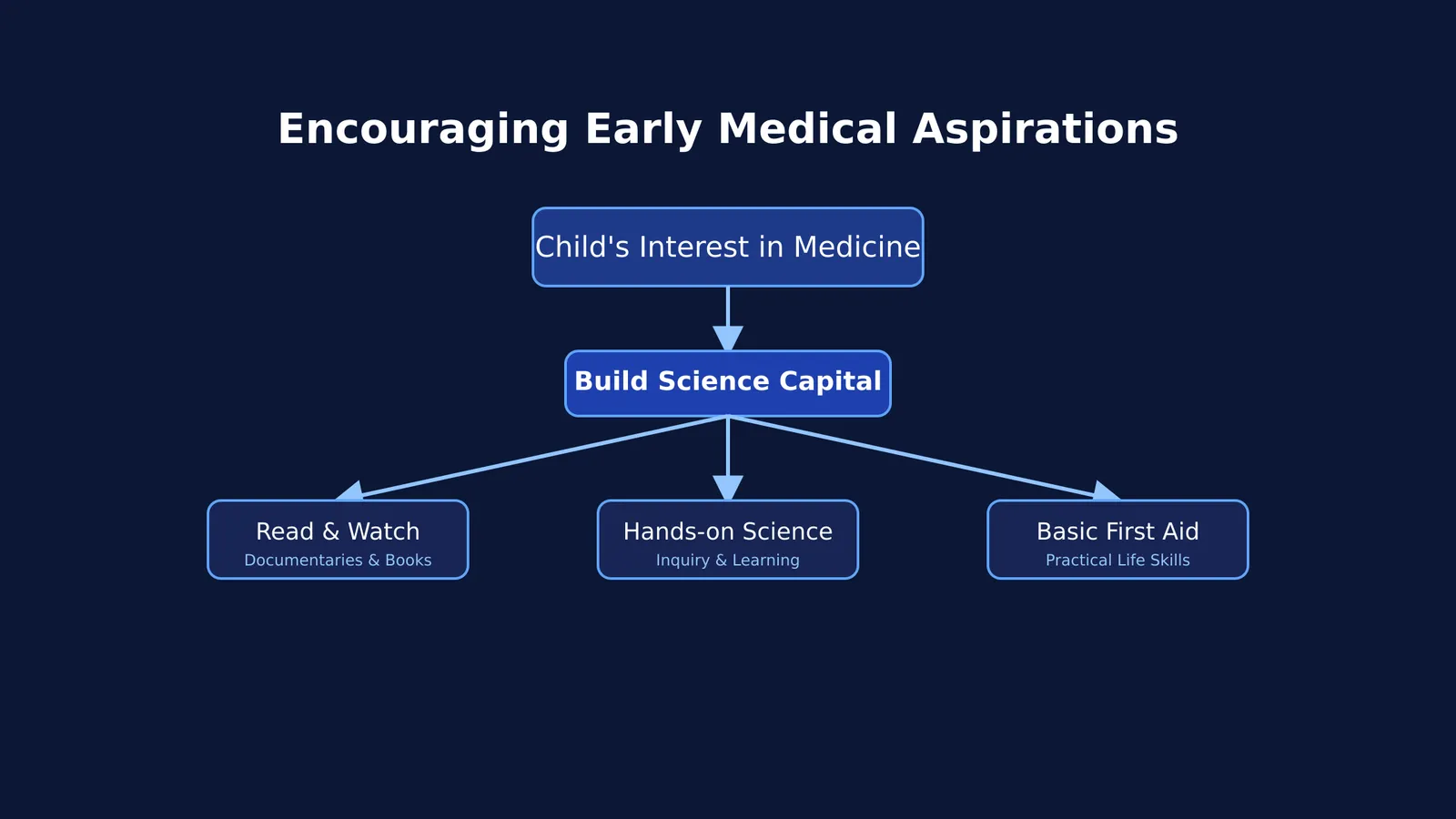
Instead of looking at entrance exams, focus on building their science capital. You want them to enjoy the process of asking questions and finding answers. Here is a practical checklist for parents:
Read widely and watch documentaries: Offer books and biographies about the human body, the history of medicine, or famous scientists. This builds their vocabulary and reading stamina, which is crucial for later studies.
Learn basic first aid: Many local Red Cross or St John Ambulance chapters offer basic first aid awareness courses for children. Learning how to bandage a scrape or what to do in an emergency makes medicine feel tangible and gives them a useful life skill.
Encourage hands-on science: In India, the National Education Policy (NEP) 2020 explicitly mandates a shift toward active, inquiry-based learning in primary science. The policy replaces the traditional system with a 5+3+3+4 structure, where the preparatory stage (ages 8 to 11) focuses on interactive classroom learning. You can mirror this at home by asking "why do you think that happens?" rather than just giving them the answer.
Use interactive tools: If they get curious about how the heart pumps or how a bone heals, look up a visual explanation together. For instance, Fermi's AI tutor can hold a line of reasoning across a session and notice where a student is stuck, making it a good way to explore science topics at their own pace.
Should we start thinking about entrance exams yet?
No. A 10-year-old is usually in Class 5. Exams like NEET or JEE are years away.
Starting coaching or focusing on competitive exams at this age is often counterproductive and can cause a child to lose interest entirely. If you want to know more about keeping their motivation high, read our guide on when your child loses interest in studies.
Instead, build a solid foundation. If they struggle with a topic, help them understand the concepts rather than drilling them on tests. If you notice they are feeling unsure about their abilities, it can be helpful to read up on building girls' confidence in maths and physics, as gender stereotypes can begin to affect science aspirations around this age.
If they change their mind next year and decide they want to be an engineer or a teacher, that is completely fine. As our article on when your child's career choice differs from yours explores, the goal at this age is to build curious, confident learners who are ready for whatever path they eventually choose.


