On this page
Choosing between the Science, Commerce, and Arts streams after Class 10 is one of the first major decisions a student makes. For many families, this period is marked by confusion, anxiety, and a reliance on what peers or relatives suggest.
Research highlights that choosing a stream without aligning it to a student's actual interests can disrupt their mental peace and lead to long-term career dissatisfaction. To help your child make an informed choice, consider replacing the stress of expectation with a structured family exercise.
Why is choosing a stream after 10th so confusing?
The difficulty in choosing a stream often comes from a lack of awareness rather than a lack of ability. A survey by Mindler reported by The Tribune found that 93% of Indian students are aware of only seven career options, despite the existence of hundreds of modern career paths. When children believe their only choices are engineering, medicine, or a generic office job, they force themselves into streams that may not fit their natural strengths.
When students are unaware of the possibilities, they often rely on common myths: Science is for the highest scorers, Commerce is a safe middle ground, and Arts is for those who struggle academically. Breaking down these myths requires actively exploring what each stream actually offers.
How to choose the right stream after Class 10?
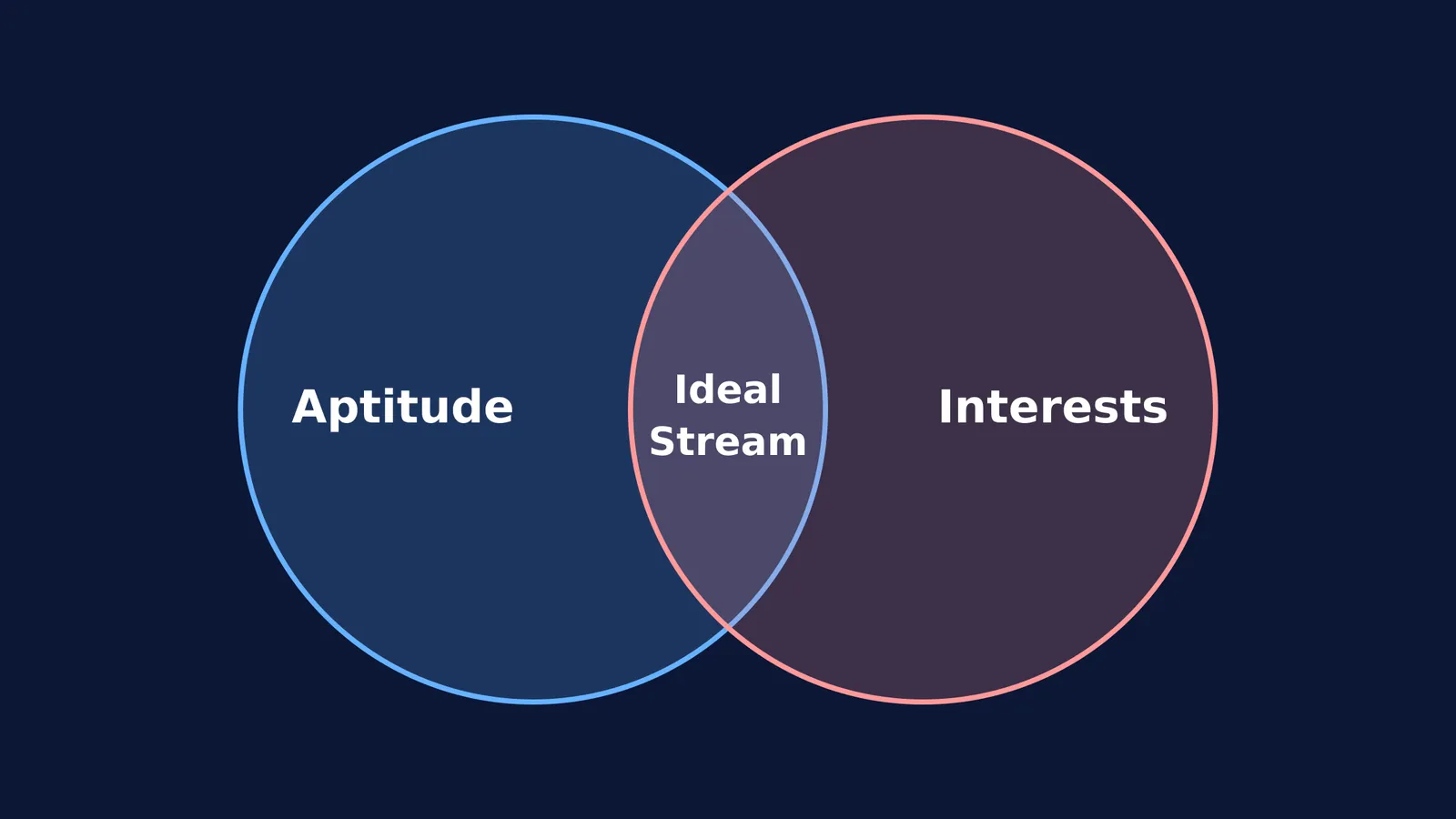
To move from confusion to clarity, sit down with your child and create a two-part list.
The Aptitude List: Look at their past academic performance across subjects. Which subjects do they grasp quickly with minimal effort? If they naturally understand mathematical concepts but struggle to memorize historical dates, this provides a clear signal.
The Interest List: Ask them which subjects they are genuinely curious about. What do they read about or watch videos on outside of school hours?
The ideal stream lies where these two lists intersect. If there is a mismatch—for instance, they love the idea of being a doctor but find biology exhausting—it is crucial to discuss the daily reality of that study path. Fermi's AI tutor can help students identify their concept gaps and test their true understanding of a subject before committing to it for the next two years.
How can sample chapters help your child decide?
The jump in complexity from Class 10 to Class 11 is significant, especially in the Science and Commerce streams. A student who enjoyed Class 10 physics might feel overwhelmed by the depth of Class 11 mechanics.
To bridge this gap, encourage your child to read a few sample chapters from the Class 11 textbooks of their shortlisted streams. Have them spend a weekend looking through an introductory chapter of accountancy, a section on world history, or a physics chapter on motion. This hands-on experience gives them a realistic preview of the workload and the nature of the content.
If they are unsure how to approach these new topics, exploring the Fermi Concept Library can provide an interactive introduction to complex ideas, making it easier to gauge their interest in the subject matter.
Why is talking to seniors important?
One of the most effective ways to understand a stream is to speak with those who are currently navigating it or have recently graduated.
Arrange short conversations with seniors in Class 11 or 12 for each stream. Your child can ask practical questions:
How much time do you spend studying each day?
What was the hardest subject to adapt to?
Are you happy with your choice?
Additionally, speaking with young professionals in fields like design, data science, economics, or law can help broaden your child's awareness beyond the standard options.
How can parents support the process?
As a parent, your role is to guide the exploration process rather than dictate the final choice. Validating their concerns and providing them with the tools to research their options thoroughly is key, as discussed in How parents can help children learn without adding pressure.
It is also important to remind them that a stream choice is a starting point, not a locked door. Many modern careers are interdisciplinary, and a strong foundation—coupled with a study routine that lasts—will serve them well regardless of the specific path they choose.
By replacing panic with a structured exploration of their aptitude, interests, and the realities of each syllabus, you help your child choose a stream that aligns with their future potential.