

On this page
It can be incredibly frustrating for a parent to ask their 15-year-old how their day went, only to receive a one-word answer, and then later overhear that same teenager talking animatedly to their grandmother on the phone for an hour. It is easy to feel shut out or to wonder if you are doing something wrong. However, a child telling a grandparent their secrets is not a sign of parental failure. It is often the sign of a healthy, functioning family dynamic where the child has established a psychological safety net.
Why do children share more with grandparents than parents?
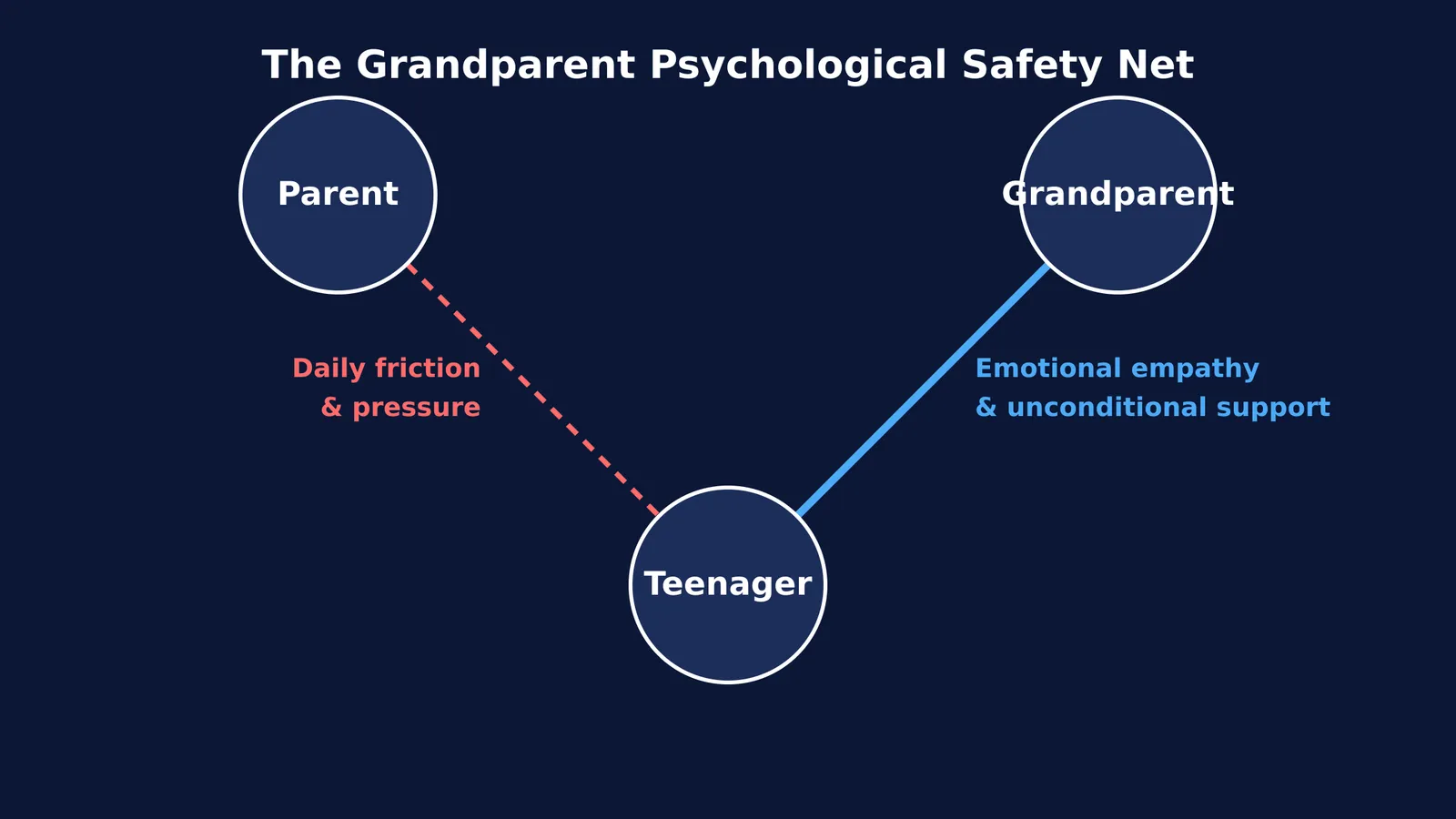
The dynamic between a teenager and a parent is inherently fraught with friction. Parents are the disciplinarians, the rule-enforcers, and the academic taskmasters. Grandparents, however, operate outside this daily hierarchy.
A national study surveyed 1,596 children aged 11–16 to understand the impact of grandparents. They found that active grandparental involvement is significantly associated with child well-being (10.1111/j.1099-0860.2009.00215.x). The study revealed that children view their grandparents as people they can confide in because they provide a sense of stability, often describing them with the sentiment: "they've always been there for me."
Similarly, research into adolescent adjustment found that grandparents often serve as a vital psychological safety net. Based on a sample of 1,515 secondary school students, greater grandparent involvement was associated with fewer emotional problems and more prosocial behaviour (10.1037/a0014383). Because grandparents generally offer unconditional support without the daily pressure of academic or behavioral monitoring, teenagers feel safer disclosing sensitive information or anxieties that they fear might invite a lecture from their parents.
How does brain science explain the grandparent bond?
The ability of a grandparent to act as a calm, non-judgmental sounding board is not just a matter of having more free time; it appears to be neurologically hardwired.
In a 2021 study, researchers used functional magnetic resonance imaging (fMRI) to examine the neural function of 50 grandmothers (10.1098/rspb.2021.1997). The brain imaging showed that when grandmothers viewed photographs of their grandchildren, they exhibited significant activation in brain regions associated with emotional empathy. This suggests they are wired to directly feel what their grandchildren are feeling.
Interestingly, when viewing photos of their own adult children, the grandmothers showed activation in areas associated with cognitive empathy—meaning they intellectually understood their adult child's thoughts and motivations, but did not have the same visceral, emotional resonance. This heightened emotional empathy makes grandparents incredibly intuitive to a teenager's feelings, encouraging the child to open up.
How can we reduce the friction of parenting?
Much of the daily friction between parents and teenagers stems from academic pressure. When a teenager feels stuck on a difficult assignment, they often resist asking a parent for help to avoid triggering an argument or a lecture about their study habits.
This is where shifting the academic burden can clear the air for better communication. Fermi's AI tutor works out what a student already knows, builds a plan for the session, and teaches through it—so the student sits down to a clear next step instead of a blank page. Because it explains the reasoning rather than just printing an answer, it acts as a patient guide, freeing parents from being the "homework police." When parents are no longer the primary enforcers of academic progress, there is more room for the positive, low-stakes interactions that teenagers crave.
It also helps to recognise that teenagers are managing complex subjects. Whether they are figuring out how cells repair damaged DNA or the mechanisms behind genetic drift, the academic load is heavy. Removing yourself as the friction point in their studies allows you to step back into a more supportive role.
What can parents learn from the "grandparent approach"?
You do not need to become a grandparent to borrow their most effective communication strategies. If you want your child to share more with you, try adopting these proven techniques:
Listen without fixing: When your teenager complains about a problem, our parental instinct is to offer a solution or a critique. Grandparents usually just listen and validate the feeling. Try saying, "That sounds really frustrating," and then wait.
Remove the stakes: Teenagers often confide in grandparents while doing side-by-side activities (like cooking or driving) where eye contact is minimal. This reduces the intensity of the conversation.
Praise the confidant: If your child shares something with their grandparent, do not act jealous. Instead, be grateful they have a trusted adult to turn to. Say, "I'm really glad you and your grandma can talk about these things."
Schedule "off-duty" time: Create pockets of time where discipline and academic monitoring are strictly off-limits. Go for a walk or grab a coffee with the explicit agreement that school and chores will not be discussed.
By seeing grandparents as allies rather than competitors for your child's affection, you build a stronger, more resilient family network. The goal is not to force your teenager to tell you everything, but to ensure they always have someone safe to tell.


