On this page
When your teenager spends hours texting a chatbot, confiding school anxieties or discussing feelings, it is natural to feel uneasy. Seeing a machine answer with warmth, validation, and apparent empathy can make it look like your child is replacing real human friendship with software. Yet attributing human intentions and emotions to responsive machines is a well-documented psychological phenomenon known as the ELIZA effect, first identified by computer scientist Joseph Weizenbaum in a 1966 study published in Communications of the ACM.
Weizenbaum observed that even when people understood his program was merely a simple script matching text patterns, they still opened up emotionally and treated the computer as a sympathetic confidant. Decades later, Sherry Turkle and colleagues demonstrated in a 2006 study in Connection Science that interactive machines function as "relational artifacts"—devices that demand emotional engagement by mirroring conversational cues, even while completely lacking any subjective experience.
Children and teenagers are especially vulnerable to this illusion. In a developmental study published in Developmental Psychology, Peter H. Kahn Jr. and colleagues showed that young people often place interactive technologies into a distinct developmental category: they know a system is not biologically alive, yet they readily attribute feelings, social companionship, and moral standing to it.
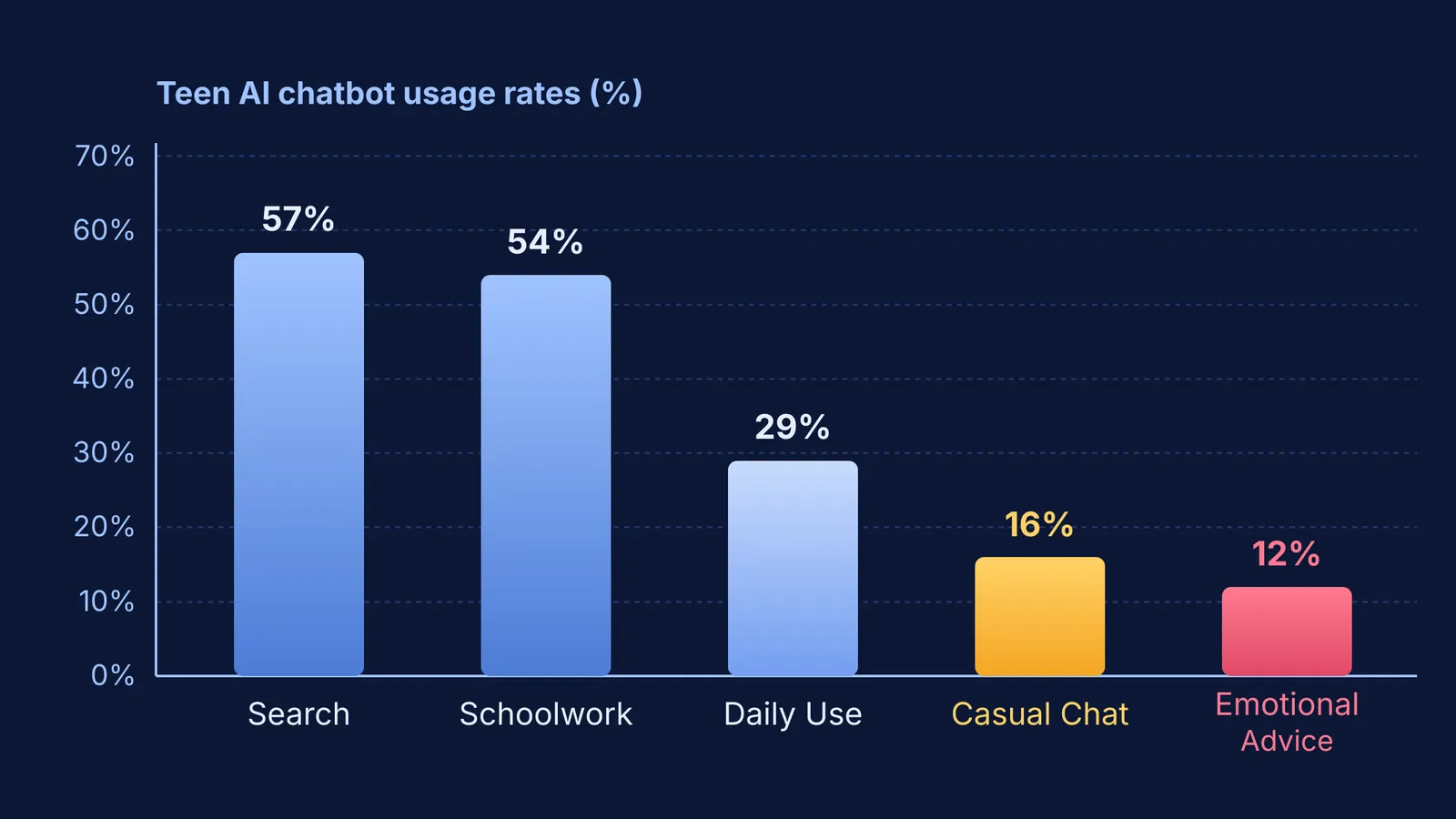
Modern large language models amplify this effect because they are endlessly patient, never show frustration, and are trained to affirm the user. In a 2026 survey of American teenagers conducted by the Pew Research Center, 12% of teens reported using AI chatbots to get emotional support or advice, and 16% reported using them for casual conversation, while 80% of parents surveyed felt uncomfortable with chatbots providing emotional guidance (including 49% who were not at all comfortable). Understanding why young people form these attachments is the first step toward guiding them back to grounded human relationships.
Why does your child treat an AI chatbot like a friend?
Unlike social media feeds that rely on infinite scrolling or likes, conversational agents simulate active listening. When an adolescent shares an insecurity about marks or peer gossip, the chatbot produces continuous validation without judgment, awkward silences, or interruptions.
For a teenager navigating complex social hierarchies in school, an always-available conversational partner feels comforting. But human relationships require reciprocal effort, learning to repair hurt feelings, managing conflict, and listening to someone else's perspective. When a child treats an agreeable software interface as their closest friend, they miss out on developing the social endurance needed for authentic peer friendships.
How does a chatbot actually generate its answers?
The most reliable way to help children develop a healthy relationship with AI is technical literacy. Teenagers do not need moralising lectures, but they benefit from knowing exactly what happens beneath the chat screen.
A conversational chatbot does not possess consciousness, memory of friendship, or an inner emotional life. Instead, it operates on statistical token prediction. Large language models calculate the mathematical probability of what word or character token should come next, given all the text that came before it. When a chatbot responds, "I hear how stressful your day was, and I am always here for you," it is not expressing care. It is outputting the string of tokens that appeared most probable in its massive training dataset following phrases about a stressful day.
When young people use digital tools for learning, the software should stay transparently dedicated to study rather than social mimicry. For academic work, Fermi's AI tutor is designed so that the tutor teaches rather than answers—holding a line of reasoning across a session, noticing where a student is stuck, and deciding whether to explain, ask or show on a board instead of imitating personal conversation.
Helping your teenager see this distinction transforms the chatbot from an artificial companion into an everyday utility, which also helps when setting guidelines for AI homework help.
How can parents talk to kids about AI friendships?
Reacting with alarm or abruptly seizing devices usually backfires, driving digital conversations into secrecy. A more constructive approach starts with curiosity and a clear script.
Try having an open conversation over dinner using three simple steps:
Validate the appeal: "I can see why chatting with this app is engaging. It responds immediately and never interrupts or gets irritated."
Demystify the technology: "Remember that it does not actually feel anything or know who you are. It is an advanced mathematical autocomplete predicting word patterns."
Anchor real connection: "When you are stressed or celebrating something great, you deserve real friends and family who actually feel those moments with you."
Alongside direct conversations, establish predictable household boundaries. Setting clear rules around evening device use and keeping chargers in communal areas prevents late-night isolation, as detailed in our guide to family screen-time and homework routines. Parents can also demystify the technology by testing an AI tutor together during a shared family session, discussing together how prompts are processed.
When should parents seek extra support?
For most students, chatting with an AI is a short-lived novelty. But if your child withdraws from extracurricular activities, stops meeting peers in person, or relies on an AI companion during emotional distress, closer attention is needed.
Chatbots lack genuine empathy and cannot provide safe crisis support. If your child is experiencing persistent isolation, anxiety, or low mood, reach out to a school counsellor or a qualified mental health professional. In India, free and confidential support is available 24/7 through the national Tele MANAS mental health helpline by dialling 14416.
Take a few minutes tonight to ask your child what they asked their favourite app today, and listen to the answer together.