

On this page
According to the ASER 2023 report, 26.7% of rural youth aged 14–18 cannot fluently read a Standard II level text in their regional language. While conversational Hindi might seem easy for those who speak it at home, the formal grammar taught in schools often feels like a completely different language. For students whose home language is not Hindi, the barrier is even higher.
Hindi grammar is frequently taught as a rigid academic subject, full of tables to memorise, rather than a functional communication skill. This gap between the textbook and natural language leads to frustration and poor marks.
Why does my child struggle with Hindi grammar?
The difficulty is not just a lack of effort; it is rooted in the structure of the language itself. Two main hurdles trip up learners when compared to English:
Grammatical gender for everything. Unlike English, which reserves gender largely for living things, every noun in Hindi is either masculine or feminine. A room (*kamrā*) is masculine, while a car (*gāṛī*) is feminine. Because this assignment is often arbitrary, children cannot simply guess it. Furthermore, it is not enough to just know the noun's gender. Adjectives, verbs and postpositions must all change to match it. If a child says 'my big book' in Hindi (*merī baṛī kitāb*), both the possessive 'my' and the adjective 'big' must take the feminine ending. When children try to translate directly from English or a regional language in their heads, they often drop these agreements, leading to structural errors.
Word order. English follows a Subject-Verb-Object pattern ('The boy reads a book'). Hindi uses a Subject-Object-Verb pattern ('The boy a book reads'). For a student whose primary language of instruction is English, remembering to hold the verb until the very end of the sentence requires active cognitive effort. When writing essays, they often revert to the English word order, costing them marks.
How can stories help with Hindi grammar?
Reading grammar rules from a textbook is passive. It asks the child to hold a dozen rules in their working memory at once. Reading stories, on the other hand, shows how these rules work together in context.
When a child reads a short, engaging story in Hindi, they see the gender agreements happening naturally. Repeated exposure builds an 'ear' for what sounds right. If they read *merī baṛī kitāb* ten times in a storybook, they will stop writing *merā baṛā kitāb* in their exams, not because they memorised a rule, but because the wrong version now sounds incorrect to them. To build this habit at home, consider setting up a family quiet hour where everyone reads together.
What is a good 10-minute daily Hindi practice plan?
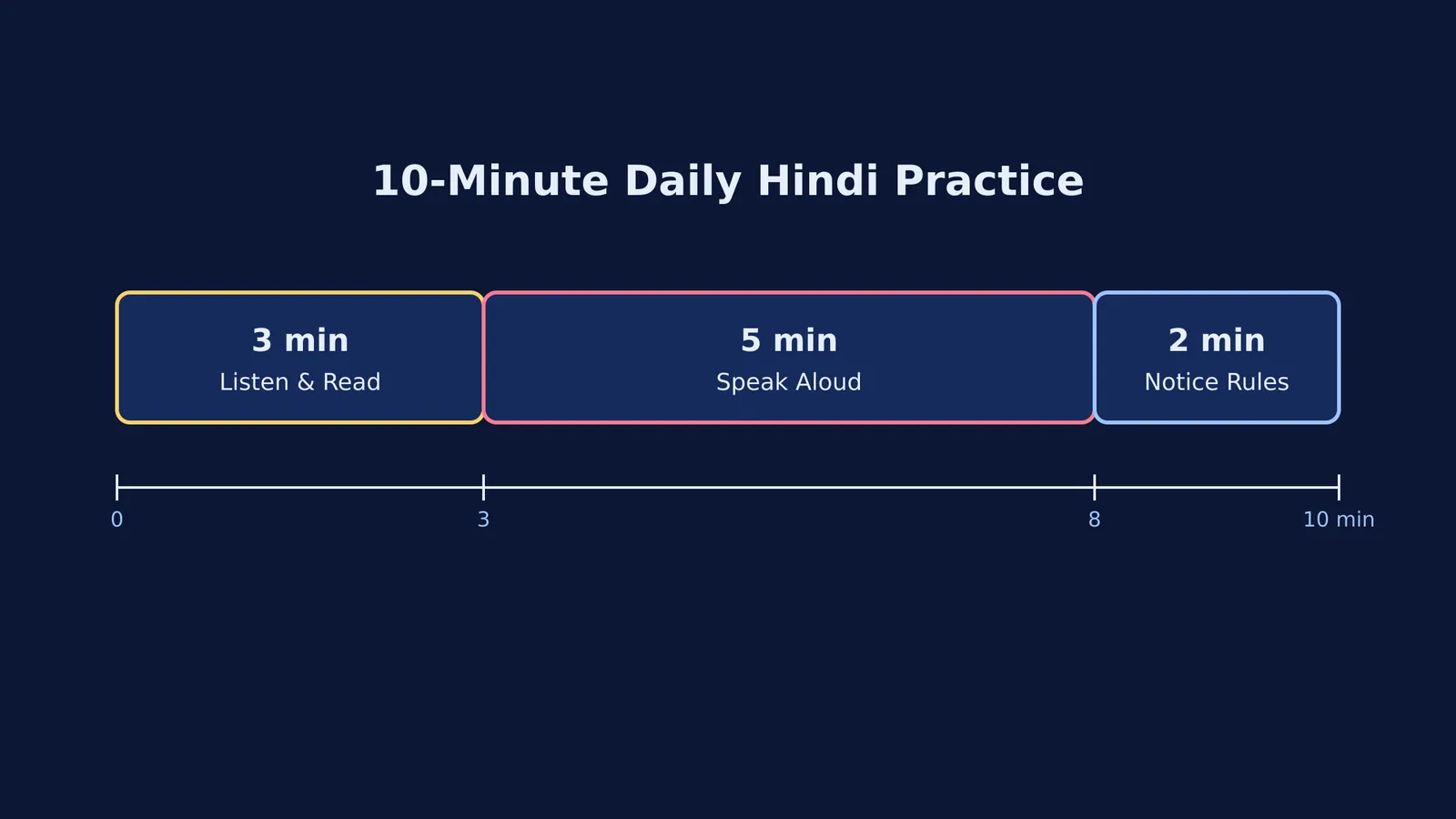
To bridge the gap between textbook knowledge and natural use, replace long weekend study sessions with a short, 10-minute daily routine:
Listen and read (3 minutes): Pick a short, age-appropriate Hindi paragraph or story. Have your child read it aloud. If they struggle with pronunciation, read it to them first and have them follow the text.
Speak aloud (5 minutes): Ask them to describe what happened in the story using three or four simple Hindi sentences. Encourage them to use the words from the text. When children speak aloud, they are forced to retrieve the correct gender and verb ending in real time, which strengthens their memory far better than passive reading. Correct their gender and verb agreements gently by repeating the correct sentence back to them, rather than stopping them mid-flow to quote a rule.
Notice the rules (2 minutes): Pick one sentence from the story and ask, 'Why did they use *merī* here instead of *merā*?' Let the child explain the rule back to you.
The same active approach applies across all school subjects. If your child also struggles to apply maths or science concepts when doing homework, the Fermi Problem Library has worked problems with a step-by-step solver that explains the reasoning rather than printing an answer. Or if they do not know where to start on a whole assignment, Fermi's AI tutor works out what they already know and builds a plan for the session, so they sit down to a clear next step.
Building daily habits takes time, especially if the child is learning in a language different from the one spoken at home (you can read more about mother tongue and learning). By shifting the focus from memorising tables to using the language in short, daily bursts, Hindi grammar can become a natural skill rather than a stressful subject, helping your child learn without pressure.


