

On this page
When the selection letter comes home, excitement often mixes with worry about how they will manage their normal school workload. Will this mean missing important science concepts? Will it create a backlog of homework? These are common concerns for any family trying to navigate a busy academic year.
Are extracurricular activities bad for academics?
Parents often worry that dedicating time to an external event will damage academic performance. However, evidence suggests the opposite. A 1995 report from the U.S. National Center for Education Statistics found that students participating in extracurricular activities are three times more likely to perform in the top quartile on a composite math and reading assessment compared with nonparticipants (NCES, 1995).
The structure required to manage both obligations often improves a student's efficiency. Without an upcoming event, students might assume they have the entire evening to finish a simple assignment, allowing work to expand to fill the time available. When they have a competition to prepare for, they learn to value the time they have. They cut out the procrastination that expands to fill unstructured afternoons. If you want to help them succeed in both areas, the key is teaching them how to manage that time proactively.
How can parents support a child in a competition?
Rather than letting event preparation consume every free hour in an unstructured way, implement a timeboxing routine. Timeboxing is the practice of allocating fixed blocks of time to specific tasks in advance. A meta-analysis published in Frontiers in Psychology reviewing 31 studies with 13,506 students found that time management is significantly and moderately positively correlated with learning outcomes, recording an effect size of r = 0.250 (Liu et al., 2026).
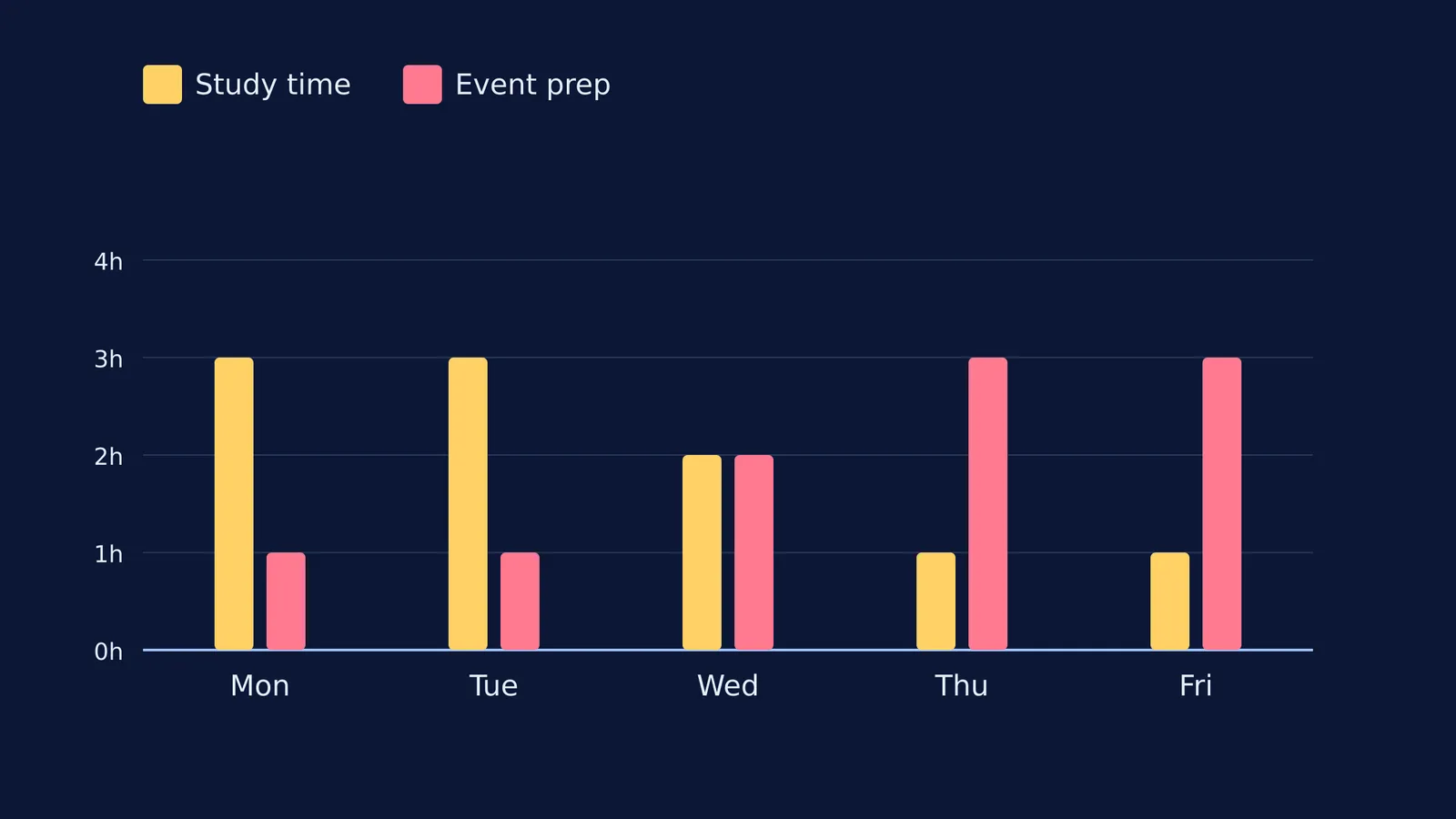
Use a shifting priority schedule for the week leading up to the event. Early in the week, keep the focus on standard schoolwork to prevent backlogs from forming. As the event date nears, flip the ratio:
Monday and Tuesday: Schedule three hours of regular study and one hour of event preparation.
Wednesday: Balance the evening with two hours of each.
Thursday and Friday: Reduce standard study to one hour and allocate three hours to event focus.
This structure reassures both you and your child that neither obligation is being ignored. You can read more about establishing durable systems in our guide on building a study routine that lasts longer than a week.
What if they miss important classes?
Even with a perfect schedule at home, inter-school events often happen during school hours. Whether it is a science fair, a debate tournament, or a sports meet, your child will likely miss a few lectures. If your child misses a school lesson, reading a textbook passively rarely catches them up effectively. They need to understand what they do not know.
This is where targeted support helps. Fermi's AI tutor can work out what they already know and build a plan for the session, so they sit down to a clear next step instead of feeling overwhelmed by a missed chapter. If they just need to cover a specific gap in their syllabus, the Fermi Concept Library contains interactive lessons for every concept in physics, chemistry, biology, mathematics and computing. You might also find our advice on supporting your child's olympiad preparation: time and pressure helpful if the event is strictly academic.
How do you balance competition prep and regular schoolwork?
A concrete framework removes the emotion and panic from a busy schedule. When helping your child, use the 3-2-1 Preparation Plan to balance their week.
Map the non-negotiables: Write down school hours, sleep schedules, and meals.
Set the timeboxes: Use the shifting priority schedule to lock in specific hours for study and for the event.
Decide the threshold for stopping: Decide in advance what finished looks like for the day, so they can rest without guilt.
High expectations are fine, but endless pushing can backfire and lead to burnout. You can read more about this in our article on how parents can help children learn without adding pressure.
Remember, the goal of an inter-school event is growth, confidence, and experience. You are teaching them how to manage competing priorities—a fundamental life skill that will outlast any single competition.


