

On this page
It can be frustrating when the report card arrives and your child has scored top marks in mathematics and science, but has dropped grades heavily in Hindi. When a child scores low only in their second language, parents often wonder if it is a lack of effort.
In most cases, it has little to do with effort. The way children learn concept-driven subjects is fundamentally different from how they acquire a language.
Why is my child weak in Hindi but good in other subjects?
Mathematics and science rely on understanding clear rules and applying them. A child who grasps a concept can solve problems immediately. Language, however, is exposure-driven. You cannot memorize a few rules and suddenly become fluent; you need to absorb how words fit together naturally over thousands of sentences.
Second-language learning is heavily influenced by the "Matthew Effect"—the idea that the rich get richer. Children who already have a large vocabulary find reading easier. Because reading is easy, they read more often, and because they read more, their vocabulary grows even further.
Conversely, a child whose Hindi vocabulary is small finds reading a struggle. They avoid reading outside of school hours, which means they do not get the exposure needed to catch up. Their learning stalls, even if they study hard just before an exam.
How does reading for pleasure grow vocabulary?
Most vocabulary is not learned through flashcards or memorising lists. It is acquired incidentally as a byproduct of trying to understand an interesting story.
In a landmark 1983 study known as the Fiji Book Flood, researchers Warwick Elley and Francis Mangubhai tested the effect of reading for pleasure on second-language acquisition. They found that students who read for pleasure progressed in reading and listening comprehension at twice the rate of children taught using traditional methods.
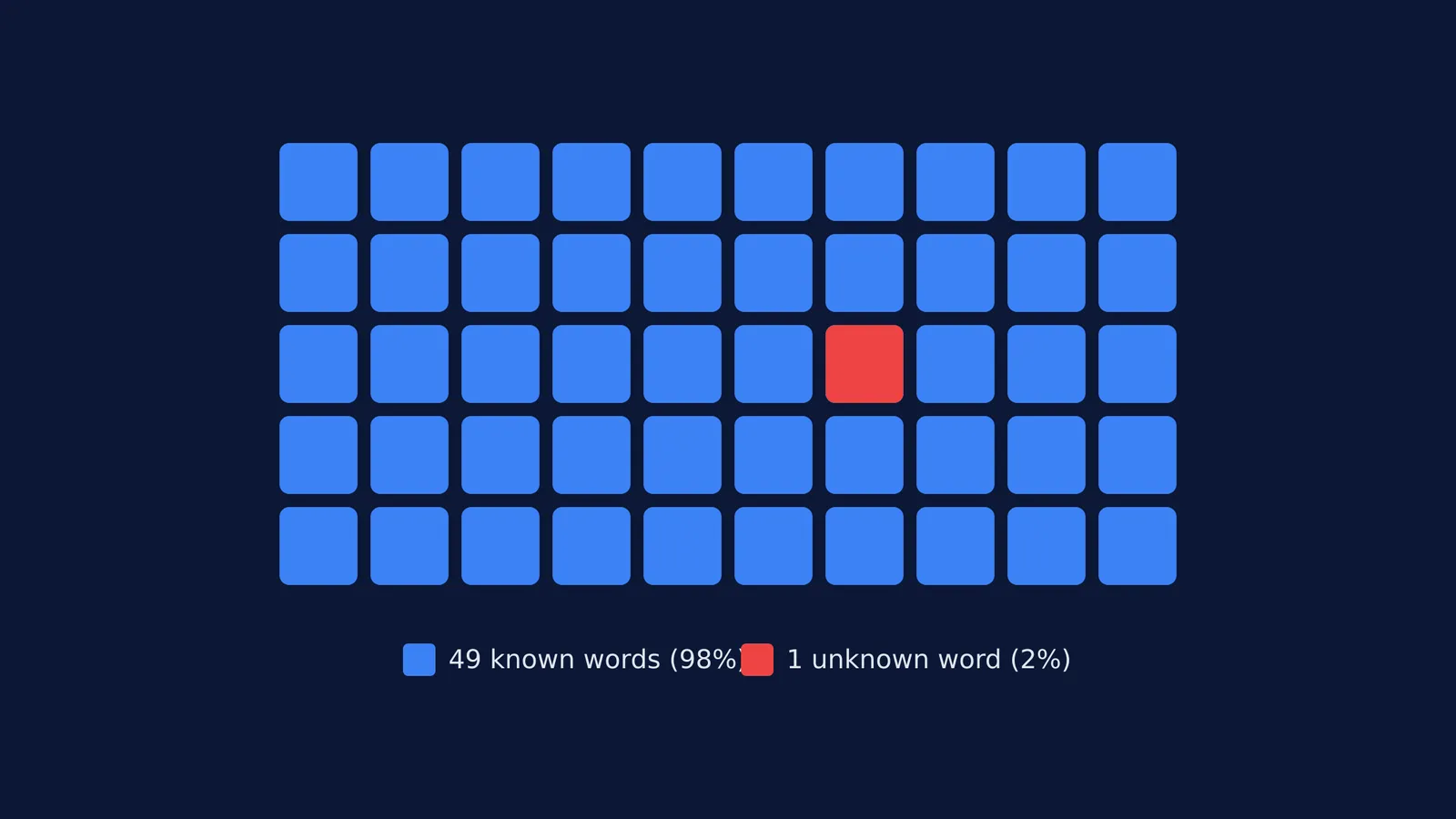
However, you cannot simply hand a struggling child a dense novel. A 2000 study by Marcella Hu and Paul Nation measured exactly how much vocabulary a learner needs for reading to be pleasurable and useful. They found that for unassisted reading, a learner must already know 98% of the words on the page. That means there can be only one unknown word in every 50 words.
If the text falls below this vocabulary threshold, the reader has to stop too often. The pleasure disappears, and incidental vocabulary growth stops. This explains why reading the school Hindi textbook does not help a struggling child: the text is usually far too difficult to allow for natural learning.
When your child is spending a disproportionate amount of their energy trying to catch up in their second language, you want their other subjects to be as efficient as possible. For maths and science, Fermi's AI tutor can work out what they already know and build a plan for the session, so they sit down to a clear next step instead of wasting time figuring out where to begin.
How can I help my child improve in Hindi?
To break the cycle of struggle, the focus must shift from exam preparation to daily exposure at a comfortable level.
Start with Graded Readers or comics. Since this vocabulary threshold is critical, find reading material that is extremely easy. Comics like *Amar Chitra Katha* or *Tinkle* published in Hindi provide visual clues that help children guess unknown words. Graded readers, which restrict the vocabulary to a few hundred common words, are another excellent bridge.
Add a small daily writing practice. Children who speak a second language well enough often lose marks on spelling (such as confusing the short and long matras in Hindi). Do not ask them to write essays. Ask them to copy out just a few sentences from a storybook they enjoyed, paying close attention to the spelling. Short, daily sessions build muscle memory better than a long weekly drill.
Read for fun, without a dictionary. Encourage them to read for a few minutes a day, purely for pleasure. Tell them not to stop and look up every word in the dictionary. If they understand the gist of the story, they should keep going. The goal is volume and exposure, not perfect comprehension of every sentence.
Consistent, low-pressure reading and writing will slowly build the vocabulary base they need. Over time, the Hindi textbook will start to feel less like a chore and more like a language they actually know.
For more on how children handle study expectations, you can read our guide on what to do when your child is losing interest in studies, or see how to manage the pressure of exam stress in teenagers.


