

On this page
When a student moves to a selective school or starts a demanding coaching programme, their confidence often drops. They look around, see peers answering questions instantly, and conclude they are the slow one.
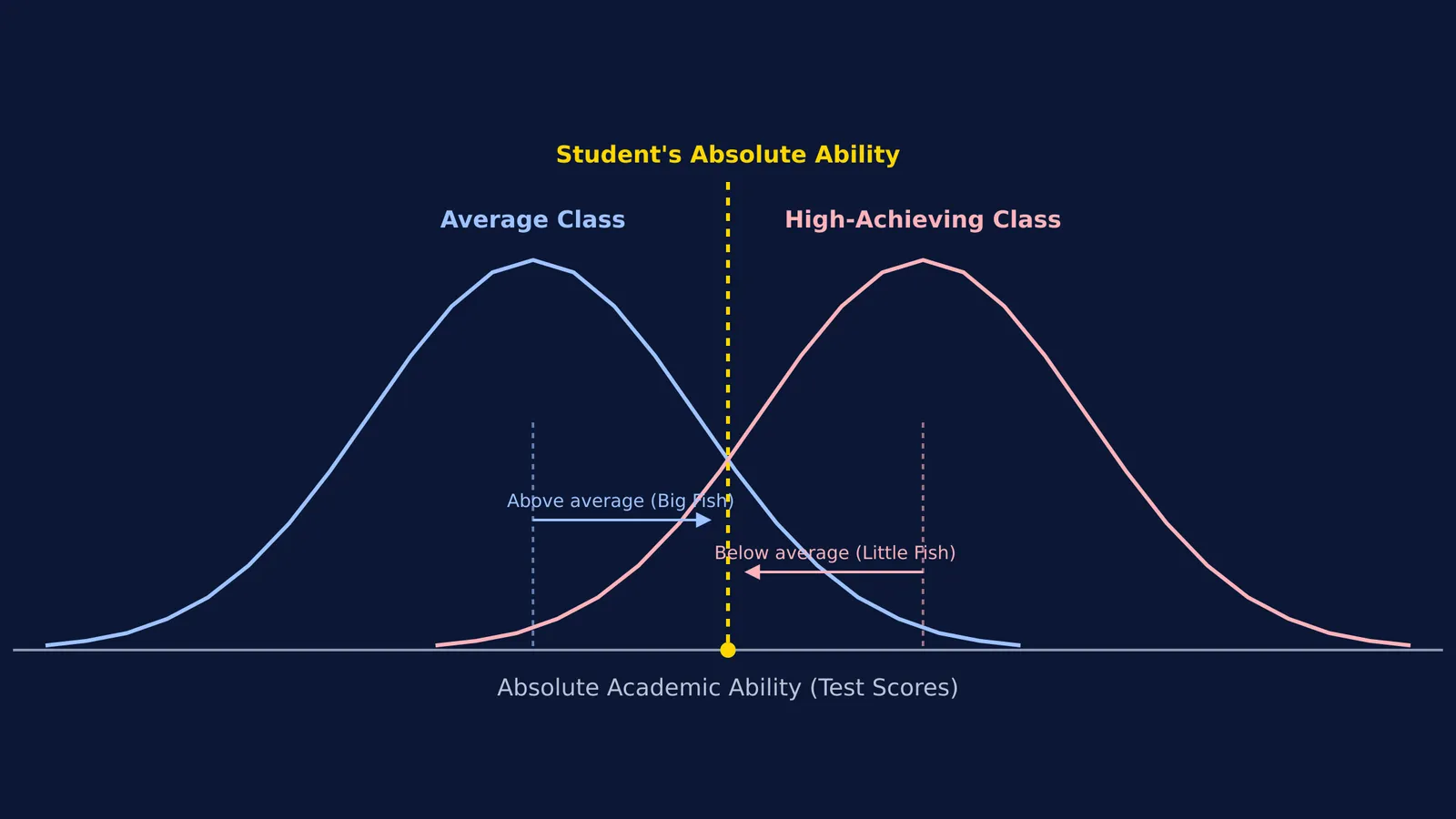
This is a documented psychological phenomenon known as the Big-Fish-Little-Pond Effect. A 2022 study of 2,438 students across 117 school classes found that class-average achievement has a stable negative effect on individual academic self-concept. In other words, simply being placed in a high-achieving class reliably lowers a student's belief in their own abilities, even if their actual test scores remain strong.
Why does my child feel everyone else is smarter?
The 2022 study highlighted something surprising: students do not just compare themselves to their closest friends or the most popular students. Instead, they measure themselves against the "generalized peer"—the overall standard of the entire classroom. When the baseline shifts, the student's internal sense of where they stand shifts with it.
For a teenager, realising they are no longer the "big fish" can feel like a sudden, inexplicable loss of intelligence. They might misinterpret a lower relative rank as a sign that they have hit their limit, especially in subjects like physics and mathematics where early concepts build heavily on one another.
How do you respond to the comparison trap?
When your child says, "Everyone in class is smarter than me," it is deeply tempting to disagree immediately, list their past successes, or tell them not to worry. However, denying their experience often makes them feel unheard, and it does not change the reality of the classroom they face every day.
Instead, try these practical steps to reframe the conversation:
Acknowledge the shift in the pond: Validate that their environment has genuinely changed. You might say, "It makes sense that it feels much harder now; you are in a room where everyone was at the top of their previous class. The standard is different."
Separate speed from intelligence: In highly competitive Indian classrooms and coaching centres, the quickest hand to go up is often mistaken for the smartest brain. Remind your child that understanding a difficult concept deeply takes time. Some students memorise methods quickly, but applying first principles to unseen problems—the real test in exams like JEE and NEET—requires patient, careful thought.
Compare them to their past selves: Shift the comparison away from the classmate sitting next to them and toward their own timeline. Ask, "What is a topic in chemistry that you found completely impossible last month, but can solve easily today?"
How can you refocus their study habits?
Comparison thrives when the only metric is the final answer or the weekly test rank. You can help your child by changing the focus of their daily study routine from performance to the active process of learning.
When they get stuck on a homework problem, encourage them to look for the specific step where they went wrong, rather than throwing the whole problem away or assuming they simply do not understand the chapter. This turns a moment of frustration into an active learning exercise. If they frequently do not know where to begin when they sit down at their desk, Fermi's AI tutor can work out what they already know and build a plan for the session, so they sit down to a clear next step. When they make wrong-method mistakes, the Fermi Problem Library has worked problems with a step-by-step solver that explains the reasoning rather than printing an answer.
What is a good script for naming real strengths?
When a student's confidence is low, general praise like "You are so smart" or "You will do fine" is easily dismissed. Instead, name the specific, actionable strengths you see them using during their exam preparation.
Instead of: "You're just as clever as they are, don't worry."
Try: "I noticed how you kept trying different methods on that rotational motion problem until one finally worked. That kind of persistence is what actually matters."
By praising their effort and their strategy, you help them build an academic self-concept that does not depend on being the fastest in the room. For more on this approach, see how to praise children: process praise vs 'you're so smart'. When they face a difficult week, you can also look at talking about failure at home: how parents model learning and what to do when your child says 'I'm bad at maths' to build a more resilient approach to their studies.


