

On this page
Many parents see their children happily consume hundreds of pages of fantasy or science fiction, only to struggle when faced with a thin physics or history chapter. It is natural to assume the issue is a lack of focus or motivation. In reality, reading a novel and reading a textbook rely on different cognitive skills, and textbooks require significantly more mental effort.
Why are stories easier to process than textbooks?
The difference lies in how the text is structured. Narrative texts follow a temporal and causal chain—someone does something, which causes something else to happen. Because human beings use this same logic to navigate everyday life, a child reading a story can easily predict what will happen next and connect the events.
Expository texts (textbooks), on the other hand, are often packed with dense facts and use logical structures like compare-and-contrast or problem-and-solution. A 2021 meta-analysis of over 33,000 participants confirmed that narrative texts are significantly easier to understand and recall than expository texts (Mar et al., 2021).
Why does a child read novels but avoid textbooks?
When a child sits down with a storybook, they are relying on their decoding skills and basic world knowledge. If they miss a minor detail, the plot carries them forward. With a textbook, missing a single sentence can derail the entire concept. The vocabulary is technical, the cognitive load is high, and the text demands constant, active integration of new facts.
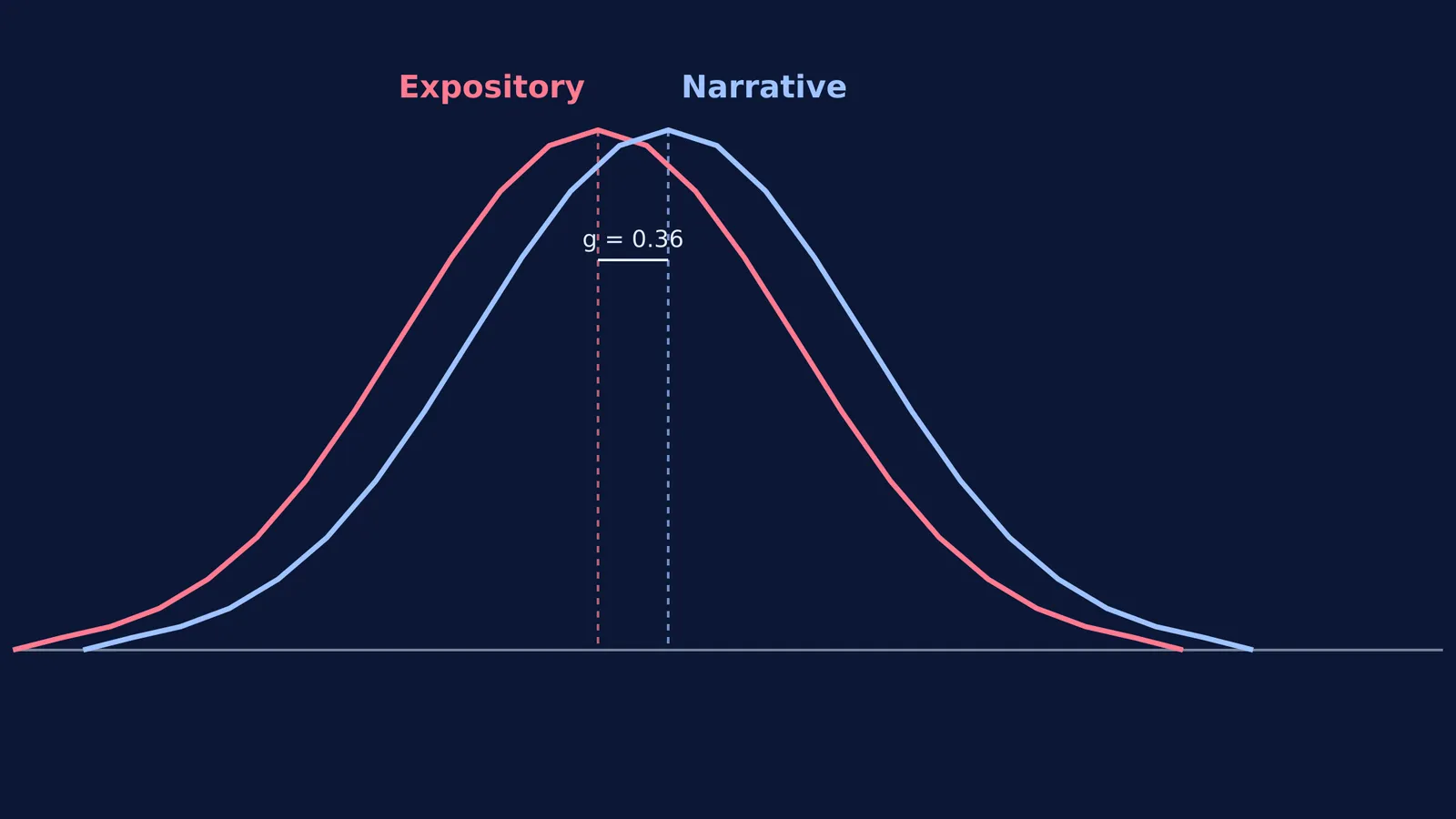
Inferential comprehension—the ability to connect ideas and read between the lines—was measurably higher for narratives, with a standardized effect size of 0.36 (Clinton et al., 2020). This means that even a strong reader will slow down when switching from a novel to a textbook. If a student attempts to read a biology chapter the way they read a novel—passively absorbing the words—they will quickly lose their place and feel overwhelmed.
This frustration is what causes them to avoid textbooks entirely. They feel capable as readers when tackling fiction, but the sudden drop in fluency and comprehension when switching to non-fiction makes them feel inadequate, leading to task avoidance.
How can active reading bridge the comprehension gap?
To build textbook stamina, you have to change how your child interacts with the material. Instead of reading straight through, encourage them to ask questions before, during, and after they read. This is known as active reading.
A practical framework you can use is the SQ3R method (Survey, Question, Read, Recite, Review). Have your child survey the headings, turn them into questions, and read specifically to answer those questions. Once they finish a section, they should close the book and recite what they learned in their own words. Reviewing their notes later reinforces the memory.
If a child feels stuck, having a tool that models this thinking can be transformative. Fermi's AI tutor works out what your child already knows, builds a plan for the session, and teaches through it — writing on a board, drawing the figure, running the simulation, and checking understanding as it goes. This ensures the student is not just reading, but actively learning.
To help them build this habit, you can model it yourself during study sessions. For younger children, shared reading with young children is a great way to introduce the habit of pausing to discuss what a text means.
How can you build textbook stamina in short sessions?
A child used to reading novels for an hour cannot instantly read a chemistry textbook for the same duration. The mental effort required for expository text means that fatigue sets in faster.
Start with 15-minute focused blocks of textbook reading, followed by a 5-minute break.
Ask your child to write down one key takeaway or a summary sentence at the end of every block.
Gradually increase the reading duration as their stamina builds.
If your child hits a wall with a particular topic, they can look it up in the Fermi Concept Library, where every concept in physics, chemistry, biology, mathematics and computing has its own lesson and its place in the map.
Over time, this routine helps children see that reading a textbook is a different task entirely. When they know how to break down expository text into manageable pieces, they start tackling it with the same confidence they bring to their favorite stories. Reading for pleasure is a wonderful foundation, and with a few adjustments, it can become the springboard for academic success. If they are completely withdrawing from their work, it helps to understand what to do when your child loses interest in studies and adjust the pressure accordingly.


