

On this page
Your child reads a page aloud, every word right, then shrugs when you ask "What happened?". There is a clear reason, and a simple fix.
Why can my child read fluently but not understand?
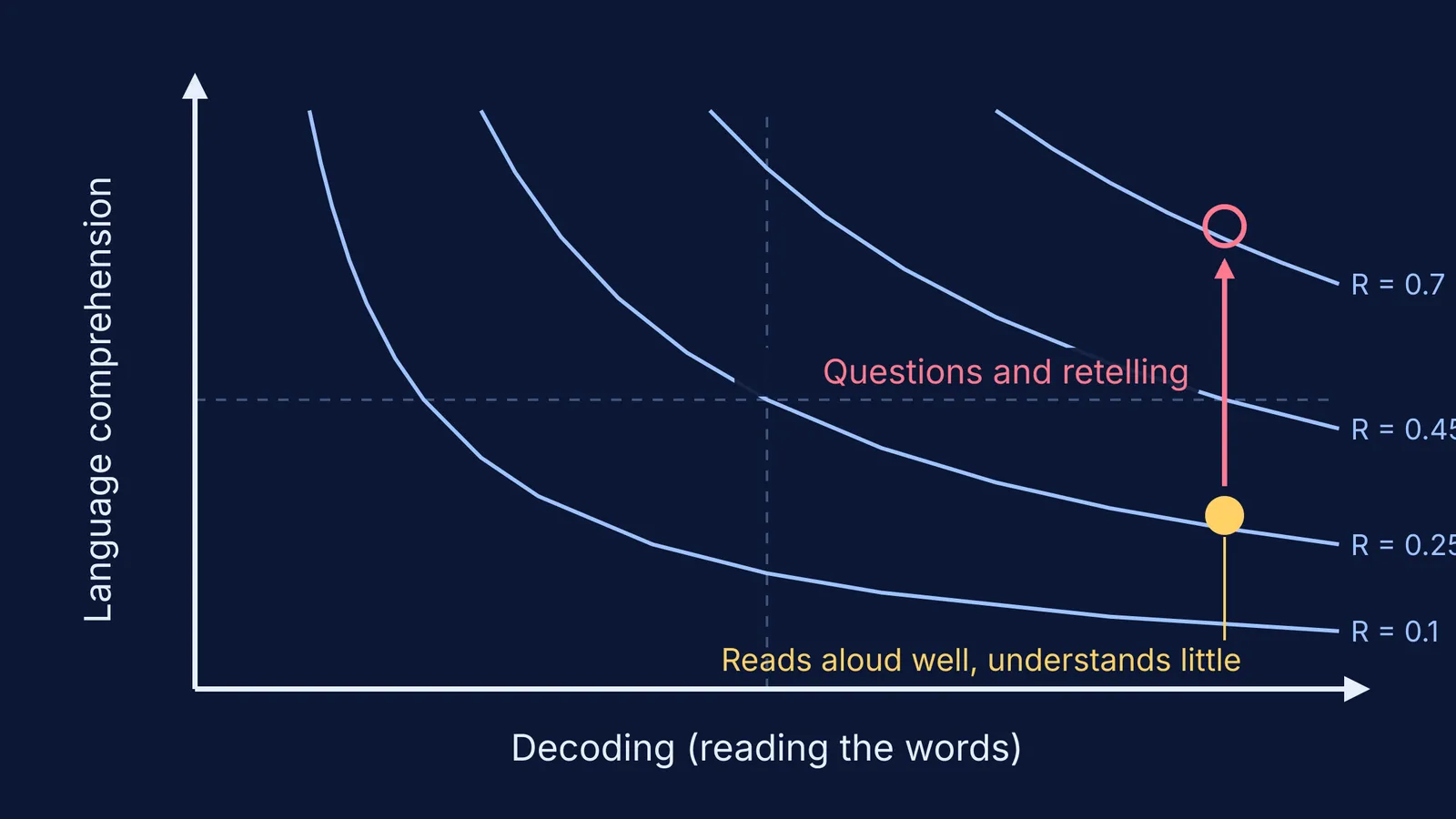
Reading has two parts that grow separately. In 1986, Philip Gough and William Tunmer proposed the "simple view of reading": reading comprehension equals decoding (turning print into words) multiplied by language comprehension (understanding those words when they are spoken) (Gough and Tunmer, Remedial and Special Education). Because the two are multiplied, a child who decodes well but has weak language comprehension still understands little.
ASER, India's nationwide rural household survey of children's learning, measures the first part. It tests whether a child can read letters, words, a Class 1 paragraph or a Class 2 "story" (ASER 2024 national findings). In 2024, 23.4% of Class 3 children in government schools could read at least a Class 2 level text, the highest level since the survey began. Reading the story aloud is not the same as understanding it.
Beyond decoding, young readers need vocabulary, knowledge of the world and thinking skills such as inference, says a US Institute of Education Sciences practice guide (IES practice guide, 2010). Its first recommendation, teaching comprehension strategies, is rated "strong evidence", based on 10 studies with primary-grade students.
What questions should I ask before, during and after reading?
The guide names six strategies: activating prior knowledge or predicting, questioning, visualising, monitoring and fixing up, drawing inferences, and summarising or retelling (IES practice guide, full text). Ask these in any language you share (see our guide to home language and learning); pick two or three per session.
Before reading (one minute):
"Look at the title and the picture. What do you think this is about?"
"Has something like this ever happened to you?"
During reading (at one or two natural pauses):
"What picture do you see in your head right now?"
"Did that part make sense? If not, let's read it again."
"Why do you think she did that?" (The answer is not written down. Working it out is inference.)
"What will happen next? What makes you think so?"
After reading:
"Who was in it, and where were they?"
"What was the problem, and how was it solved?"
"Which word was new? What do you think it means here?"
For non-fiction in Classes 5 and 6, swap the story questions for "What is this page trying to teach me?" and "What caused this?".
Sometimes a Class 6 science page stalls on the idea itself, not the reading. The Fermi Concept Library gives every concept in physics, chemistry, biology, mathematics and computing its own lesson, so you can fill that gap before going back to the chapter.
How do I run a five-minute retell at home?
In the IES guide, retelling means the child describes the main points of what they read in their own words, and four studies found positive effects on comprehension, though only one focused closely on retelling itself (IES practice guide, full text). The guide also suggests linking the parts of a story (setting, characters, plot, problem, resolution) to the five fingers of one hand.
Your child reads a short story or one textbook page.
Close the book. They retell, one finger at a time: where and when, who, what happened, what went wrong, how it ended.
Listen without correcting. If they get stuck, ask "What comes next?" (a guide prompt) or "What else did the story say about the crow?" (adapted from another).
Open the book together and check one thing they missed.
Swap roles: you retell the next page and let them check you.
A worked example with a Class 3 child and the thirsty crow story:
First try: "The crow was thirsty. Then it drank water."
You: "What was the problem?" Child: "The water was low in the pot. Its beak couldn't reach."
You: "How did it fix that?" Child: "It dropped stones in till the water came up."
Second try: "A thirsty crow found a pot with a little water at the bottom. Its beak couldn't reach, so it dropped in pebbles until the water rose, and then it drank."
The second retell has a problem and a solution. That gap between the two tries is the comprehension you are building.
When should I worry about a reading difficulty?
The same model describes the opposite pattern, trouble decoding the words themselves, which Gough and Tunmer linked to dyslexia (Gough and Tunmer). If your child still sounds out most words slowly long after classmates read smoothly, talk to the class teacher and ask about an assessment; that is a reason to ask, not a diagnosis. Our guide to dyslexia signs and how assessment works explains the steps.
If reading time regularly ends in tears, ease off and speak to the school counsellor, or call the government's Tele MANAS helpline on 14416.
Start tonight with one short story, three questions and one five-finger retell, then try our tips on reading for pleasure.


