

On this page
It is a common frustration: another parent mentions an upcoming project, a science fair, or a permission slip, and you suddenly realise your child never told you about it. When children forget to hand over school notices, you miss out on important deadlines, community events, and critical updates about their academic progress.
Schools frequently send general newsletters, club announcements, and important calendar updates home with students. According to a 2024 report by the National Center for Education Statistics (NCES), 90% of students have parents who receive general communications from their school. Yet, if those notices travel in a crowded backpack stuffed with textbooks and gym kits, many of them will never make it to the kitchen table. Instead, they sit at the bottom of the bag until the end of the term.
You cannot rely entirely on a tired student to be the perfect messenger. To stay informed and effectively support your child's education, you need reliable systems that do not depend on your child remembering to pass on the information.
Why does my child forget to give me school notices?
Children do not usually hide school notices on purpose. After a long, exhausting day of classes and extracurricular activities, their main goal is to get home and switch off. Unpacking their bag and handing over a crumpled piece of paper is rarely their top priority.
Younger children simply forget they were handed a note at all, while teenagers might feel that school administration is not their responsibility. Furthermore, because much of what comes home is general school-wide information rather than individual notes directly related to them, children are even more likely to ignore it. Over time, filtering out these paper notices becomes a deeply ingrained habit.
How to make sure school notices reach you?
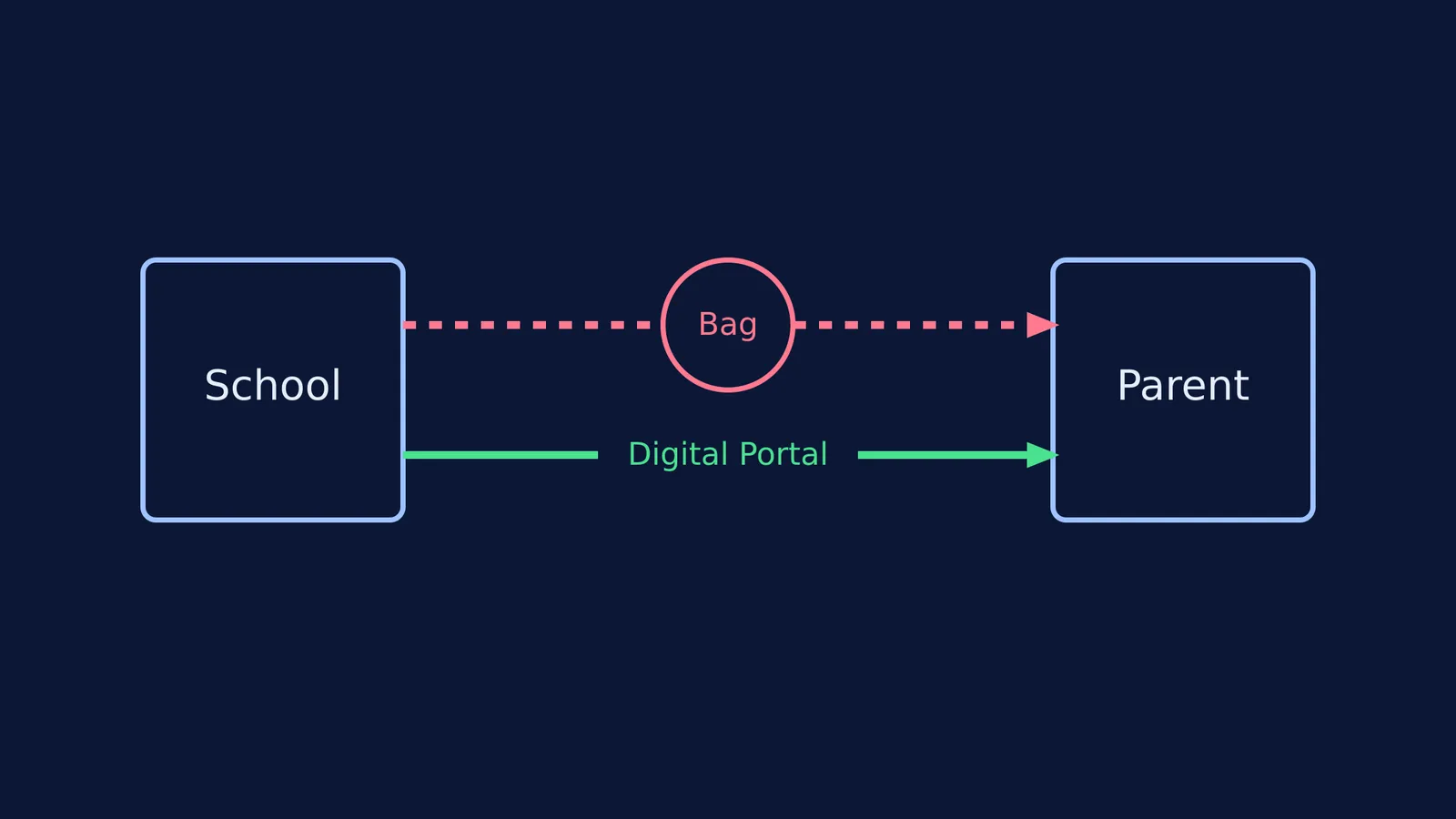
To fix the communication gap, take the child out of the delivery chain wherever possible. Establishing a process that bypasses the backpack entirely is the most effective approach.
Set a fixed bag check routine: Make emptying the school bag part of the daily afternoon routine. As soon as they get home, ask them to take out their lunchbox and any papers before they start resting. Check the bag yourself if they are young. Doing this daily means notices do not pile up, get ruined by a leaking water bottle, or get forgotten entirely.
Move to digital updates: Check if your school has an online system, an email newsletter, or a parent portal. Log in to the digital system weekly rather than waiting for your child to tell you to check it. Many schools now publish the exact same information online that they send home on paper.
Contact the teacher directly: If you suspect you are missing things, email the class teacher. Ask them to send important updates digitally or confirm which days physical notices usually go out. Teachers are usually happy to loop parents into direct communication if it ensures administrative tasks are handled smoothly.
What if I still feel uninformed?
Even with strong daily routines in place, you might feel you only hear about the big events rather than your child's day-to-day progress. If your child is struggling with a subject and quietly hiding the notices about extra remedial classes or poor quiz results, a direct conversation with the school is the best step. You can prepare by looking at our guide on parent-teacher meeting questions that lead to real follow-up.
When you know exactly what your child is working on, you can support them much better at home. For example, if you find out they have a difficult physics test coming up, the Fermi Concept Library has a lesson for every concept in physics, chemistry, biology, mathematics and computing, and its place in the map. If you find out they have a major assignment and do not know where to start, Fermi's AI tutor can work out what they already know and build a plan for the session.
Building a reliable habit for catching school notices takes a few weeks of consistent effort, but it completely removes the friction of missed deadlines. If you are trying to balance offering parental support with giving your teenager some independence, you can read more about staying involved in high school without hovering. Establishing open communication with both your child and their school creates a stronger foundation for their academic journey. When you are fully aware of what is happening in the classroom, you are better equipped to provide the right support at the right time.


