

On this page
In primary school, Social Science feels like bedtime reading. Environmental Studies in Class 5 focuses on families and neighbourhood plants, while Class 6 and 7 history presents ancient rulers through stories. In Class 8, the curriculum expands into three dense textbooks: *Our Pasts III* (modern Indian history), *Resources and Development* (geography), and *Social and Political Life III* (civics).
This transition catches many families by surprise. In the National Achievement Survey 2021 conducted by the Ministry of Education across 720 districts, Class 8 students achieved a national average scaled score of 255 out of 500 in Social Science, answering only 39% of questions correctly. The dip reflects a mismatch between primary study habits and middle-school grading expectations rather than lost ability.
Earlier, students could earn high marks by cramming textbook paragraphs word for word. In Class 8, exams introduce analytical questions evaluating colonial policies, farming systems, and constitutional mechanisms. When a child writes rambling paragraphs without headings, examiners struggle to spot grading keywords. When discussing test papers at home, talking to your teenager about marks without a fight begins by diagnosing whether low marks stem from memory gaps or answer formatting.
Why do Class 8 social science marks suddenly drop?
The primary trigger is a steep rise in cognitive demand. The NCERT Position Paper on the Teaching of Social Sciences notes that over-reliance on memorising isolated textbook facts drives disengagement and curricular fatigue. Middle-school assessments move away from simple definitions toward cause-and-effect reasoning. When students encounter modern history chapters on colonial rule and revenue systems, passive reading fails because students lack a mental schema to organise dense detail.
How do timelines and maps replace rote memorisation?
Treating dates as isolated numbers leads to rapid forgetting. A student tries to recall 1757, 1764, 1793, and 1857 as disconnected flashcards without understanding what connects them.
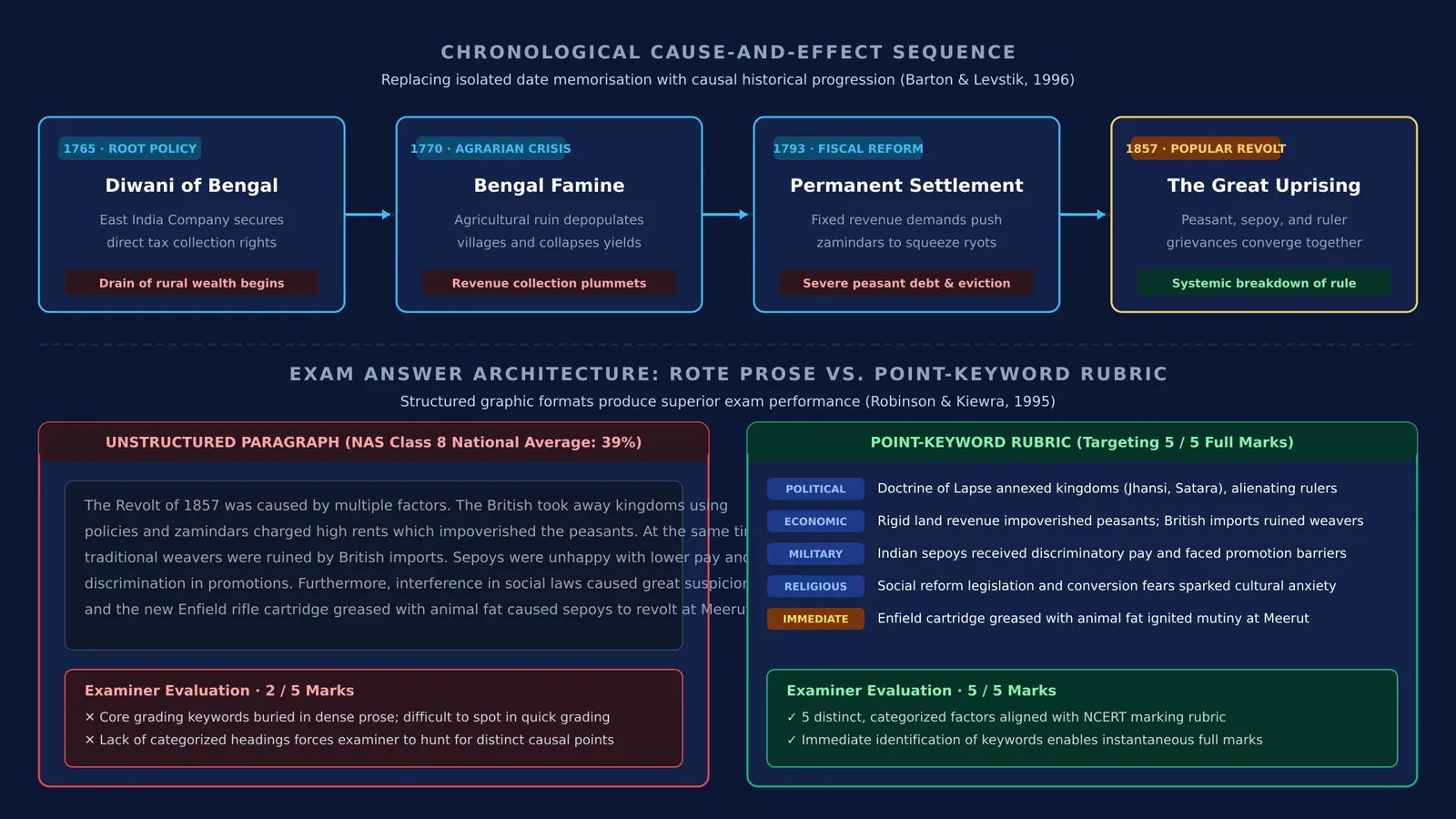
Educational research confirms that chronological understanding develops through causal sequence. A study in the *American Educational Research Journal* by Barton and Levstik (1996) demonstrated that children understand historical time far more effectively when events are organized into visual sequences connecting everyday causes with social consequences.
Instead of memorising that the Permanent Settlement began in 1793, sketch a horizontal causal chain:
1765: British East India Company acquires Diwani (revenue rights) of Bengal.
Strain: Heavy revenue extraction triggers agricultural ruin and famine.
1793: Permanent Settlement fixes revenue rates to secure colonial collections.
Consequence: Ryots face high rents from zamindars, driving peasant indebtedness and revolt.
A similar method works for geography, where identifying mineral belts and industrial regions requires spatial memory. Practising on outline maps provides visual anchors that reinforce recall. Pairing visual diagrams with verbal notes draws on dual coding notes, which combines spatial and linguistic channels to strengthen memory.
How can students turn long textbook answers into point-wise notes?
Examiners grade Class 8 papers against rubrics that reward distinct factors. Uninterrupted paragraphs obscure key arguments, costing students marks even when they know the material.
Research supports structured formatting. In the *Journal of Educational Psychology*, Robinson and Kiewra (1995) showed that graphic organizers produce superior comprehension and relationship-learning compared to linear text outlines. Furthermore, a meta-analysis of 16 intervention studies by Dexter and Hughes (2011) found that graphic organizers significantly improve factual comprehension and content-area learning across grades 4 to 12.
Teach your child the Point-Keyword Formula for multi-mark questions. Here is a restructured answer on the Revolt of 1857:
Political cause: The Doctrine of Lapse annexed kingdoms like Jhansi, angering Indian rulers.
Economic cause: Heavy revenue demands impoverished peasants and ruined artisans.
Military cause: Indian sepoys faced discriminatory pay and limited promotions.
Religious cause: Social reform laws provoked cultural anxiety among orthodox communities.
Immediate cause: The grease on the new Enfield rifle cartridge triggered mutiny at Meerut.
Each point opens with a clear category, states a single fact, and highlights a key historical term.
What is an effective weekly study routine for middle school social science?
Cramming before term exams causes cognitive overload. A consistent weekly routine turns passive reading into active recall:
Read and highlight keywords on Sunday: Read the textbook chapter, underlining only key terms, dates, and causal verbs.
Build a timeline or map on Tuesday: Sketch one timeline or locate key features on an outline map.
Frame practice questions on Thursday: Answer end-of-chapter questions using the Point-Keyword Formula.
When reviewing periodic assessments, reading a report card beyond the marks clarifies whether low scores reflect reading volume or answer execution. When a student feels stuck or unsure how to begin tackling an extensive chapter, Fermi's AI tutor can work out what they already know and build a plan for the session, so they sit down to a clear next step.
Start with tonight's homework: choose one textbook question, skip the paragraph, and help your child write numbered points with bold category headings.


