

On this page
It starts as one lost eraser. Then a pencil disappears. Before the end of the first term, you are buying a completely new set of stationery. If your child keeps returning from school with an empty pencil case, it is easy to assume they are simply being careless. But looking at how a child's brain develops shows a different picture.
Why does my child keep losing stationery at school?
Losing things is closely tied to executive function—the brain's management system that handles working memory, focus and cognitive flexibility. When a child packs their bag, they need working memory to remember what they took out, and cognitive flexibility to switch from classwork to packing up before the bell rings.
Executive function is still maturing during the primary and early secondary school years. If a child puts down a pencil while talking to a friend, their brain may simply fail to encode the action. This is incredibly common. The average child permanently loses nine items every school year, according to a survey by My Nametags. It is a developmental reality, rather than intentional carelessness.
How should you label school stationery effectively?
Telling a child to be more careful rarely works because it does not reduce their cognitive load. Instead, you have to build systems that act as an external memory.
The first step is visual labelling. Children often have a better visual-spatial memory than a verbal one. Writing their name on a pencil is helpful for the teacher, but a distinctive visual cue—like a bright stripe of neon tape around the top of every pen and pencil—makes it instantly recognisable to the child from across the room.
You can involve your child in the labelling process. Letting them choose the colour of the tape or the design of the stickers gives them a sense of ownership over their supplies. When children feel a personal connection to their belongings, they are more likely to notice when an item is missing.
When studying at home, reducing friction is key. If your child struggles to plan their work after searching for their supplies, Fermi's AI tutor can build a plan for the session so they sit down to a clear next step.
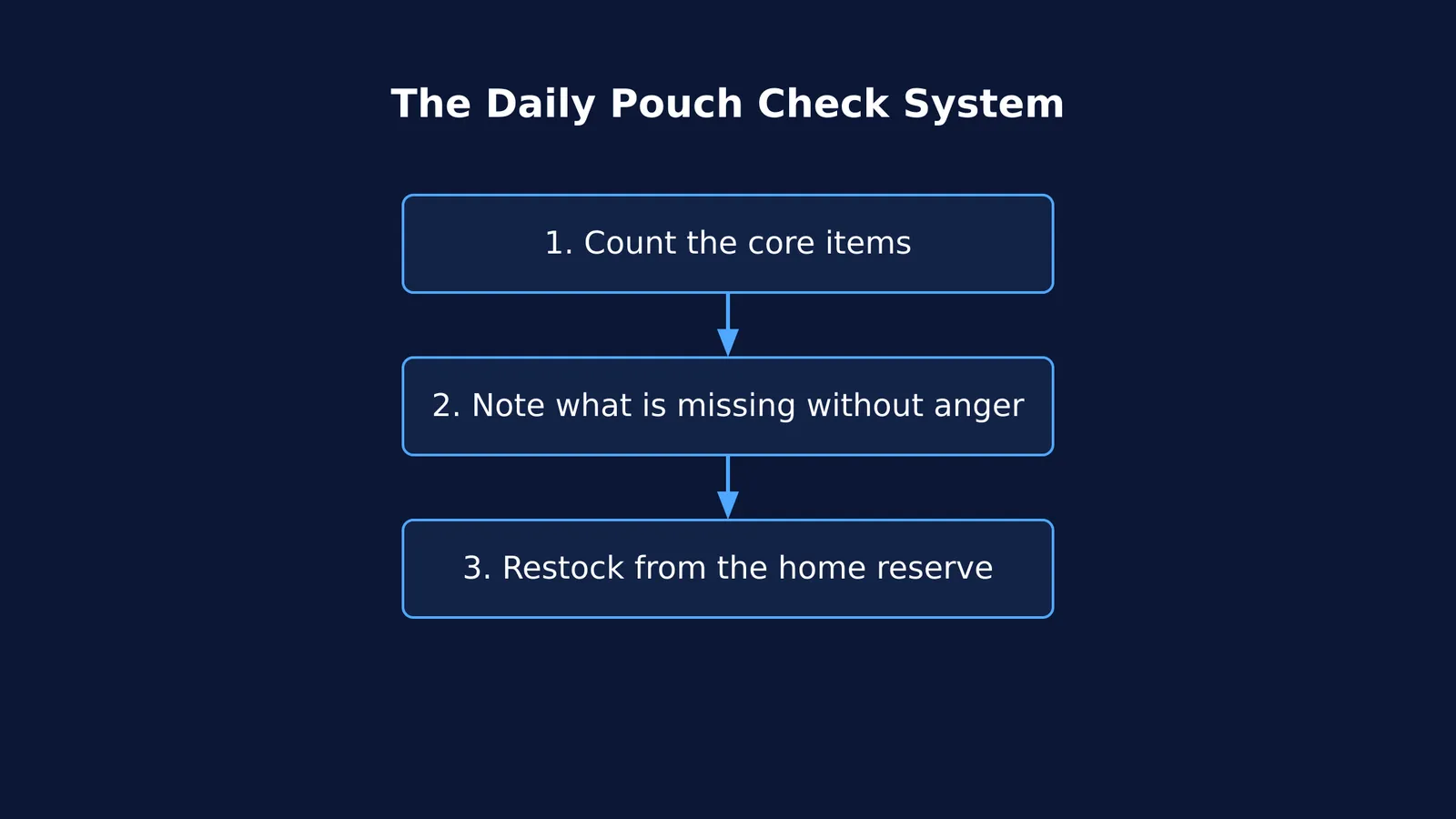
How does the daily pouch check system work?
A daily routine moves the responsibility of keeping track of items from the chaotic classroom to the calm environment of home. Setting up a pouch check takes a few moments every afternoon.
A consistent routine is the foundation of building good habits. By doing the pouch check at the same time every day, such as immediately after unpacking the school bag, it becomes an automatic behaviour rather than a chore.
Count the core items: Decide on a standard kit, such as a set number of pencils and an eraser. When your child unpacks their bag, have them count the items.
Note what is missing: If they are short of a pencil, acknowledge it without anger. Say, "I see we are missing a pencil today."
Restock from the reserve: Keep a box of spare stationery at home. Your child must take a new pencil from the reserve to make their kit complete for the next day.
This system gives them daily feedback on what they have lost, rather than waiting until the pouch is completely empty weeks later. For younger children, you might need a simple visual checklist inside their bag.
Should you punish a child for losing things?
Punishing a child for losing a compass or a pen often backfires. Stress impairs executive function. If a child is anxious about losing their things, their cognitive load increases, making them more likely to forget a step and lose something else.
Instead of punishment, use natural consequences. Give them a termly stationery budget or a set amount of pocket money. If they run through their reserve box of pencils before the term ends, they must use their own money to buy replacements. This teaches them the value of money and makes them responsible for the loss, without turning it into a shouting match.
Remember that as their executive function matures, their ability to keep track of their belongings will naturally improve. Until then, a labelled pouch and a calm daily check will save both your stationery budget and your patience.


