

On this page
When Indian students choose a third language for Class 6 or Class 9, the choice usually comes down to French or German. Both are popular, well-supported by schools, and seen as percentage boosters for board exams. However, they demand different study habits and offer different advantages for a child's future career.
Here is how the two languages compare on workload, scoring, and long-term usefulness.
Is French or German easier to learn?
The early workload depends heavily on how a child learns. French often feels easier in the beginning because it shares many words with English. However, its pronunciation rules are complex, and the spelling often does not match the sound. As students progress, they must navigate many irregular verbs and subtle tenses, which can make advanced writing challenging.
German has the opposite learning curve. The grammar is rigorous and requires memorisation right from the start, as students must learn noun genders and a complex system of four cases. However, German is highly phonetic—words are pronounced exactly as they are written. Once a student grasps the underlying structural rules, German becomes highly predictable, logical, and often feels easier at higher levels. Both languages require consistent practice, just like other core subjects; you can learn more about building strong foundations in our guide on home language and learning: what NEP 2020 and research say.
Which language is more scoring in board exams?
For CBSE, ICSE or state board students, both languages are designed to be highly scoring.
The question papers for both languages usually rely on established patterns, focusing heavily on grammar worksheets, reading comprehension, and straightforward writing tasks. Because German grammar operates almost like a mathematical formula, students who master the rules often find they can secure full marks in the grammar sections without ambiguity. French is similarly high-scoring, provided students pay close attention to spelling and accent marks.
What is the career scope for German vs French?
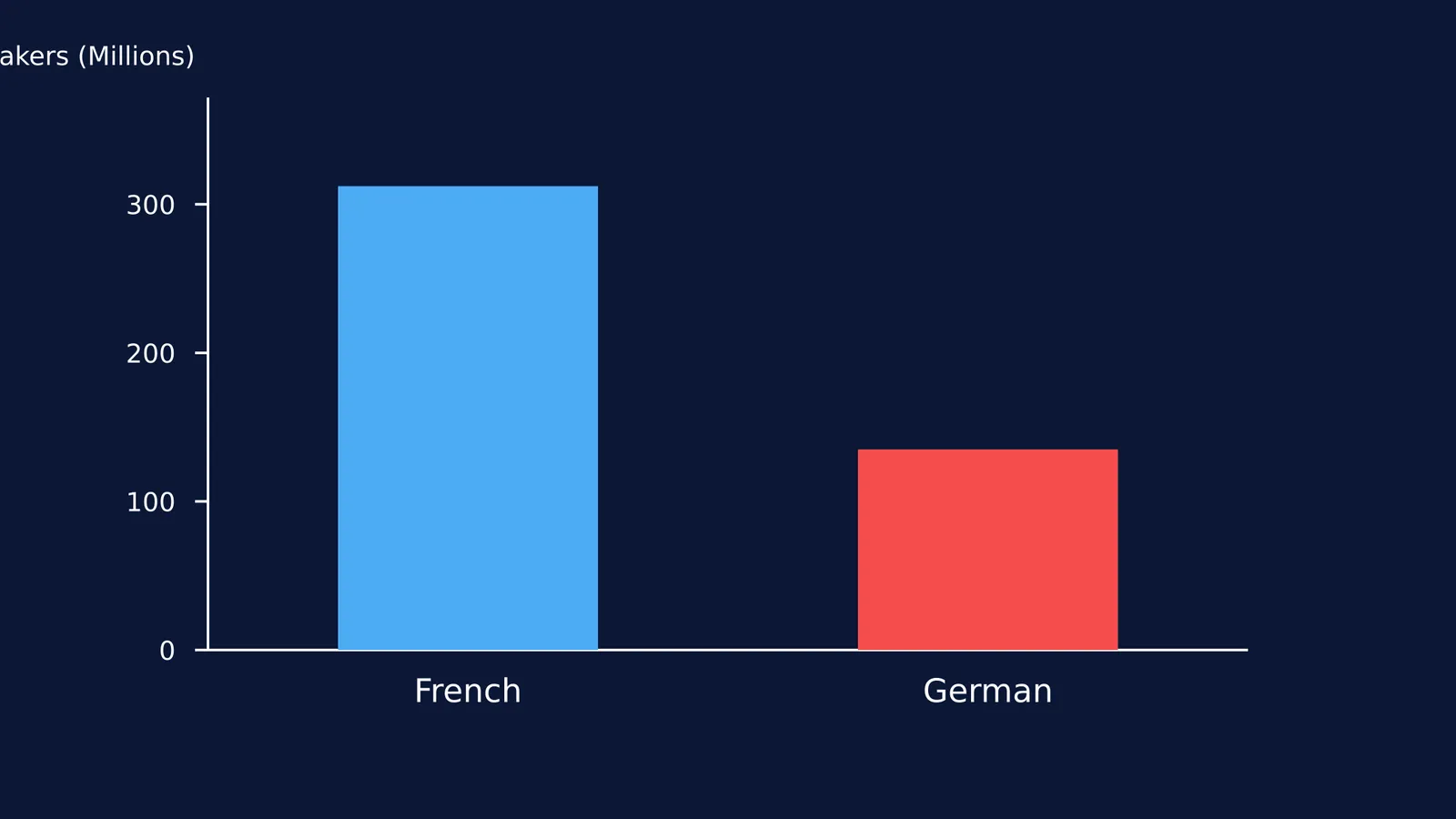
When looking at global reach, French is spoken by about 312.2 million people worldwide, making it a major international language of diplomacy, literature, and business across multiple continents.
German, while having fewer speakers globally (around 135 million), holds immense weight in science, engineering, and technology. Germany is currently one of the top destinations for higher education, particularly for STEM fields. According to the DAAD and DZHW "Wissenschaft weltoffen 2024" report, Germany hosted nearly 380,000 international students in the 2023/24 academic year, with Indian students forming the largest group at roughly 49,000. For students planning to study engineering, automotive design, or applied sciences abroad, knowing German offers a distinct advantage, as many public universities in Germany charge no tuition fees for programs taught in the local language.
France is also actively recruiting international talent, hosting over 430,000 international students in 2023/24, with growth particularly strong in business and engineering schools. However, Germany's dominance in core manufacturing and scientific research often makes German the preferred choice for STEM-focused students.
A framework for making the decision
When helping your child choose, consider these practical steps:
Assess their interests: Do they lean towards literature, diplomacy, and the arts (French), or are they more interested in logic-driven subjects and engineering (German)?
Consider higher education plans: If they have an early interest in studying STEM subjects in Europe, German is highly practical.
Look at school resources: Which language has better teachers and a stronger track record at your child's specific school?
When your child is balancing a new foreign language alongside demanding science and mathematics curricula, efficient study habits across all subjects become crucial. For their core STEM subjects, Fermi's AI tutor can work out what they already know and build a plan for the session, so they sit down to a clear next step instead of feeling overwhelmed by the workload.
Ultimately, the best choice is the one the child feels most motivated to study. Both French and German will strengthen their cognitive skills and boost their board exam percentages, provided they stay consistent.


