

On this page
The morning of a major exam is tense enough without a race against the clock. Every year, news channels show heartbreaking footage of students crying outside an examination centre because they arrived a few minutes too late. The gates are locked, and their year of preparation is effectively over.
Knowing the rules and planning a buffer does more than ensure you get in. It protects the working memory you need to actually perform on the test.
What if child reaches late to exam centre?
The rules for national and board exams leave no room for argument. Once the specified gate closing time passes, entry is strictly prohibited. Traffic jams, vehicle breakdowns, or bad weather are not accepted as valid excuses.
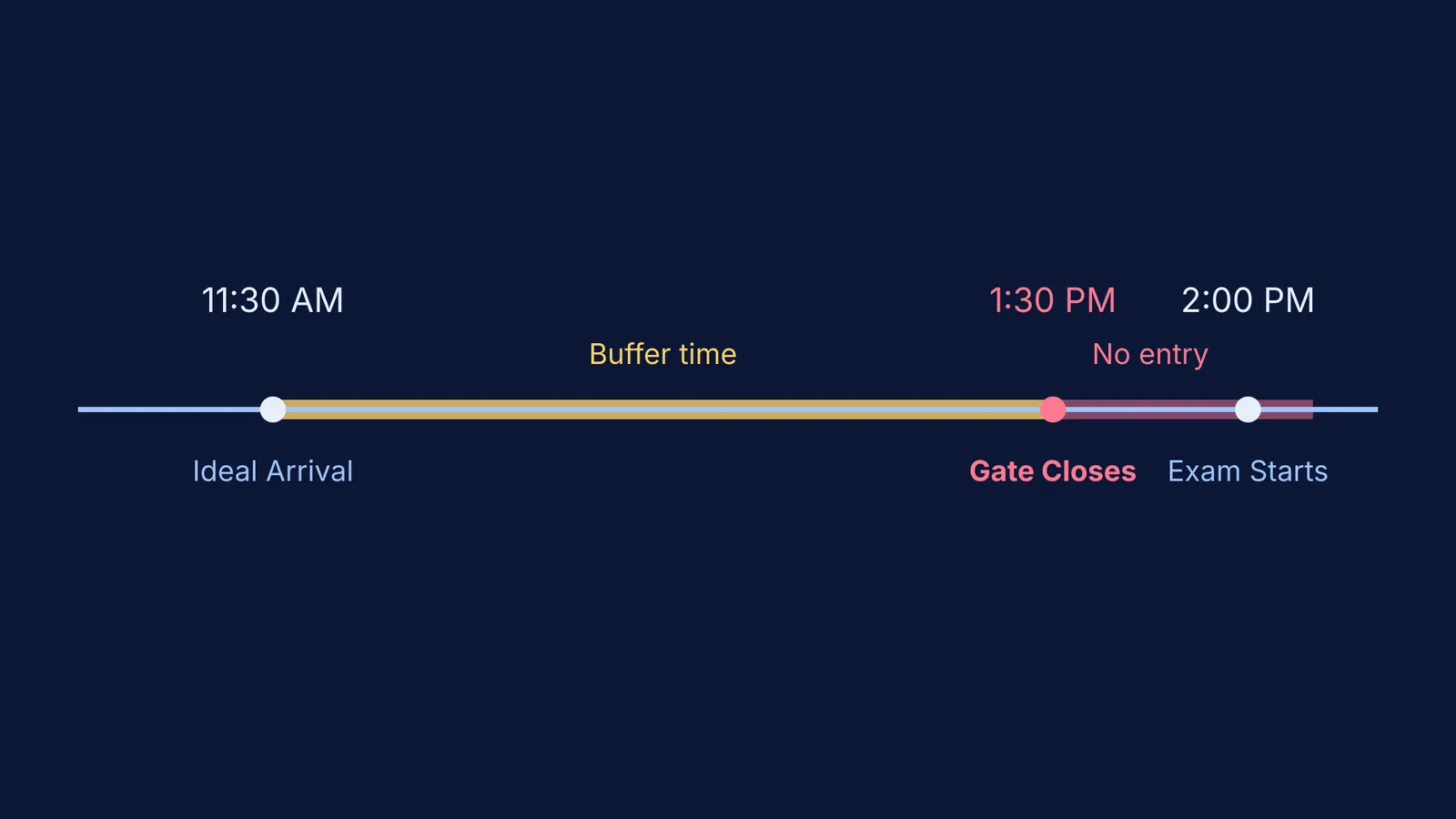
For NEET-UG, the examination starts at 2:00 PM, but the gate closes completely at 1:30 PM (National Testing Agency). If you arrive at 1:31 PM, you will not be allowed inside. Similarly, for CBSE Class 10 and 12 board exams, the exam begins at 10:30 AM, but no student may enter after 10:00 AM (CBSE Guidelines). For JEE Main, the gate closes exactly 30 minutes before the shift begins.
Missing the gate closing time means forfeiting the attempt. For an exam like NEET-UG, which is held only once a year, this means waiting another 12 months.
Why is the gate closing time so early?
The gap between the gate closing and the exam starting is not empty time. Security checks for competitive exams are extensive.
Students must undergo thorough frisking to prevent cheating. They also complete biometric registrations, which often include facial recognition and fingerprint scanning. Organising large numbers of students, verifying their admit cards, and seating them in the correct rooms takes a substantial amount of time. If latecomers were allowed, it would disrupt the focus of students who are already seated and reading their question papers.
How does time pressure hurt exam performance?
Even if a student manages to slip through the gates just before they close, the panic of the morning has a measurable cost on their score.
High-stakes pressure "co-opts" the brain's working memory, leaving fewer mental resources available to solve complex problems (Ramirez & Beilock, 2011; Science). The stress of a rushed morning spikes cortisol levels, shifting the brain from deliberate, logical reasoning to reactive processing. A student who arrives out of breath and terrified is far more likely to misread a question or forget a formula they knew perfectly the night before.
This is why managing anxiety begins weeks before the exam and extends to the morning commute. In the lead-up to the test, knowing what to study reduces panic. Fermi's AI tutor can work out what you already know and build a plan for the session, so you sit down to a clear next step instead of worrying about where to start.
On the day of the exam, removing logistical stress is the easiest way to protect your cognitive load.
How should you plan your reporting for exam day?
To ensure you are never turned away, you should aim to arrive at the exam centre 1 to 2 hours before the gate closes. Here is a practical checklist to follow:
Do a dry run: Visit the exam centre on the Sunday before the test, at the exact time you will be travelling. This helps you understand the route and typical traffic conditions.
Pack the night before: Place your admit card, a valid photo ID, passport-size photographs, and allowed stationery in a clear pouch.
Add a 50% buffer: If your dry run took 40 minutes, leave home early enough to allow 60 minutes for the journey. A flat tyre or an unexpected diversion should not cost you the exam.
Plan your morning: Managing the logistics fits into broader Exam season at home: routines that help the whole family. Wake up on time, have a familiar breakfast, and leave the house calmly.
Once you are inside and seated early, you can use those quiet minutes to breathe and settle your mind, giving you the best possible start when the paper finally arrives. For strategies on what to do once the clock starts, read about Time management in the exam hall: a two-pass plan for JEE and NEET.


