

On this page
If your morning involves shouting, searching for a left shoe, and watching the school bus drive away, you are not alone. Getting out the door on time is a daily battle in many homes.
When a child is continually late, the instinct is to tell them to hurry up. But the problem usually starts the night before, with late bedtimes and left-over decisions.
Why does my child miss the school bus every morning?
Children and adults alike suffer from what psychologists Daniel Kahneman and Amos Tversky identified in 1977 as the planning fallacy: the tendency to underestimate how long a task will take, even when past experience shows otherwise. Your child thinks finding their shoes takes a moment; reality shows it takes much longer.
Teenagers are especially prone to this optimism. They do not account for distractions, fatigue, or the fact that they are operating on too little sleep. The American Academy of Pediatrics recommends 9 to 12 hours of sleep per night for children aged 6 to 12, and 8 to 10 hours for teenagers. When a child stays up late, waking up early enough to complete a morning routine becomes physically difficult.
How long should a morning routine take?
A realistic morning routine for a school-aged child or teenager takes nearly an hour. This covers waking up, washing, dressing, eating breakfast, and gathering bags.
The mistake most families make is calculating the required time perfectly, assuming every step will go exactly to plan. If the bus arrives at 7:30 AM and you allow exactly enough time for the routine without any margin, you are sure to be late the moment a shirt button goes missing.
How to fix the morning routine and get to school on time
To fix the morning rush, shift the work to the night before and build your schedule backwards from the bus.
Cut the morning decisions
Decision-making takes time. If a child has to choose what to wear, what to eat, or which books to pack in the morning, they will stall. Remove these choices. Pack the school bag before dinner. Lay out the uniform, including socks and shoes, before bed. Decide on breakfast the night before.
Work backwards from the bus
If the bus leaves at 7:30 AM, that is your anchor. Do not calculate forward from when the child wakes up; calculate backward from the departure time.
Add a time buffer
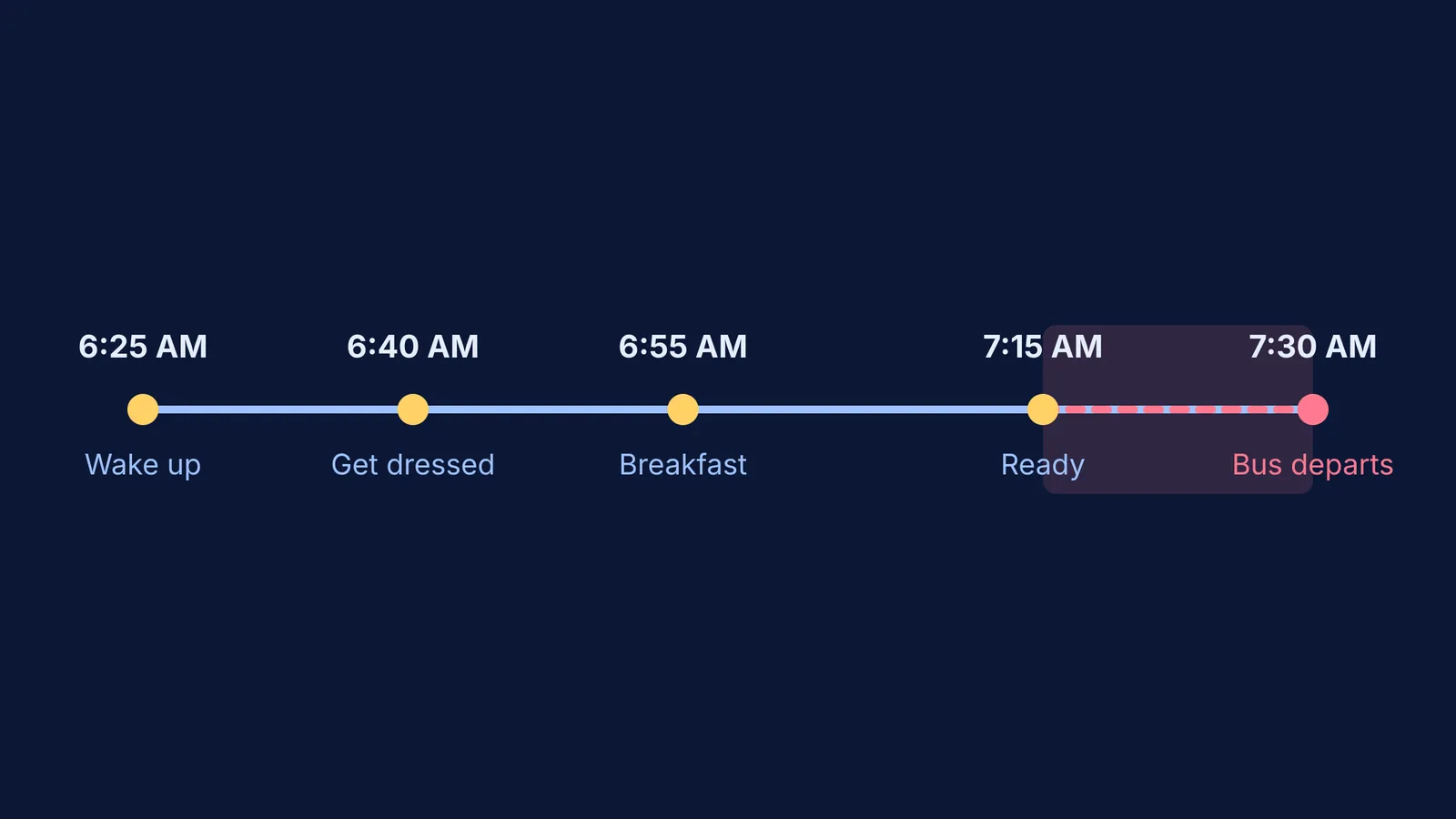
This is the most important step. If the bus leaves at 7:30 AM, the goal is to be fully ready with shoes on at 7:15 AM. That extra time is your buffer. It absorbs the missing book, the bathroom queue, or the spilled milk. If nothing goes wrong, your child gets quiet time to read or relax before leaving.
If your child also struggles with time management in the evening, resulting in late nights and rushed mornings, Fermi's AI tutor can help. It works out what a student already knows and builds a plan for the session, so they sit down to a clear next step instead of wasting time figuring out where to start.
A morning routine plan for school days
Here is how a backward schedule looks for a 7:30 AM bus:
7:30 AM: Bus departs.
7:15 AM: Buffer starts. Child is fully dressed, bag packed, shoes on.
6:55 AM: Breakfast.
6:40 AM: Get dressed and brush teeth.
6:25 AM: Wake up and wash.
By planning this way, you give your child a realistic chance of success. If your child sets unrealistic targets, keeping the goal and adding checkpoints applies to mornings just as much as to studying. Similarly, establishing a study plan for Class 11 physics or any tough subject keeps the evening structured, ensuring they get to bed on time and wake up ready for the routine.
A calm morning sets the tone for the entire school day. When a child leaves the house without being rushed, they arrive at school ready to learn.


