

On this page
Do arts competitions hurt academic performance?
Many parents worry that time spent on dance, music or visual arts will pull focus away from core subjects like maths and physics. It is natural to assume that hours spent in a studio are hours lost to studying. However, studies consistently show the opposite. According to a landmark 2012 report by the National Endowment for the Arts, high school students who earn few or no arts credits are five times more likely to drop out than those who earn many arts credits.
The discipline required to prepare for a performance or a gallery exhibition builds time management and resilience. These soft skills directly transfer to the classroom. When a student learns how to push through a difficult piano piece or perfect a dance routine, they are practising the exact same perseverance needed to tackle complex exam syllabuses with greater focus. The dedication needed for arts competitions often translates directly into stronger study habits.
How many hours of extracurriculars is too much?
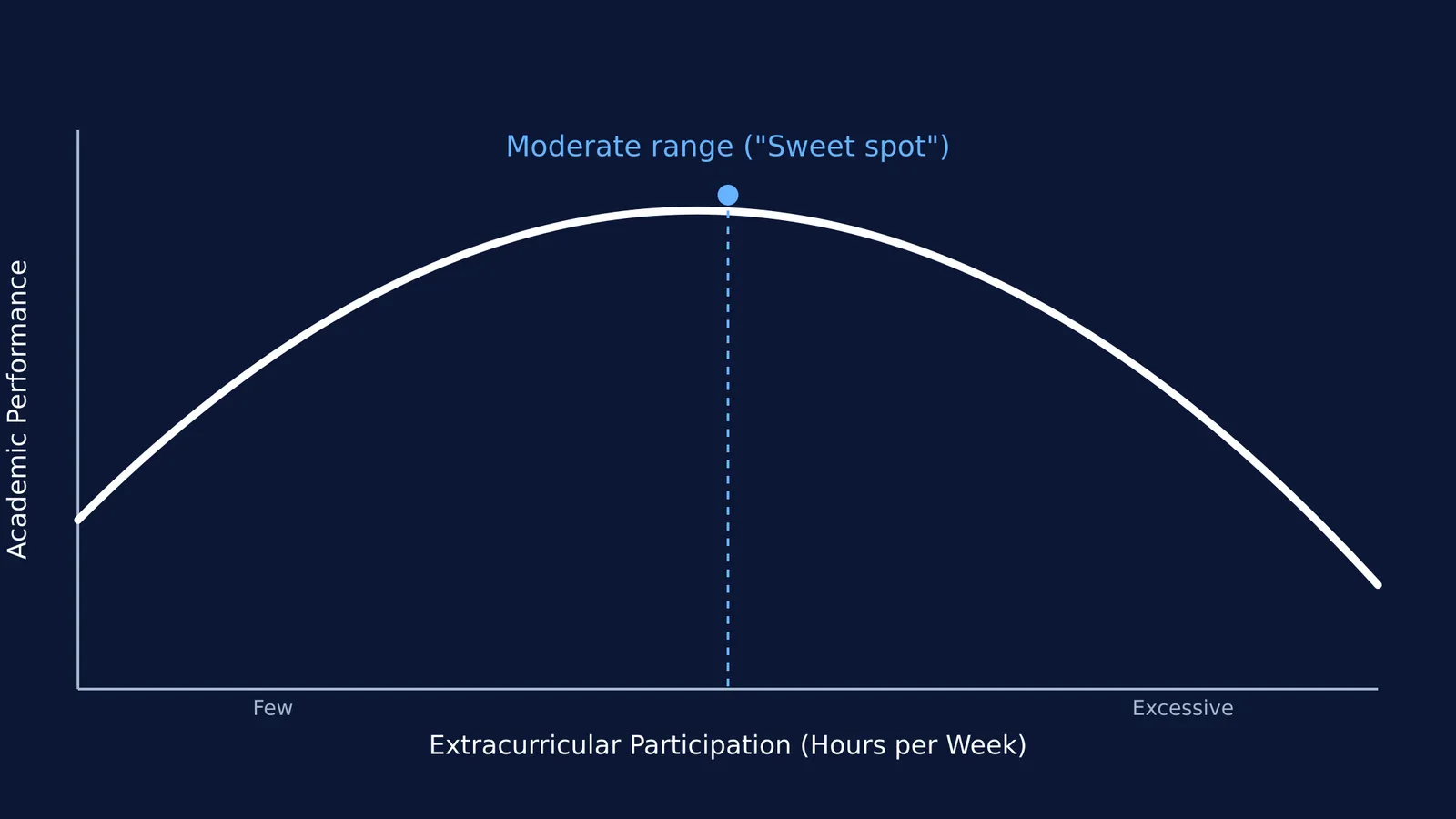
While participation is beneficial, overcommitment is a real risk. Educational research points to a "sweet spot" for extracurricular involvement. According to the National Center for Education Statistics, extracurricular participation is consistently linked to better academic performance and higher engagement. Within a moderate range, students often report the highest academic satisfaction and lowest burnout.
However, when participation becomes excessive, academic performance begins to decline. At this level, the demanding schedule cuts into necessary sleep and homework time, leading to fatigue and diminished cognitive function. The brain needs time to rest and consolidate what it learned during the day. If your child is practising for a major competition, you need to monitor their rest closely to ensure they are not trading academic success for artistic achievement.
Why the arts act as a buffer against exam anxiety
It is also important to remember that creative pursuits are not just another task on a checklist. For many students preparing for high-pressure exams like JEE or NEET, an art or music class is the only time in the week where they are not being graded on a strict right-or-wrong scale.
This break from academic pressure acts as a powerful stress reliever. Returning to a difficult physics problem after an hour of painting or dancing often leads to better concentration. The arts provide a holistic buffer, preventing the kind of deep burnout that can derail an entire term of studying. In many cases, the mental space gained during creative work is exactly what allows a student to solve a problem they were previously stuck on. The physical movement involved in dance or the intense focus required for visual arts can help clear the mind, making subsequent study sessions far more productive.
How to manage your child's art competitions with school work?
Balancing a rigorous competition calendar with board exams requires proactive planning and communication. Here is a practical framework to keep both on track:
Audit the week: Track every hour spent on school, commuting, arts practice and sleep. Ensure practice stays at a manageable level. If the total is overwhelming, sit down with your child and decide what can be trimmed.
Sync the calendars: Plot the year's major art competitions alongside exam dates on a shared family calendar. You can read more about balancing extracurriculars and marks to see why this helps. Identify the clash weeks where a tournament falls near a school assessment, and scale back practice temporarily in the weeks leading up to it.
Protect sleep: Never borrow time from the full night of sleep a teenager needs. Sleep deprivation hurts both creative performance and memory retention, making study sessions less effective.
Build a sustainable routine: Help them design a realistic daily schedule that builds in transition time between school and extracurriculars. You can read more about how parents can help children learn without adding pressure and how to build a study routine that lasts longer than a week.
Making study time more efficient
When a child spends hours a week in a dance studio or at a piano, the study time they do have must be highly effective. They cannot afford to spend an hour stuck on a single numerical or passively reading a textbook. Their time at the desk must be active and focused. Working smarter instead of harder becomes the only way to manage both worlds successfully without burning out.
This is where Fermi's AI tutor helps. It can work out what you already know and build a plan for the session, so you sit down to a clear next step. If your child is struggling with a specific physics or chemistry question after a long rehearsal, the Fermi Problem Library has worked problems with a step-by-step solver that explains the reasoning rather than printing an answer. This ensures that every minute spent studying actually leads to understanding, leaving more time for the creative pursuits they love.


