

On this page
If your teenager shrugs every time someone asks "What do you want to become?", you are not alone, and neither are they. A blank answer at 15 often means they have not seen enough yet, not that they lack drive. Below is what the research says, and a four-week plan you can start this weekend.
Is it normal for a teenager to have no goals?
Yes, and it is getting more common. Writing for the OECD, its education director Andreas Schleicher reports that across OECD countries 39% of 15-year-olds now "sit in the 'don't know' column" on career plans, the highest share ever. Among students who do name a goal, the same article says 58% expect to work as professionals such as doctors, engineers and lawyers. So even teenagers who seem certain may be choosing from a small set of familiar jobs.
Researchers also separate a goal from a purpose. In a 2003 paper in Applied Developmental Science, William Damon, Jenni Menon and Kendall Cotton Bronk of Stanford define purpose as "a stable and generalized intention to accomplish something that is at once meaningful to the self and of consequence to the world beyond the self." They describe youth as "a formative period for cultivating a sense of purpose". It takes years, not one family dinner.
Why don't big future goals motivate teenagers?
A goal that sits years away gives a teenager nothing to do tonight. In a classic experiment, Albert Bandura and Dale Schunk (1981) gave children who struggled with and disliked arithmetic a self-study programme with either close-at-hand subgoals, one distant goal, or no goal. With the near subgoals, children progressed rapidly, built confidence and developed intrinsic interest in arithmetic, an activity that had initially held little attraction for them. The distant goal had no demonstrable effect.
For your teenager, this means you can stop asking "What is your goal in life?" and start asking "What do you want to try this month?" In that study, interest grew as children made progress on small steps; it did not have to be there first.
How can I help my teenager explore careers without pressure?
Widening what they see works better than pushing for a decision. The same OECD analysis found that 15-year-olds who take part in workplace visits, job fairs, career talks and conversations with people in work are significantly more likely, a decade later, to be employed, earn higher wages and feel satisfied with their jobs than their peers.
In an Indian family, much of that is already within reach:
A relative, neighbour or family friend who works in a field your teenager knows nothing about. Ask for 20 minutes of honest conversation, not advice. Our guide on arranging career talks with relatives who work has a format.
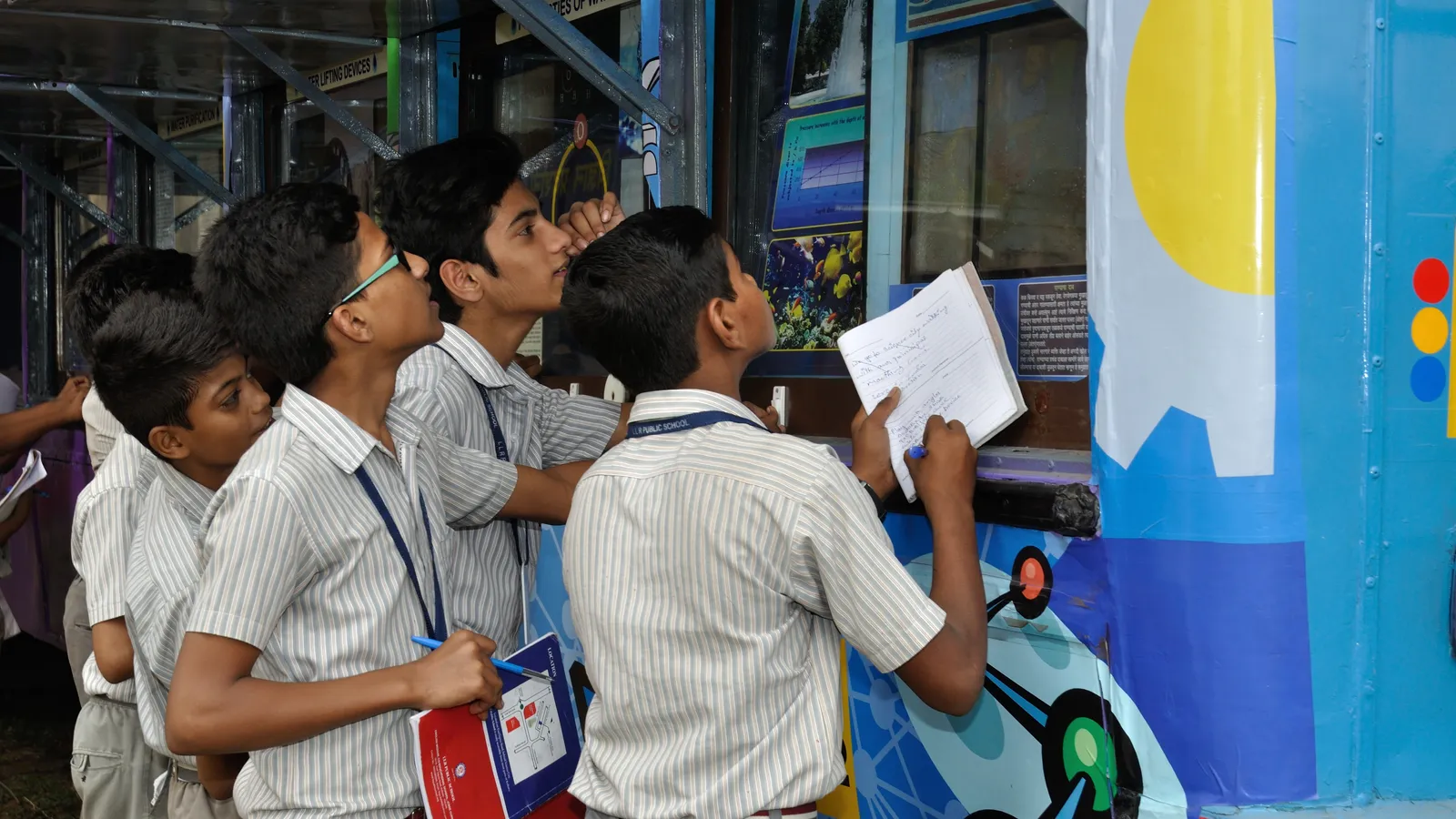
A visit to a workplace: a clinic, a software office, a farm, a science centre.
A short project they choose and finish, such as a podcast episode, a repaired cycle or a small coding task. Our one-month project plan for building interest shows how to set one up.
Following up a question from any of these. If a visit leaves them asking how solar panels or vaccines actually work, the Fermi Concept Library has a lesson for every concept in physics, chemistry, biology, mathematics and computing, so the question can turn into an evening of reading.
A four-week plan to try
Week 1: Notice. Quietly note what your teenager talks about, watches or fiddles with. Do not judge whether it could be a career.
Week 2: Ask one open question. "What was the most interesting thing you saw this week?" Accept "nothing" and ask again next week.
Week 3: One exposure. Set up one conversation or visit linked to something you noticed. Let your teenager prepare two questions.
Week 4: One small goal. Together, pick something to finish in seven days, such as reading one article, building one thing or asking one person. Check in at the end, then repeat the cycle with a new interest.
What to say, and what to skip:
Say: "You don't need to know yet. Let's find out what you like by trying a few things."
Say: "Which part of that did you enjoy most?"
Skip: "Sharma ji's son already knows he wants IIT."
For more on keeping these chats from turning into lectures, read how to talk to your teenager about their future without lecturing.
When is it more than a phase?
Not knowing what to do after school is ordinary. It is different if your teenager has lost interest in almost everything, including friends, or if changes in sleep, eating or mood last for weeks. In that case, talk to a doctor or a qualified counsellor rather than a career planner. In India you can also call Tele MANAS, the government's free, 24x7 mental-health helpline, on 14416 or 1800-891-4416.
This week, swap one "What do you want to become?" for "What do you want to try?" and see where the answer leads.


