On this page
It is a common dilemma in Class 10 when choosing a stream: your teenager consistently scores top marks in mathematics and grasps complex logic effortlessly, yet they insist on taking the Biology stream (PCB) because they want to be a doctor or a researcher. As a parent, it feels like they are throwing away a natural talent.
So, how do you guide a child who is good at maths but wants the biology stream? The answer lies in understanding the difference between what they are good at and what they enjoy, and finding a path that accommodates both, even when your child's career choice differs from yours.
Aptitude vs interest: which matters more?
Career counsellors draw a sharp line between aptitude (your innate ability to learn a skill) and interest (what you actually want to do).
When a student chooses a stream based only on interest, they might overlook areas where they would naturally excel. A 2024 report by YouScience on over 540,000 middle and high school students found that teenagers often have hidden talents for technical careers. For example, 75% more students have the aptitude for computers and technology than have an interest in it, and there is a 66% gap in advanced manufacturing.
However, forcing a teenager into the Maths stream (PCM) just because they have the aptitude can backfire. While aptitude determines how easily they learn, interest determines whether they will stay engaged when the coursework gets tough.
What if my child is good at maths but wants the biology stream?
If your child is set on biology, their mathematical ability is not wasted. In fact, it is a massive advantage.
Physics is often the deciding factor in competitive medical exams, and physics is essentially applied mathematics. Students with a strong maths foundation find mechanics, optics and electromagnetism much easier to handle than those who struggle with numbers. You can read more about how this plays out in our guide on NEET physics for biology students.
Furthermore, modern biology is deeply mathematical. Fields like genetics, epidemiology and pharmacology rely heavily on statistics, calculus and data analysis.
Is PCMB a good option for Class 11?
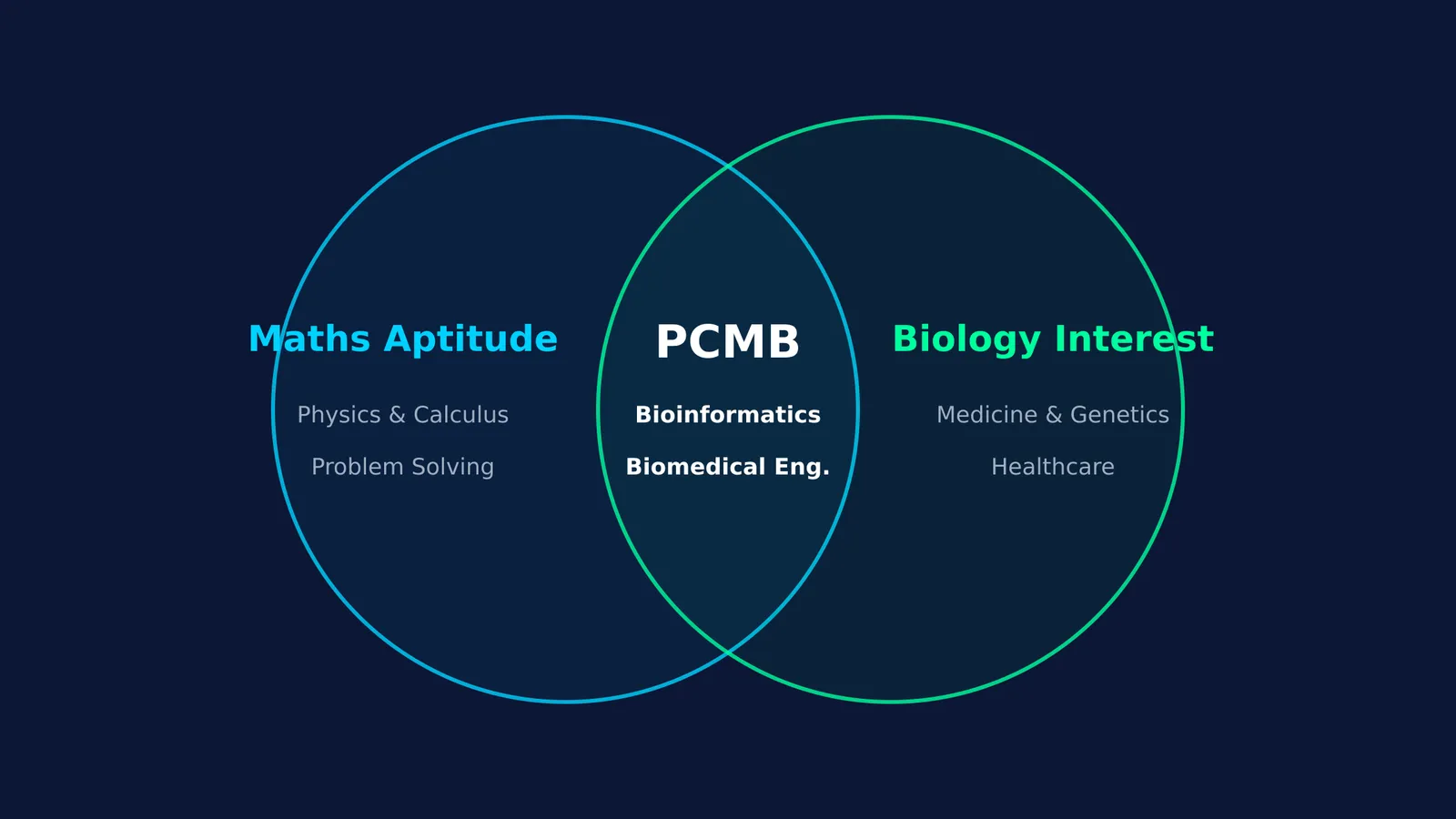
If they are genuinely strong at maths and passionate about biology, taking Physics, Chemistry, Mathematics and Biology (PCMB) is the most robust way to keep options open.
PCMB is demanding, but it leaves almost every career door unlocked. They can sit for medical exams, engineering exams, or pivot into interdisciplinary fields that actively demand both skill sets:
Bioinformatics: Using computer science and mathematics to analyse biological data, such as DNA sequences.
Biomedical Engineering: Designing medical equipment, prosthetics and diagnostic software.
Biotechnology: A fast-growing field that blends biological research with industrial technology.
How to talk it through without forcing?
Having this conversation requires exploring the day-to-day reality of the subjects rather than just the job titles.
Here is a simple framework to talk it through:
Explore the "why": Ask them what exactly draws them to biology. Is it a fascination with the human body, a desire to help people, or just a dislike of engineering?
Test the waters: Before they commit, have them spend a weekend looking at Class 11 material for both subjects. They can use the Concept Library to explore introductory topics in genetics or calculus to see how the real syllabus feels.
Solve a problem together: Sometimes the fear of a subject comes from not knowing how to study it. Have them tackle a tough physics or maths problem using the Fermi Problem Library. When they see a step-by-step solver that explains the reasoning rather than just printing an answer, they might feel more confident about keeping maths in their combination.
Discuss the workload: Be honest about the time commitment required for PCMB. Look at a typical weekly schedule and ask if they are ready for the extra hours of study.
Ultimately, a student's career path is a long journey. If they choose biology now, their mathematical brain will still help them structure their thinking, solve complex problems, and stand out in the science stream.