

On this page
It is a common puzzle for parents: your child completes their worksheets perfectly, recites definitions without hesitation, and scores full marks on practice quizzes. Yet, when asked a simple "why" question about the topic a week later, they stare blankly.
High marks on routine assignments can mask a lack of true understanding. When practice is heavily based on rote learning and repetition, it builds immediate fluency but fragile knowledge.
Why do full marks hide missing knowledge?
Students often mistake familiarity for mastery. When a child reads a textbook chapter multiple times or drills identical maths problems, the material becomes easy to process. This creates a false sense of security. They recognize the words and the steps, which tricks the brain into feeling competent. However, recognition is not the same as the ability to recall and apply that information from scratch.
This gap between perceived knowledge and actual understanding has a scientific name. In a landmark 2002 study published in *Cognitive Science*, researchers Leonid Rozenblit and Frank Keil identified the "illusion of explanatory depth".
They found that people believe they understand complex causal mechanisms—such as how a zipper or a flush toilet works—in far greater detail than they actually do. In the study, participants rated their understanding highly at first. But after being asked to write a detailed, step-by-step explanation of how the object works, their self-rated understanding dropped significantly. The act of explaining forced them to confront knowledge gaps they did not know existed.
The same happens in academics. A child might memorize the steps to balance a chemical equation or the definition of mitosis, but without grasping the underlying principles, they cannot apply the knowledge to a slightly different exam question.
Does explaining to others improve learning?
Yes. Active recall and self-explanation are among the most effective study strategies.
When a student has to explain a concept, they are forced to retrieve the information from memory, organize it logically, and translate it into their own words. A meta-analysis of 64 studies on self-explanation found a consistent positive impact on learning outcomes, yielding an average effect size of +0.55 compared to passive study methods.
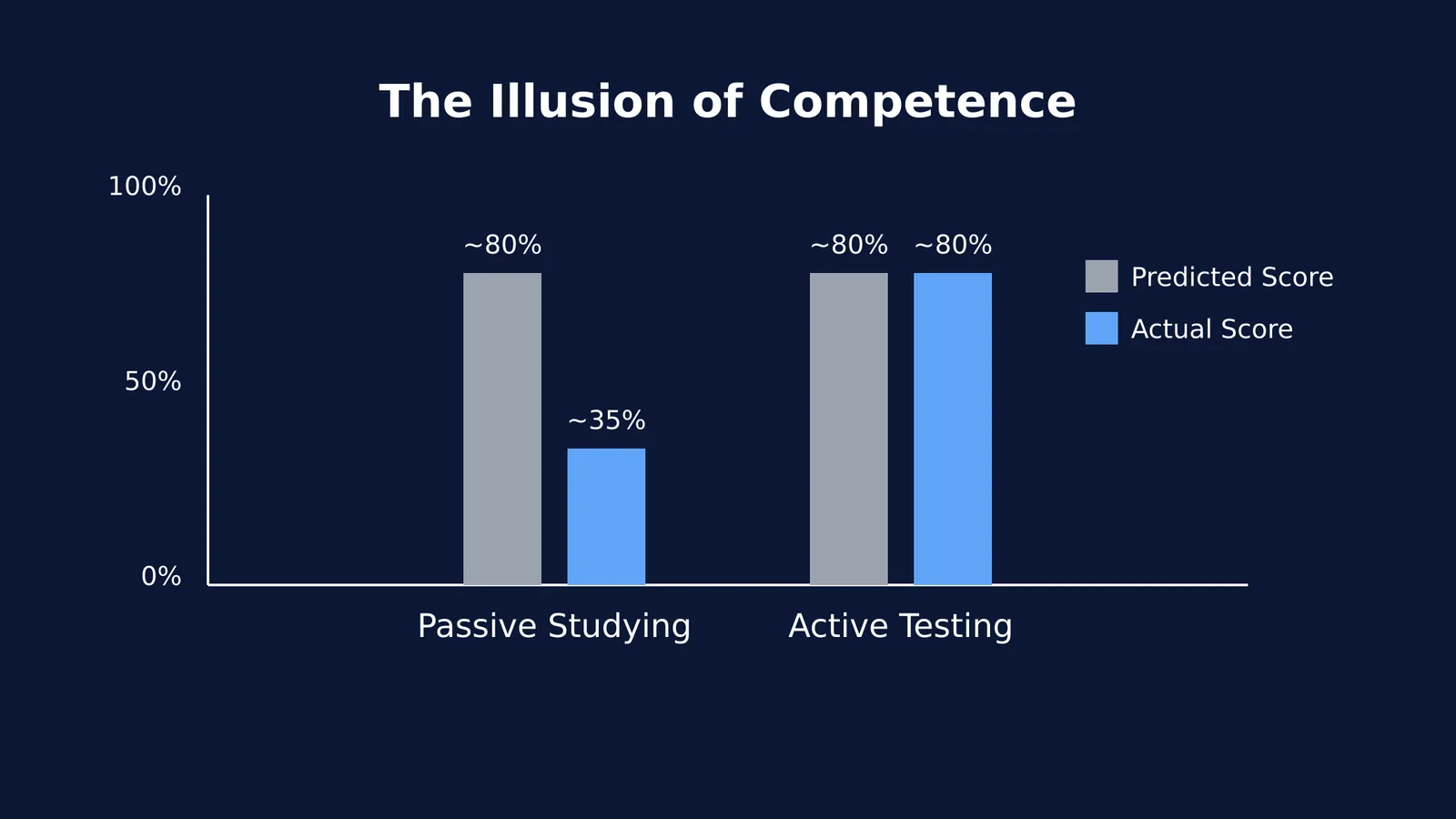
Furthermore, a 2008 study in *Science* demonstrated the critical importance of retrieval practice. Researchers found that repeated studying after initially learning a vocabulary item had no effect on delayed recall, whereas repeated testing produced a large positive effect. Crucially, the students' predictions of their own performance were uncorrelated with their actual performance on the final test—highlighting the danger of relying on how "easy" studying feels.
How to test understanding at home?
You do not need to be a subject expert to test your child's understanding. You simply need to be a curious listener. The goal is to move them away from reciting facts and toward explaining reasoning.
Here is a practical framework to use at home:
The "Teach Me" prompt: Ask your child to explain a topic they just finished studying as if you know nothing about it. For example, "I completely forgot how AC generators work. Can you draw it and explain it to me?"
The "Why" check: When they get a maths or physics problem right, point to a specific step in the middle and ask, "Why did you choose to use this formula here instead of the other one?"
The analogy game: Ask them to relate the concept to something everyday. "If the cell nucleus is the brain, what is the mitochondria?"
If they are stuck and you cannot help, Fermi's AI tutor can guide them. Rather than just giving the final answer, the tutor teaches—it holds a line of reasoning across a whole session, notices where a student is stuck, and decides whether to explain, ask, or show. It checks understanding as it goes, ensuring the student is actively building a mental model.
For mathematics and physics homework, the Fermi Problem Library offers worked problems with a step-by-step solver that explains the reasoning rather than printing an answer.
By shifting the focus from "did you get the right answer?" to "can you explain how you got there?", you can break the illusion of competence and help your child build knowledge that lasts.
Read next:


