

On this page
Finding a detention notice or learning that your child was disciplined at school triggers an immediate surge of emotion. Most parents swing toward one of two extremes: reflexively defending their child against the school, or erupting in anger at home and heaping a second punishment on top of the first. Both impulses miss the opportunity of the moment. Handled with calm curiosity, school discipline teaches young people how to navigate authority, take accountability for their mistakes, and evaluate fairness.
Why do initial parental reactions often backfire?
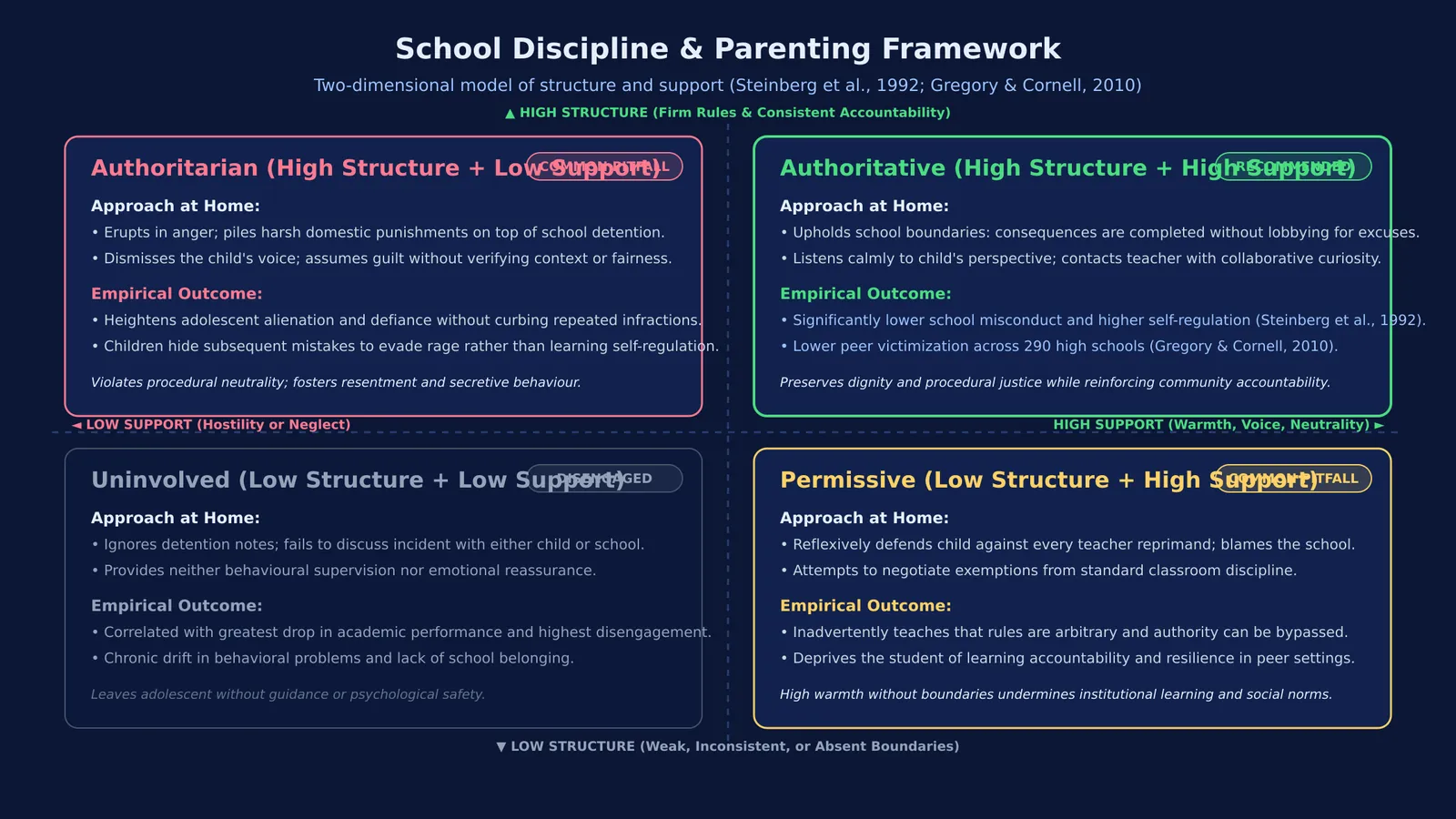
When parents defend their child against every teacher reprimand, they inadvertently teach that rules are negotiable and classroom authority is arbitrary. Conversely, when parents react with fury at home, children shut down. Mistakes get hidden, and the child focuses entirely on escaping punishment rather than examining their conduct.
Developmental psychology warns against purely punitive reactions. In a 1992 study published in *Child Development* (DOI: 10.1111/j.1467-8624.1992.tb01694.x), psychologist Laurence Steinberg and his colleagues surveyed approximately 6,400 high school students aged 14 to 18. They found that authoritative parenting—combining firm supervision and clear rules with emotional warmth and respect for autonomy—fostered higher psychosocial maturity and led to significantly lower school misconduct. Harsh, authoritarian discipline increased alienation without curbing repeat infractions. Adopting practical principles for talking about failure at home keeps the dialogue constructive instead of combative.
How should you hear both sides before reacting?
To guide a student through a disciplinary issue, parents need a full picture of what happened. Decades of research on procedural justice by legal scholar Tom R. Tyler, detailed in *Why People Obey the Law* (Princeton University Press), shows that individuals accept adverse decisions when four conditions are met: voice, neutrality, respectful treatment, and trustworthy motives.
You can put these principles into practice through two disciplined steps:
Hear your child's version without interrupting: Give your child space to describe the incident from start to finish. Ask open questions: "What was happening right before that?" and "What was the teacher asking the class to do?" Listening does not mean agreeing with excuses; it gives them voice and clarifies what occurred.
Contact the teacher with neutral curiosity: Reach out by email or diary note with an inquiry rather than an accusation. Frame your message around partnership: "I want to understand the full context of what occurred today so we can reinforce classroom expectations at home." Structuring your communication much like parent-teacher meeting questions keeps the focus on observable behaviour rather than defensive reactions.
How do you support the rule while ensuring fairness?
A healthy school environment relies on clear boundaries backed by personal support. In a study of 290 high schools and over 7,300 ninth-grade students published in the *Journal of Educational Psychology* (DOI: 10.1037/a0018562), Anne Gregory and Dewey Cornell showed that an authoritative school climate—defined by high structure alongside high student support—correlated with significantly lower peer victimization and disciplinary problems.
Supporting the rule means holding your child accountable to the shared standard:
If your child disrupted class, used a phone during study hours, or left assignments incomplete, do not lobby for an exemption. Completing the detention or extra assignment teaches that actions carry predictable consequences.
If the disciplinary action crossed legal or ethical boundaries, address that directly with school leadership.
Under Section 17 of the Right to Education Act and guidelines issued by the Central Board of Secondary Education (CBSE), schools must practice positive discipline. Penalties involving physical exertion, public ridicule, or collective classroom punishment are unlawful. If an incident compromised your child's dignity, request a private meeting with the principal. For students experiencing acute emotional distress, free support is available through the national Tele MANAS helpline (14416).
When disciplinary friction stems from academic frustration or falling behind in coursework, having a low-stress study space helps rebuild momentum. Fermi's AI tutor works out what a student already knows, builds a plan for the session, and teaches through challenging concepts at home without the anxiety of being judged.
What should you say to your child and the teacher?
Clear, calm scripts prevent disciplinary conversations from turning into household power struggles.
What to say to your child:
"I hear that you felt singled out, but the teacher needs the classroom orderly so everyone can learn."
"The consequence stands, and you will complete it responsibly. What can you do tomorrow to make things right with your teacher?"
What to say to the teacher:
"We discussed the incident with our child and reinforced the importance of following classroom rules."
"We want to make sure they stay focused. Please let us know if there are specific behaviours we should support from home."
Parenting through school discipline is not about choosing between your child and their school. By hearing both sides, supporting necessary boundaries, and insisting on fair treatment, you model the integrity and emotional poise you want your child to build. For older students, this approach aligns with staying involved in high school without hovering.


