

On this page
It is a jarring moment when a parent realises, "My child forged my signature on a test paper." You might feel a mix of betrayal, anger and confusion. Why would a child who is usually honest resort to faking a signature or concealing a low grade?
The instinctive reaction is often to punish the lie immediately. However, research in developmental psychology suggests that a forged signature is rarely a sign of bad character; it is almost always a coping mechanism. Understanding the root causes of academic anxiety and fear of failure is the first step toward rebuilding honest communication and ensuring it does not happen again.
Why did my child forge my signature on a test paper?
Children usually hide grades or forge signatures because they dread the consequences of failure. This fear may stem from anxiety over getting yelled at, losing privileges, or simply the heartbreak of disappointing their parents.
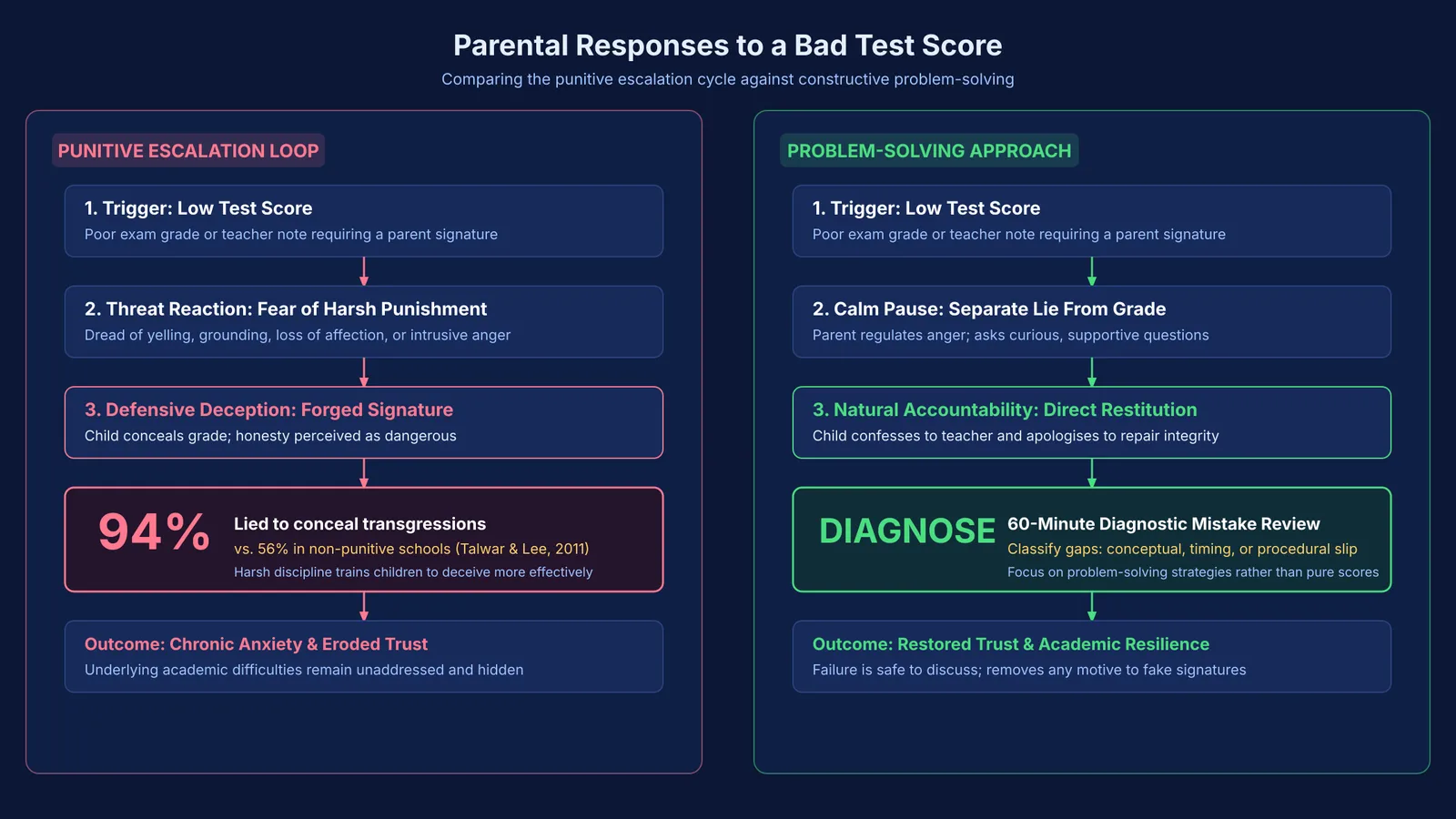
When children believe that affection or approval depends entirely on high academic performance, honesty feels dangerous. In a 2011 study published in *Child Development*, researchers Victoria Talwar and Kang Lee examined lie-telling behavior and found that children raised in punitive environments were significantly more likely to lie to conceal their transgressions. Specifically, 94% of children in a punitive school lied about a rule violation compared to 56% in a non-punitive school. Harsh penalties did not deter dishonesty; instead, they trained children to lie more effectively to protect themselves from punishment.
Academic pressure does not only come from harsh discipline; it also stems from well-intentioned parental hovering. A longitudinal study by researchers at the National University of Singapore found that children with intrusive parents—those who intervene excessively in school tasks to guarantee high marks—are more prone to developing self-critical perfectionism. When children internalise the belief that any mistake is catastrophic, admitting to a poor test score feels unbearable, making a forged signature feel like their only escape.
My child forged my signature on a test paper: how should I react?
If you have just discovered a forged signature on an exam sheet or school diary, your immediate reaction sets the foundation for whether your child will be honest with you in the future.
Pause before reacting: Avoid confronting your child in the heat of anger. Take time to regulate your emotions so you can approach the conversation calmly and constructively.
Separate the lie from the grade: Address the forgery firmly, but keep it distinct from the low mark. Clarify that while forging a signature is unacceptable, you care far more about why they felt unable to bring the test to you directly.
Ask open-ended questions: Replace accusatory questions like "Why did you lie to me?" with curious, supportive inquiries such as "What were you worried would happen if you showed me this mark?" This reframes the conversation from an interrogation into shared problem-solving.
What should the consequences be for forging a signature?
While empathy is essential, forging a parent's signature still requires a meaningful consequence. The goal is to restore trust and teach accountability, not to inflict punitive suffering.
Natural consequences: If your child forged your signature on a teacher's test slip, the natural restitution is for them to inform the teacher, take responsibility for the forgery, and apologise. Facing the situation directly teaches far greater accountability than arbitrary groundings.
Rebuilding trust through transparency: Explain that trust is earned back through consistent openness. For the next few weeks, establish a routine of reviewing school assignments, diaries, and portals together until honesty is re-established.
How to prevent lying about grades in the future?
Preventing future deception requires creating a home environment where mistakes are treated as normal parts of the learning process rather than personal catastrophes.
Praise the effort, not just the marks: Focusing exclusively on top scores teaches children that anything less is a failure. When you help children learn without pressure, you emphasise persistence, strategy, and improvement rather than fixating solely on test scores.
Avoid comparisons: Comparing a student to siblings or peers deepens feelings of inadequacy and resentment. In practice, sibling comparison regularly backfires, driving children toward secrecy to protect their self-worth.
Provide a safe way to learn: Often, children hide their work because they feel overwhelmed by difficult topics and do not know where to turn. When a student brings a topic, a problem set or a scanned assignment, Fermi's AI tutor works out what they already know, builds a plan for the session, and teaches through it—writing on a board, drawing figures and checking understanding as it goes.
Review mistakes together: Treat an unsatisfactory exam as diagnostic feedback rather than a final verdict. Sit down together for a structured 60-minute session to bounce back after a bad test. Categorise errors into conceptual gaps, procedural slips, or time pressure, and create a concrete study plan.
When children recognise that a poor score is a challenge to solve collaboratively rather than a trigger for punishment, the fear disappears—and with it, any temptation to forge a signature.


