

On this page
Your child finishes the homework, hands it in and stops. It is tempting to call this laziness and answer it with a talk about the future. Motivation research points somewhere else: start small, start with what they already care about, and let them do most of the talking.
What does it mean when a child does only the minimum?
Doing the minimum is a behaviour, not a cause, and the cause decides what helps. Common causes:
They don't see the point. The work feels like a list of tasks with no link to anything they care about.
Trying fully feels risky. Score 60 after doing the minimum and you can say you didn't try. Score 60 after your best and it feels like a verdict.
There is an old gap. A topic from two years ago never made sense, so everything built on it feels like guessing.
Their energy is going somewhere else. They may work very hard at cricket, drawing, coding or a game.
Notice where their effort goes when nobody is asking. Our guide on what to try first when your child loses interest in studies goes through the causes in more detail.
Tele MANAS is part of the National Tele Mental Health Programme, run by the Ministry of Health and Family Welfare.
Why don't lectures about marks and the future work?
The lecture usually goes: "Boards decide your stream, your stream decides your college, your college decides your life." For the children who most need convincing, it may do the opposite of what you intend.
Elizabeth Canning and Judith Harackiewicz ran three laboratory studies with undergraduates at a US university, in which students were either told why a mental maths technique was useful or wrote about its usefulness themselves (Motivation Science, 2015). In the first study, being told directly undermined performance and interest for those who lacked confidence, while self-generated reasons had positive effects. In the second, also writing their own examples removed that harm. In the third, less confident students benefited more when the examples given were about everyday life rather than careers and school. The paper's title sums it up: "Teach it, don't preach it."
These were university students in a lab, not children at home, so treat it as a hint, not a rule. But a speech about boards and careers is close to the kind of message that backfired. A child who already doubts themselves may hear pressure, not a reason. Our guide to autonomy-supportive parenting and real choices covers what to do instead of control.
How do you find one area your child cares about and build from it?
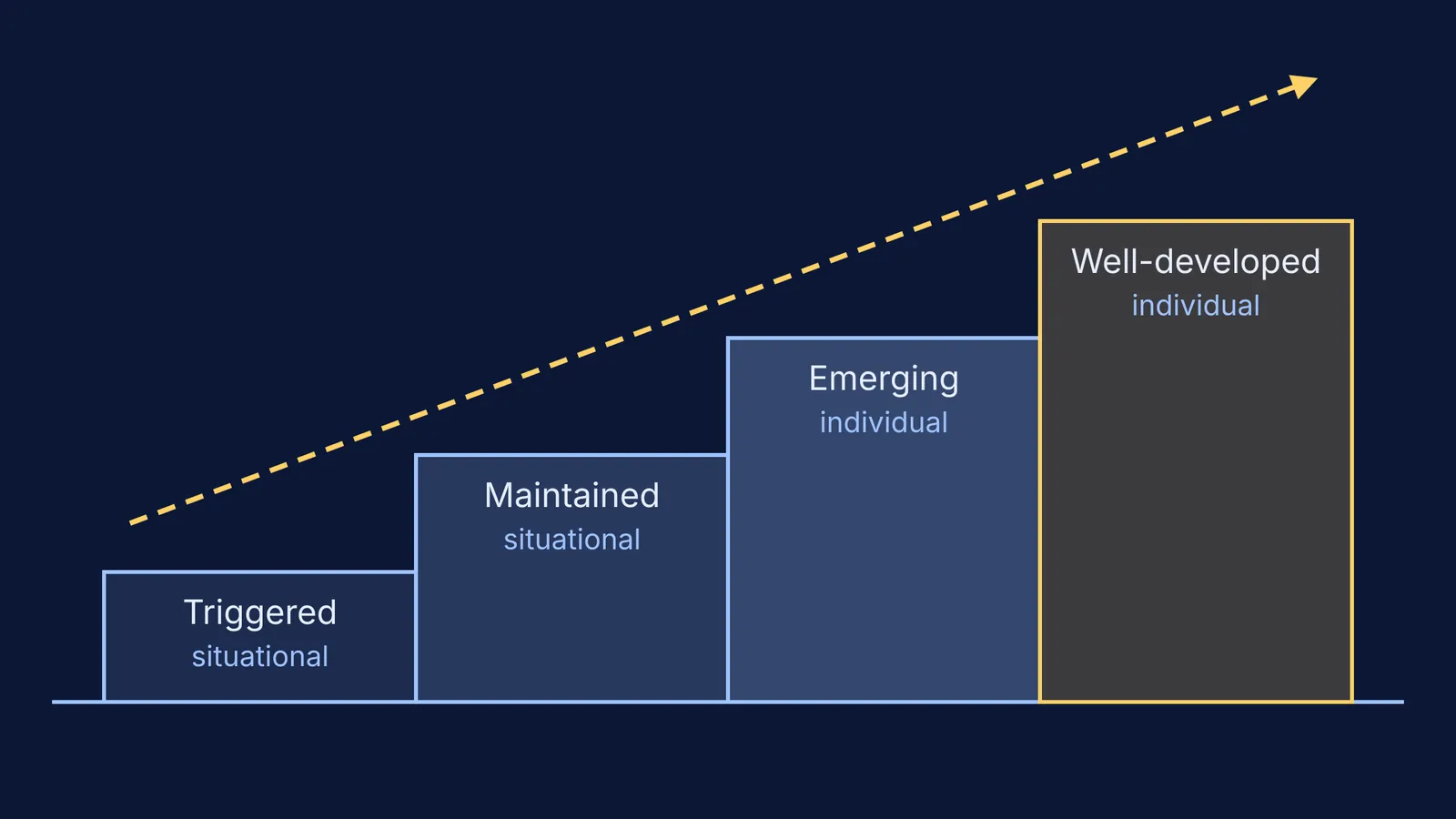
Psychologists Suzanne Hidi and K. Ann Renninger describe interest growing in four phases: triggered situational interest, maintained situational interest, emerging individual interest and well-developed individual interest (Educational Psychologist, 2006). Put simply: a spark, staying with it, coming back on your own, then caring deeply. You can't insist your way to the last phase. You can set up the first and protect the second.
Chris Hulleman and Judith Harackiewicz asked first-year high-school students to write either about what they had learned or about how it connected to their own lives (Science, 2009). Personal connections predicted interest in further science courses and careers better than good grades did, and the effect was largest for the least confident students.
Parents can help too. In a US field experiment by Judith Harackiewicz and colleagues, parents of high-school students received two brochures and a website about why maths and science courses are useful (Psychological Science, 2012). Their teenagers took, on average, nearly one semester more of science and maths in the last two years of high school than the control group.
A four-week plan, with what to say
Week 1: watch, don't comment. Note what they watch, argue about or build unprompted. Pick one thing.
Week 2: ask a real question about it. "How does the bowler make the ball swing?" Then listen. Don't turn the answer into a lesson.
Week 3: let them make the link. Ask, "Where does any of this show up at school?" Let them answer, even weakly. If they are stuck, offer an everyday example, not a career one.
Week 4: one small extra piece they choose. It might be a cricket statistics sheet for maths or a short video explaining swing for physics. Praise the process; our guide on praising effort rather than ability has the wording.
Worked example. Imagine a Class 9 student who does the minimum in physics but spends hours on bowling replays. In week 3 they say, "Swing is something to do with air and pressure, isn't it?" That is their connection, so build on it, not on board marks. If they would rather see an idea working than read about it, the Fermi Simulation Lab has interactive simulations for ideas that are easier to see than to read.
Expect one area to move first and the rest to follow slowly. Pick one thing this week and start with a question.


