

On this page
If your child keeps comparing their marks with friends, they are doing something almost everyone does. Don't ban comparison; give them a better yardstick: their own last score.
Why does my child keep comparing marks with friends?
In 1954 the social psychologist Leon Festinger proposed that people have a drive to evaluate their own opinions and abilities. He added that "to the extent that objective, non-social means are not available", they do it by comparing themselves with others (Festinger, Human Relations, 1954). The same paper adds a corollary: when an objective, non-social basis for judging an ability is readily available, people will not judge it by comparing themselves with others.
A mark of 31 out of 40 says little on its own, so your child looks around the classroom to judge it. Your job is to give them a yardstick that doesn't depend on the room.
Is comparing marks with classmates harmful?
Not always; a friend's score can show what is possible. But comparison has a cost, which research calls the big-fish-little-pond effect: students of similar ability tend to rate their own ability lower when their classmates are stronger. A 2018 meta-analysis pooled 33 studies, with more than 1.27 million students in total, and found this effect overall. It was strongest among high school students and in Asian samples (Fang and colleagues, Frontiers in Psychology, 2018). In a strong class or coaching batch, feeling "average" may say more about the group than the student.
The kind of feedback also matters. In a classic study of 200 fifth- and sixth-grade students, Ruth Butler gave each group either individual comments, numerical grades, standard praise or no feedback. Interest and performance were highest after comments. After grades and praise, students were most likely to explain their work in terms of ability rather than the task (Butler, Journal of Educational Psychology, 1987). At home, you can bring the focus back to the work. Our guide to praising the process instead of saying "you're so smart" has the words to use.
How do you make a personal progress chart?
A progress chart is one notebook page per subject, updated after every test, that answers "Am I doing well?" without a class list. Each entry has four parts:
Date and test, for example "Maths unit test 3: linear equations".
Marks, written as a fraction of the total so different tests can be compared.
Marks lost, sorted into three types: didn't know the idea, knew it but used the wrong method, or a careless slip.
One thing to do before the next test.
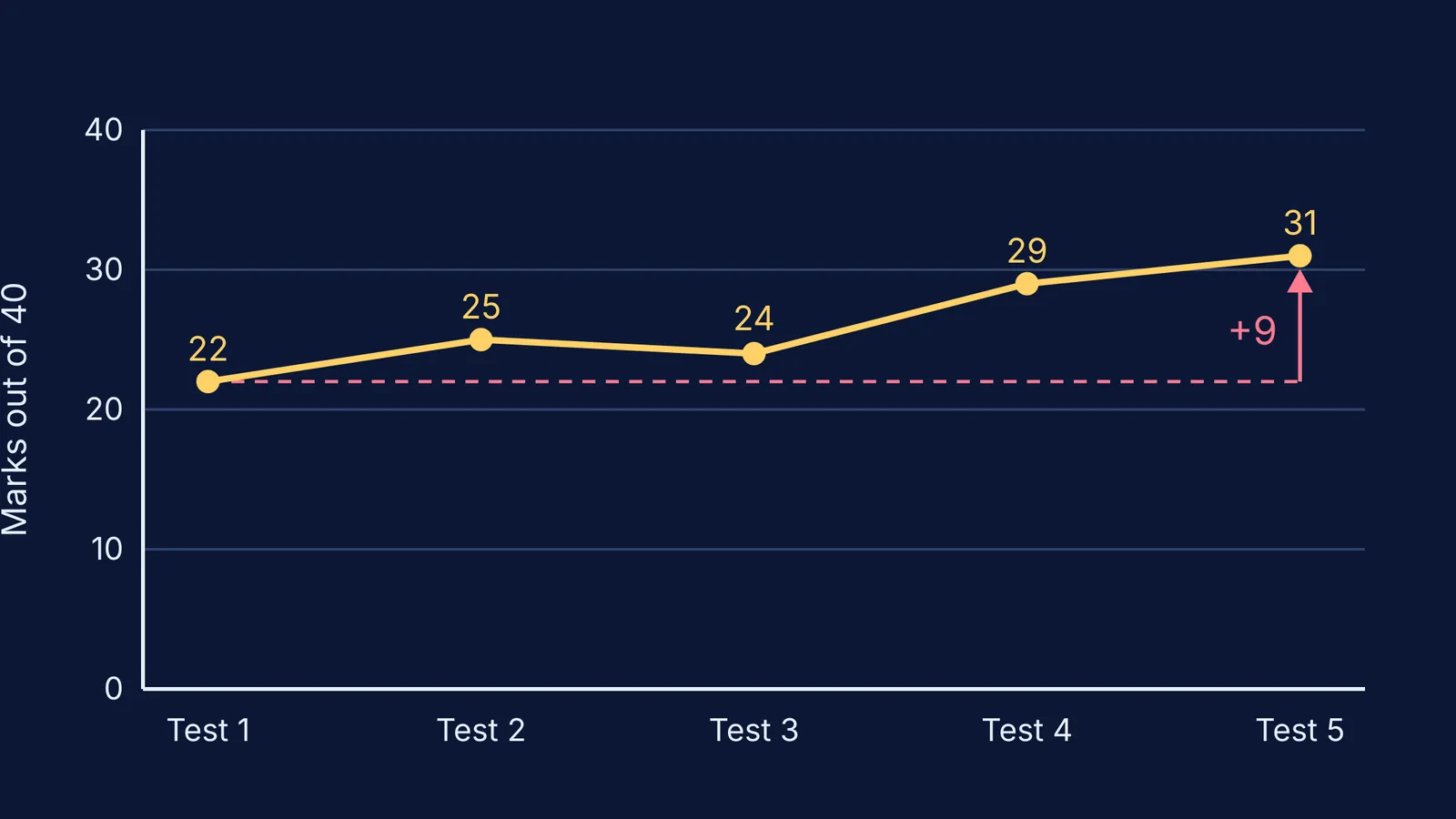
Here is a worked example with made-up numbers. Aarav, in Class 9, scores 22, 25, 24, 29 and 31 out of 40 in five maths unit tests. A friend got 36 in the last one, and that's all Aarav talks about. His chart shows he has gained 9 marks since test 1. The dip in test 3 came from careless slips in a single question. Marks lost to "didn't know the idea" fell from 10 in test 1 to 3 in test 5. His next step isn't "beat your friend" but "check the signs in the last line of every equation".
Sorting lost marks is what turns the chart into a plan. "Didn't know the idea" means going back to the chapter. The Fermi Concept Library gives every concept in physics, chemistry, biology and mathematics its own lesson, which helps with that kind of gap. "Wrong method" calls for working through solved problems step by step. Careless slips need a checking routine, not more hours. For the wider picture of school results, see how to read a report card beyond the marks.
What should I say when my child compares their marks?
Have your first sentence ready.
"She got 36 and I got 31." Try: "Okay. What did you get last time? What changed?"
"I'm the worst in my class." Try: "You're comparing yourself with a strong group. Let's look at your chart. Which kind of mistake is shrinking?"
"I beat him this time!" Try: "Well done. What did you do differently?"
Avoid "Why can't you be like her?", and avoid asking for friends' marks before you ask about your child's.
Talk about different strengths, too. One friend may be quick at mental maths, another good at explaining. Ask your child to name one strength of theirs that tests don't measure, and one a friend has that they'd like to learn. A rival becomes someone to learn from. If your teenager gets weekly coaching rank lists, our post on using rank lists without losing motivation applies the same idea.
When is comparison a sign of something more?
Talk to the class teacher or school counsellor if it comes with changes that last: trouble sleeping, avoiding school, hiding test papers, or harsh self-talk that doesn't ease. If you are worried about your child's mental health, Tele MANAS is a free 24x7 national helpline, set up by the Ministry of Health and Family Welfare, on 14416 or 1800-891-4416 (Tele MANAS details, IIT Kanpur counselling service).


