

On this page
A message or phone call from school reporting that your teenager was absent from their afternoon classes triggers immediate alarm. The natural parental instinct is anger: feeling deceived, worried about character, or panicked about exam eligibility. Yet an immediate confrontation rarely helps. Skipping classes—commonly called "bunking"—is seldom random defiance. In most cases, it is an avoidant coping mechanism driven by academic overwhelm, peer friction, or fear of failure.
Data from the Organisation for Economic Co-operation and Development (OECD) underscores how common this issue is. In the PISA 2022 Results (Volume II), an average of 31.3% of 15-year-old students across OECD countries reported skipping school or classes at least once in the two weeks prior to the assessment. Crucially, students skipping classes scored 28 points lower in mathematics than non-skipping peers. Spotting early disengagement—much like noticing when your child loses interest in studies—lets you intervene before occasional absences become chronic.
Why do teenagers bunk classes?
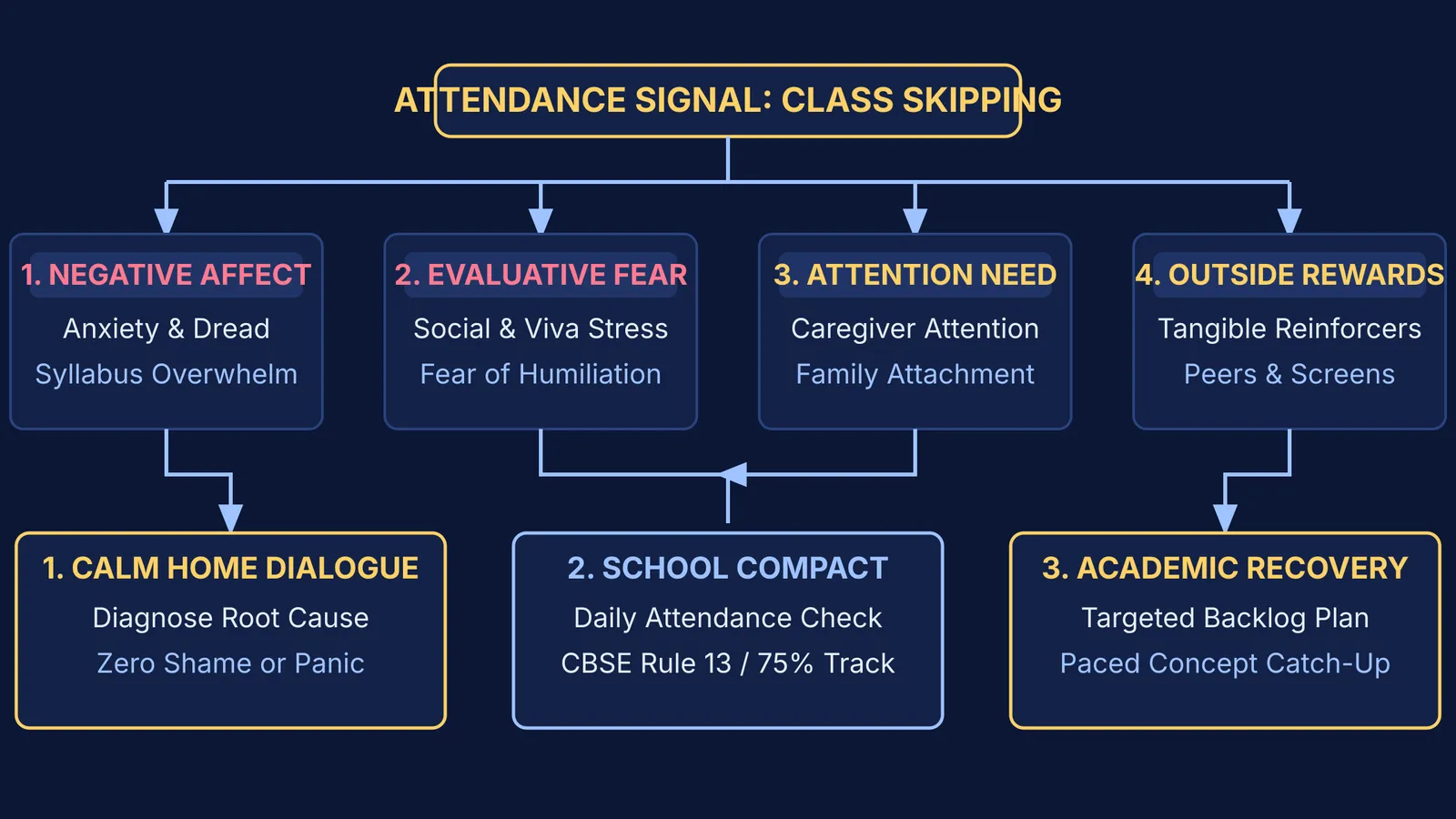
To resolve the issue, you must understand what purpose the absence serves. In a foundational study in the *Journal of Psychopathology and Behavioral Assessment*, psychologist Christopher A. Kearney demonstrated that school absenteeism falls into four functional categories (Kearney, 2002):
Avoiding negative affect (anxiety, dread, or somatic stomach aches).
Escaping evaluative situations (surprise tests, viva questions, or public failure).
Seeking caregiver attention.
Pursuing tangible outside rewards (gaming, cafes, or socializing).
In high school, evaluative fear and academic backlogs dominate. In a nationwide survey of 3,79,842 students across Classes 6 to 12 by the National Council of Educational Research and Training, 50% of students cited studies as their primary source of anxiety, rising to 54.9% at the secondary stage, while 31% cited examinations and results (NCERT Mental Health Survey, 2022). When a teen falls behind in challenging subjects, slipping out of class provides immediate relief from embarrassment.
How should you start the conversation at home?
Grounding your teenager or seizing devices in anger pushes the behavior underground. Instead, adopt a calm, diagnostic approach:
State observed facts: "The school noted you missed physics on Tuesday and Thursday. I am not here to shout; I want to understand what happened."
Separate the action from the teen: Reaffirm your trust while establishing that unexcused absences must stop.
Identify the trigger: Ask what occurred during those periods—an unfinished assignment, test anxiety, or difficulty following the teacher.
As detailed in our guide on talking to your teenager about marks without a fight, keeping parental reactivity low helps teenagers admit where they feel stuck rather than fabricating alibis.
What should you agree on with the school?
Class skipping also carries serious board exam implications. Under Rules 13 and 14 of the Examination Bye-Laws of the Central Board of Secondary Education, students in Classes 10 and 12 must maintain at least 75% attendance to sit for board examinations. The Board permits condonation of shortages up to 15% strictly for documented medical emergencies or bereavement; unexcused class skipping is ineligible.
Meet the class teacher and school counselor to create a practical compact:
Immediate period-level alerts: Ask the school to notify you of unexcused absences the same day rather than at term end.
A supportive return: Request that teachers avoid humiliating the student in front of classmates upon return.
Targeted questions: Bring structured talking points, using strategies from our guide on parent-teacher meeting questions that lead to real follow-up.
How do you help them catch up on missed coursework?
Skipping classes creates compounding debt: missing foundational lectures makes subsequent lessons incomprehensible, prompting further avoidance. Break this cycle with a tangible recovery plan. Map the missed chapters on paper and schedule 30-minute daily review sessions. For students who hesitate to ask questions in large classrooms, Fermi's AI tutor works out what a student already knows, notices where they are stuck, and builds a plan for the session. To rebuild foundational clarity, the Fermi Concept Library covers every concept in physics, chemistry, biology, mathematics and computing, each with its own lesson and its place in the map.
By combining non-punitive home conversations, school coordination, and structured academic catch-up, you replace an avoidant spiral with genuine competence and steady school attendance.


