On this page
When children see a toy or a snack they want, it is natural to ask for it. For parents managing a tight budget, the quickest response is often, "We can't afford it." While this feels like an honest and simple boundary, child psychologists suggest that this specific phrase can have unintended consequences on a child's relationship with money.
Talking about financial limits does not have to be a source of guilt or worry. By shifting the conversation from a lack of money to how the family chooses to use it, parents can teach valuable lessons about planning, goal-setting, and delayed gratification.
Why does "we can't afford it" cause worry?
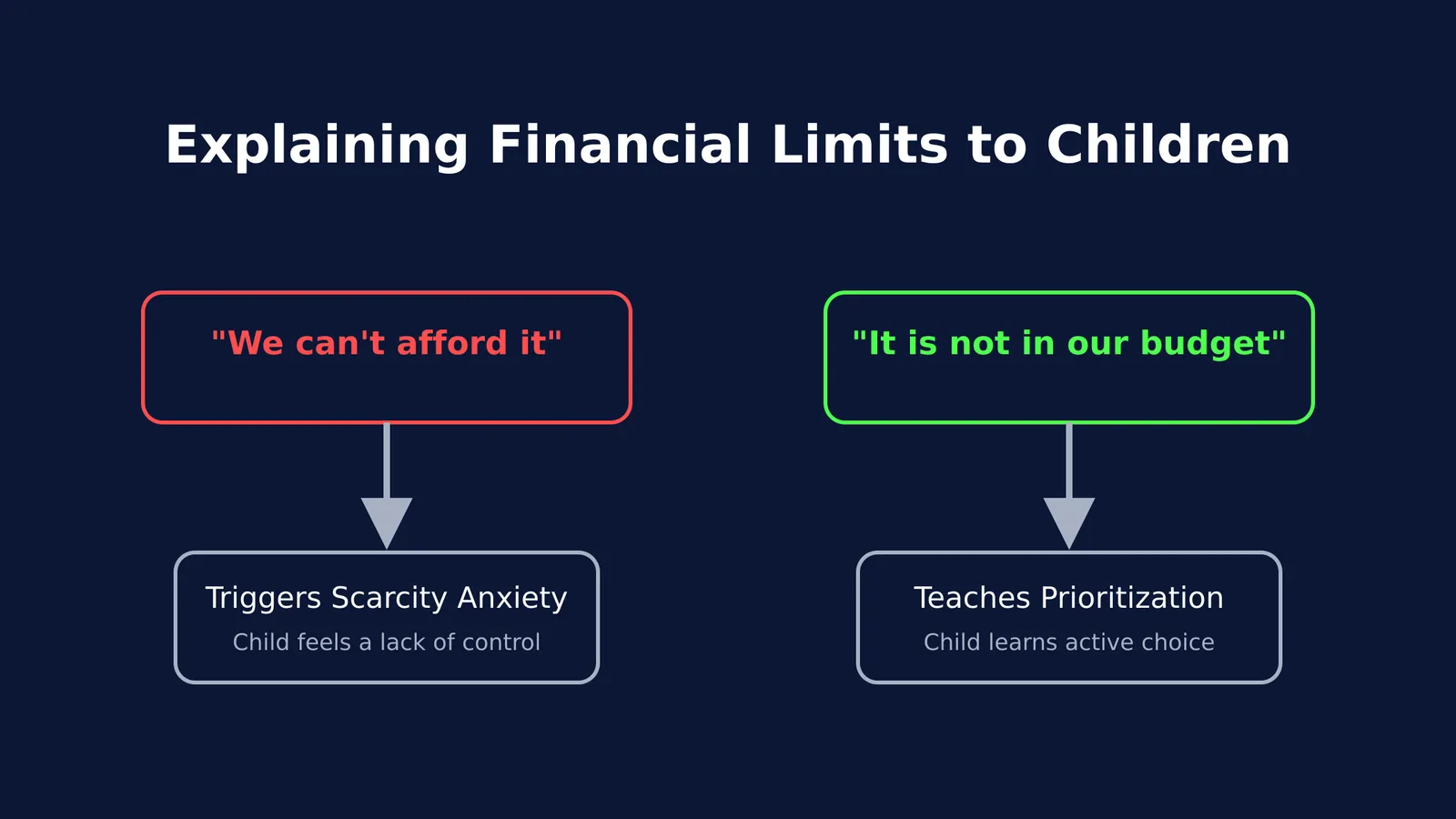
Children, especially young ones, interpret language literally. When they hear "we can't afford it," they often do not understand that you mean "we cannot afford this specific luxury item right now." Instead, they may generalize the statement to mean the family is running out of money for necessities like food or housing. This can lead to a phenomenon psychologists call scarcity anxiety, where children feel their basic security is threatened.
Parents often underestimate how much financial tension their children absorb. A 2010 American Psychological Association survey found that 69% of parents believe their stress has little to no impact on their children, yet only 14% of children say their parents' stress doesn't bother them. Hiding the reality of a budget is not the goal, but framing it as a crisis can leave children feeling powerless.
Furthermore, when you use "we can't afford it" as an excuse for an item you simply do not want to buy, older children will eventually notice the discrepancy. They may see you purchase something else later that week and feel you were dishonest, which can break down trust and confuse their understanding of how money works.
What should you say instead?
The goal is to move the conversation from what you cannot do to what you actively choose to do. This teaches children that money is a tool managed by active decisions rather than an external force that controls the family. Here is a script you can use to reframe common financial boundaries:
Instead of "We can't afford that," say "That is not in our budget this week."
Instead of "I am not made of money," say "We are choosing to save our money for our family trip next month."
Instead of "Stop asking, we are broke," say "We work hard for our money, so we have to plan carefully how we spend it."
Instead of "Maybe next time" (when you mean no), say "No, we already have something similar at home."
By giving a clear, logical reason based on priorities, you validate their desire without creating anxiety. This approach also normalizes the idea of a budget as a positive framework. You can build on this by introducing related skills, such as Teaching your child to plan their time, one step at a time or engaging in Maths talk with young children: everyday number conversations.
How early should you start talking about money?
Parents often delay financial conversations, assuming children are too young to grasp the concepts. However, the foundations of financial literacy are built much earlier than we think.
By early elementary age, children can understand that money is a finite resource exchanged for goods, and they can practice the self-control needed to delay gratification. You can encourage this by using a clear jar for saving, allowing them to see their small funds grow over time. When they want a new item, help them check their jar to see if they have enough, making the choice theirs.
As children grow and their educational needs become more complex, the same principles of mindful spending and resource allocation apply. If a student brings a topic, a course, a problem set or a scanned assignment, Fermi's AI tutor works out what they already know and builds a plan for the session. Open conversations about how you evaluate and choose educational tools help model thoughtful decision-making for your teenagers.
Whether you are discussing the price of a toy or Talking about failure at home: how parents model learning, honesty and clarity remain your best tools. A budget is not a restriction, but a plan that helps the whole family reach its goals together.