

On this page
Every day, children ask brilliant, simple questions that contain the seeds of a whole university course. "Why are leaves green?" is a classic. It is an invitation to talk about light, chemistry, and how life on Earth sustains itself.
Instead of answering from across the kitchen, taking the conversation outside turns a quick fact into a memorable lesson. Walking in a park and looking closely at leaves helps a child understand the physical world in front of them, and science shows that this kind of active learning changes how well they pay attention when they sit back down to study.
How do you explain to a child why leaves are green?
Start with the sunlight. The light from the Sun looks white, but it is actually a mixture of all the colours of the rainbow. When this light hits a leaf, the leaf does not absorb all of it.
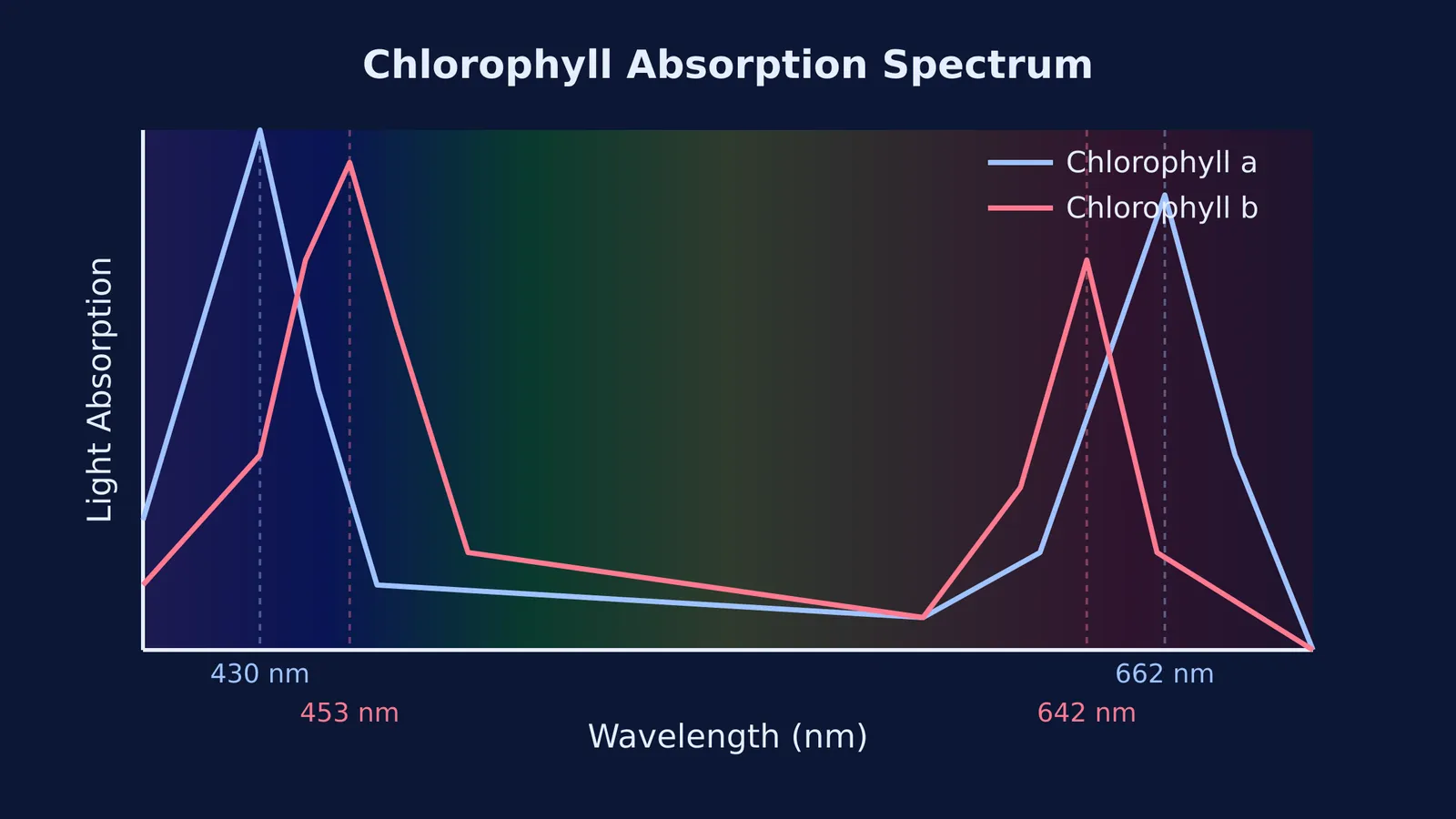
Leaves look green because they are full of a chemical called chlorophyll, which is a poor absorber of green and near-green wavelengths of light. Instead of soaking the green light up, the leaf reflects it back out into the world. Because that reflected light is what reaches our eyes, the leaf looks green to us.
If your child asks what happens to the rest of the light, you can explain that the leaf keeps it. Chlorophyll absorbs light most strongly in the blue and red portions of the spectrum. Specifically, chlorophyll *a* has its peak absorption around 430 nanometres (blue) and 662 nanometres (red).
Why do plants need to absorb light?
Plants cannot walk to a shop to buy dinner, so they have to build their own food using a process called photosynthesis.
Chlorophyll acts as an antenna to catch the energy in sunlight. Inside the plant's cells, this energy triggers a charge separation that splits water molecules, producing oxygen and powering the creation of ATP and NADPH, the stored chemical energy that converts carbon dioxide into sugars. Without this process, plants could not grow, and animals would have nothing to eat.
If your child is learning this for school and wants to see how the molecules break apart, the Fermi Simulation Lab provides interactive simulations for the ideas that are easier to see than to read. Later, as they cover topics like Robert Hill and oxygen released by isolated chloroplasts, they can use Fermi's AI tutor to work through the chemistry. The tutor teaches—it holds a line of reasoning across a whole session, notices where a student is stuck, and decides whether to explain, ask, or show.
Does outdoor learning help children understand science?
Taking the time to explain these concepts outside does more than just answer a question; it primes a child's brain for deeper study.
A 2018 study published in *Frontiers in Psychology* tested whether lessons in nature boost subsequent classroom engagement. The researchers found that normally, a teacher must redirect students' attention roughly once every 3.5 minutes of instruction. After a lesson in nature, teachers are able to teach for 6.5 minutes on average without interruption. The outdoor setting acts as a reset for their focus, making the transition back to desk work much smoother.
A leaf-collecting walk to compare colours
To make the science stick, you can build a short, practical activity into your next walk. Give your child a bag or a notebook and ask them to collect different examples of leaves.
Find the darkest green leaf: This leaf is packed with chlorophyll and is working hard to absorb red and blue light.
Find a yellowing leaf: As leaves get older or the seasons change, the tree stops making chlorophyll. The green pigment fades away, revealing the yellow and orange pigments that were hiding underneath all along.
Look at where they grow: Ask your child to notice if leaves in the bright sun look different from those hidden in the shade. (This is a great segue into Limiting factors in photosynthesis: Blackman's law and CO₂).
When they return home with their collection, they will have a physical reminder of the science they just learned. If they want to map out where photosynthesis fits into the rest of biology, the Fermi Concept Library contains every concept in physics, chemistry, biology, mathematics and computing, each with its own lesson and its place in the map.


