On this page
Your child adds 27 + 15 and writes 312, or subtracts 52 − 14 and gets 42. These slips show that "carry the 1" and "borrow from next door" have become rules with no picture behind them. The fix is to put the picture back: bundles of ten your child can tie and untie, with each move written down straight away.
Why does my child get confused with carrying and borrowing?
It is common, not a sign your child is slow. In the ASER 2024 national findings, 33.7% of Class 3 children in rural India could at least do a numerical subtraction problem. That task is a two-digit subtraction with borrowing, such as 52 − 14, set at the Class 2 level.
Wrong answers often follow a rule the child believes. In 1978, John Seely Brown and Richard Burton modelled these consistent wrong procedures as "bugs" in basic arithmetic and used their system to diagnose 1,300 school students. In 52 − 14 = 42, the child took the smaller digit from the bigger one (4 − 2 = 2) because "you can't take 4 from 2". That bug tells you what to teach.
What do carrying and borrowing actually mean?
Both describe one fact: ten ones make one ten.
Carrying means that when a column adds up to ten or more, ten ones are bundled into one ten and moved to the tens column. The small 1 you write is a whole ten.
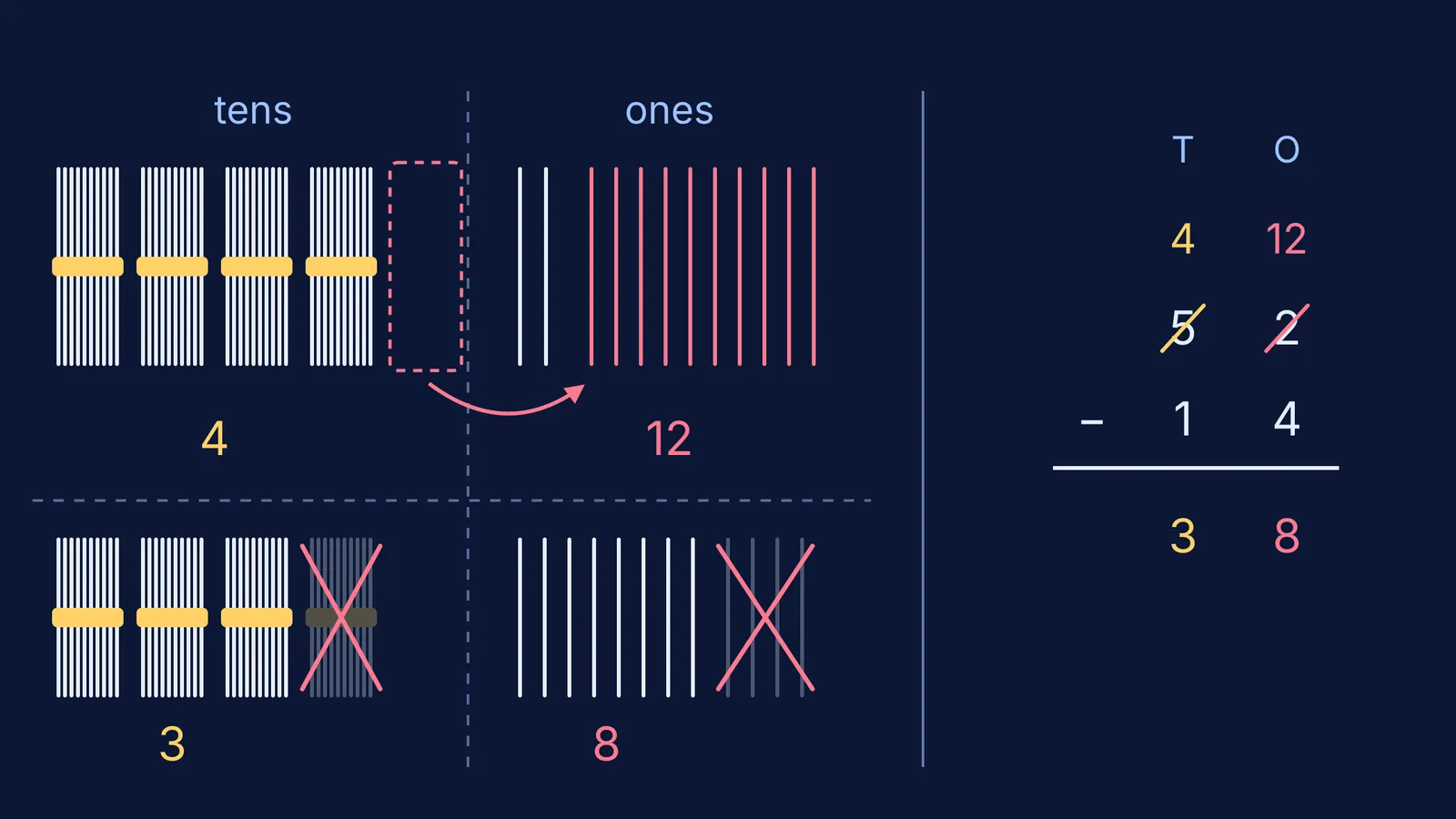
Borrowing means that when the top digit is too small, one ten is untied into ten ones. The tens digit goes down by one and the ones digit goes up by ten.
Many teachers call both "regrouping", which is a clearer name because nothing is ever given back.
How do you teach it with sticks and coins?
You need about 60 ice-cream sticks or matchsticks and some rubber bands. Coins work too: swapping one ₹10 coin for ten ₹1 coins is borrowing.
Worked example: 52 − 14.
Build 52: five bundles of ten and two loose sticks. Write 52 on paper.
Ask: "We need to take away 4 loose sticks. Do we have 4?"
Untie one bundle: now 4 bundles and 12 loose sticks. On paper, cross out the 5 and write 4; cross out the 2 and write 12.
Take away 4 loose sticks: 8 left. Write 8.
Take away 1 bundle: 3 left. Write 3. The answer is 38.
For 27 + 15, the 7 + 5 loose sticks make 12, so tie ten into a new bundle, put it with the tens and write the small 1 above the tens column.
How do you move from sticks to the written method?
Go slowly rather than dropping the objects. In a teaching approach studied by Karen Fuson and Diane Briars, first and second graders worked with base-ten blocks and recorded each step in numerals immediately; children moved to bigger problems once they could do smaller ones without the blocks. In their second study, most second graders in 42 classes (783 children) learned at least four-digit addition.
A systematic review by Emily Fyfe and colleagues calls this "concreteness fading": beginning with concrete materials and then explicitly and gradually fading to the more abstract. A meta-analysis of 55 studies found small to moderate benefits for manipulatives over abstract symbols alone, with results depending partly on how they were taught.
A four-stage plan for home, in short sessions; stay on each stage as long as your child needs:
Sticks and paper. Your child moves the sticks; you write. Then swap.
Drawings. A line is a ten, a dot is a one. Untying means crossing out a line and drawing ten dots.
Digits, said aloud. Column method only, but your child says "I untie one ten, so 4 tens and 12 ones".
Mixed practice. Mix sums that need regrouping with ones that don't, so your child decides each time.
If a slip comes back, return to the previous stage for a day.
What should I say when my child makes a slip?
Ask questions that point at the bundles, not the rule:
"What does this small 1 stand for? Show me with the sticks."
"Can the top number give away 4 ones? What could we untie?"
"52 take away 10 is 42, and we took 4 more. Can the answer still be 42?"
Keep your voice calm. Our guide to what helps when your child says they're bad at maths covers that conversation, and everyday maths talk with young children has ideas for counting in tens at the market or in the kitchen.
If slips continue for months even with sticks, talk to the class teacher and read our explainer on signs of dyscalculia and how assessment works.
For older children who still slip in long multi-step sums, the Fermi Problem Library has worked problems with a step-by-step solver that explains the reasoning rather than printing an answer.
Tonight, find 60 sticks and a few rubber bands, and try 52 − 14 together.