

On this page
The moment Class 10 results are out, the first question families ask is: "What is your percentage?" But if you look at a modern CBSE or ICSE marksheet, you will not find an overall percentage or a division printed anywhere. Instead, you only see your grades and marks for individual subjects.
Because the boards do not declare an official aggregate, the school or college admitting you for Class 11 decides how to calculate your final score. Most institutions use a "best-of-five" rule. This helps students by dropping their weakest subject, but the exact calculation depends on which board you took.
How is CBSE Class 10 percentage calculated?
The Central Board of Secondary Education (CBSE) does not calculate, declare, or inform the overall percentage on its marksheets, a policy it formally clarified for all institutions (CBSE, 2023).
When you apply for higher education, the admitting school will calculate your percentage using the best five subjects. The standard method used by most institutions is:
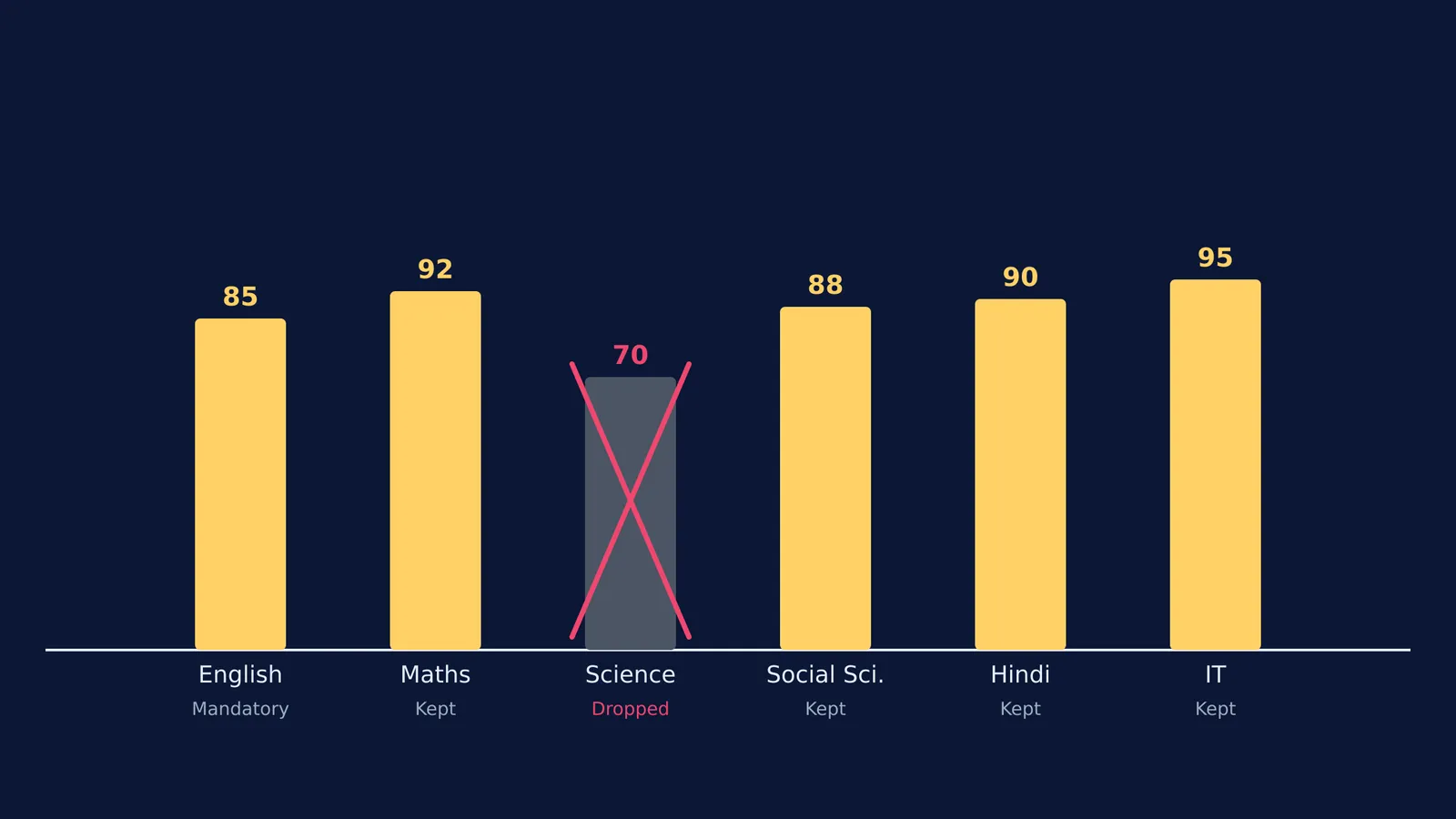
Keep English: Your score in English (or your primary language) is mandatory.
Pick the best four: Look at your remaining subjects (Mathematics, Science, Social Science, Hindi, and any skill subject like Information Technology) and choose the four where you scored the highest.
Calculate: Add these five marks together, divide the sum by 500, and multiply by 100.
If your child struggles with one of the core electives—for example, if their weakest subject is science—a sixth skill subject acts as a safety net. If they score higher in Information Technology than in Science, the school will drop the Science score and include the IT score in their best five. If a student is finding the core concepts difficult, the Fermi Concept Library has every concept in physics, chemistry, biology, mathematics and computing, each with its own lesson and its place in the map.
How is ICSE Class 10 percentage calculated?
The Council for the Indian School Certificate Examinations (CISCE) also uses a best-of-five system, but it groups papers differently (CISCE). Before you can pick your best subjects, you must average the papers that make up a single subject group.
English (Compulsory): The average of English Language and English Literature.
Science: The average of Physics, Chemistry, and Biology.
Social Science: The average of History/Civics and Geography.
Mathematics: Counted as a single subject.
To find your percentage, you must include your English average. Then, pick the highest four scores from your remaining subject groups (including your second language and your Group III elective, such as Computer Applications). Add these five scores together and divide by 500.
Because science is an average of three separate papers, a weak physics score can be balanced by strong biology and chemistry marks.
How do state boards calculate percentage?
State board rules vary widely, and many do not use a best-of-five rule at all.
Maharashtra (SSC): Uses a pure best-of-five rule. The percentage is calculated using the top 5 scoring subjects out of the 6 subjects you appeared for, without making English mandatory (Maharashtra State Board).
If you are currently choosing a school board for your child, these calculation rules are worth considering. A board with a best-of-five rule and a skill subject option gives students a buffer if they find one specific subject exceptionally difficult.
A practical checklist for checking your percentage
When filling out admission forms, do not just write down the highest possible combination of your marks. Follow this routine to ensure your application is not rejected:
Read the college criteria: Some science streams explicitly require you to include your Science and Mathematics scores in the calculation, even if they are not in your "best five".
Include the language: Ensure English (or the language specified by the college) is always part of your total.
Keep the safety net: If you took a sixth subject, calculate your percentage with and without it to see which combination yields the highest valid score.
The pressure to score perfectly in every single subject can cause severe burnout, but understanding the best-of-five rule helps families realise that one weak paper will not ruin a student's academic future.
For more on handling this period, read our guide to exam season at home.


