

On this page
A bowl of soapy water is a cheap way to do real science with a child at home. In one afternoon you can make a mix, test wands, and learn to read a bubble's colours to see when it is about to pop. Along the way your child runs their first fair test: change one thing, keep everything else the same, and count.
This works for a curious six-year-old and a Class 9 student alike. Younger children notice and guess. Older ones measure, repeat and write it down.
How do you make bubble mix at home?
The Exploratorium, the San Francisco science museum, gives a simple bubble solution formula: 2/3 cup of dishwashing liquid, 1 gallon of water and 2 to 3 tablespoons of glycerine. A gallon is about 3.8 litres, so for a 1-litre jug use roughly 40 ml of dishwashing liquid and half to three-quarters of a tablespoon of glycerine.
The same page says to stir gently and to leave the mix in an open container overnight; the solution "seems to get better with age". It also warns that if you use a different soap, you will have to experiment with the rest of the formula. That warning is your first experiment.
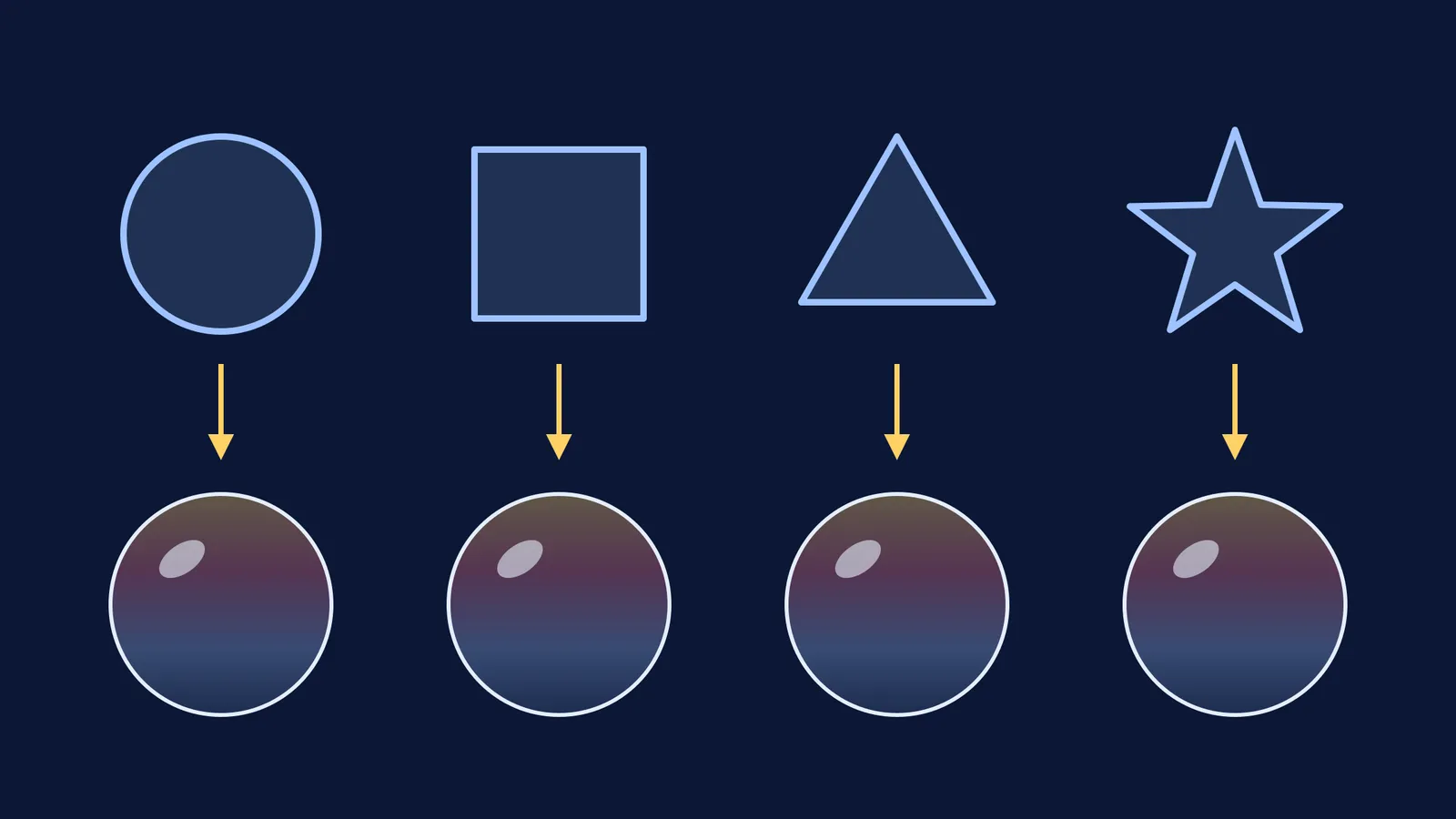
For wands, bend pipe cleaners or soft wire into a circle, a square, a triangle and a star. Make them all about the same size.
Why are bubbles always round, even from a square wand?
Ask your child to guess first: will the square wand make a square bubble? Then blow one and watch.
While the film sits in the wand it takes the wand's flat shape. Once the bubble floats free, it becomes round. Surface tension is the pull at the surface of a liquid that makes the surface shrink, and a sphere is the shape with the smallest surface area for its volume, as the University of New South Wales physics notes on soap bubbles explain. The same page notes that soap lowers the surface tension of water, which is why bubbles are easy to make in soapy water but do not last in plain water.
The Exploratorium calls bubbles "minimal surface structures". Its tray-and-straw activity shows that when bubbles touch, they stop being round. For the physics behind this, our explainer on surface tension and viscosity goes further, and the story of Agnes Pockels, who measured surface films in her kitchen, shows how far home experiments can go.
Why do bubbles change colour and then pop?
The swirling colours come from light. A soap film is 5 to 5,000 nanometres thick, about the same size as the wavelengths of visible light (380 to 760 nanometres), according to Experimentarium, the Danish science centre. Light bounces off both the outer and inner surfaces of the film, and the two reflections add up or cancel depending on the thickness. Gravity drains water downwards, so the top gets thinner and the colours settle into bands.
The Exploratorium's page on bubble colours gives the order to watch for as a film thins: first yellow cancels, leaving blue; then green, leaving magenta; then blue, leaving yellow. Finally the top goes black, which means the film is only about one millionth of an inch thick and will soon pop.
That is one reason recipes add glycerine. Physicists at the University of Lille kept a bubble made of water, glycerol and tiny plastic particles intact for 465 days, NBC News reported on their paper in Physical Review Fluids. The team think the glycerol takes in water from the air, making up for evaporation, while the particles stop the water draining away.
How do you turn bubbles into a fair test?
A fair test changes one thing and keeps the rest the same. The Science News Explores bubble experiment works this way: every mix gets the same amount of detergent, only the additive changes, the wands are bent to the same diameter, and each bubble is timed with a stopwatch, over as many tries as possible.
Here is a plan for a 40-minute session:
Question: does glycerine make bubbles last longer?
Make two cups of mix from the same jug, then add glycerine to one cup only. Label them A and B.
Keep the same: wand, how hard you blow, the room, and who holds the stopwatch.
Catch each bubble on a wet plate so it sits still, and time it until it pops.
Do 10 tries for each cup, taking turns: A, B, A, B.
Write the times in two columns, cross out the shortest and longest, and compare what is left.
When a result surprises you, ask: "What else changed between those two tries?" If your child spots that the fan was on for cup B, they have found what scientists call an uncontrolled variable.
Our post on kitchen science experiments has more ideas in the same spirit. For an older child who wants to keep exploring, the Fermi Simulation Lab has interactive simulations for ideas that are easier to see than to read.


