On this page
Many children can recite "length times breadth" but cannot tell you whether fairy lights along the bedroom walls are an area job or a perimeter job. A floor plan of a real room settles that: the two ideas become things your child can walk along and stand on.
Why do children mix up area and perimeter?
A 2021 study in the Athens Journal of Education by Demet Deniz Yilmaz and Betül Küçük Demir notes that perimeter and area are confusing because their formulae are taught almost at the same time, and that this confuses teachers as well as students. The researchers, who interviewed 10 serving and 10 trainee maths teachers, concluded that concrete materials or real-life examples should come before the formulae.
The most stubborn error is assuming the two move together. In a study in the Journal on Mathematics Education, Wanty Widjaja and Colleen Vale gave 82 students in Years 4 to 6 in Victoria, Australia, the claim that a rectangle with a larger perimeter will always have a larger area. The students found many examples that seemed to support it but struggled to find a counterexample that broke it.
A measured room gives your child both: a real-life example, and a counterexample they build themselves.
How do you do an area and perimeter project at home?
You need a measuring tape, squared paper, a pencil, a ruler, scissors and some coloured paper.
Choose a room with a few large pieces of furniture, such as a bedroom.
Sketch the room roughly, then measure. Your child writes each wall length and the door width on the sketch.
Add up the walls. That total is the perimeter: the distance you would walk if you traced the edge of the floor.
Pick a scale. On 1 cm squared paper, 1 cm for every 50 cm of room fits most bedrooms on one page, so each metre becomes 2 cm.
Draw the room. Each 1 cm square now stands for a patch of floor 50 cm by 50 cm, so four squares make one square metre. Ask your child to count them; this is usually where area clicks.
Measure each piece of furniture from above (length and width only), draw it at the same scale on coloured paper and cut it out.
Arrange. The rules: the door and cupboard must open, and there must be a clear path from the door to the bed. Try a few layouts and count the free squares each time.
What does the maths look like for a real room?
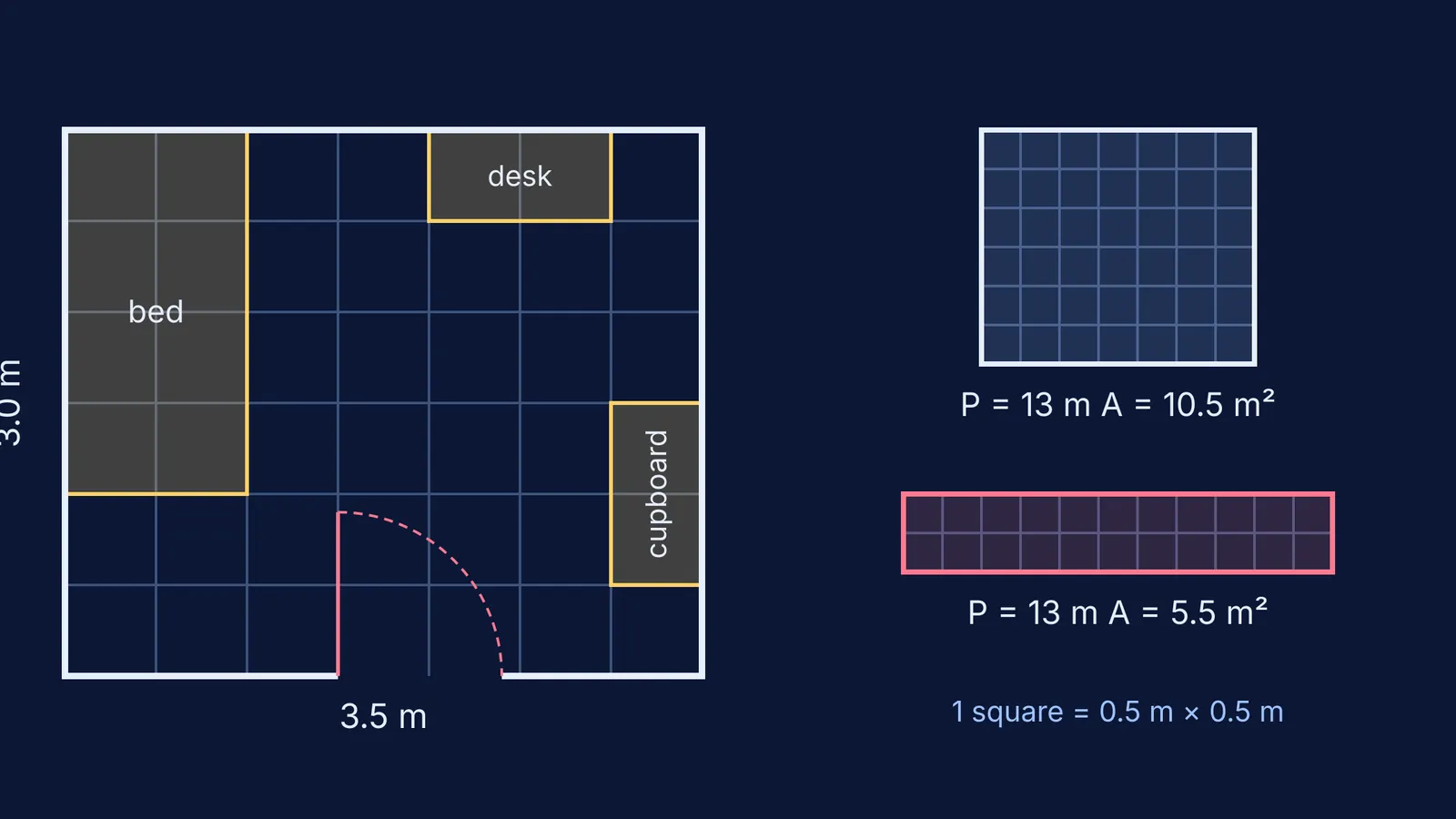
Here is the room in the diagram above, a bedroom 3.5 m long and 3.0 m wide.
Perimeter: 3.5 + 3.0 + 3.5 + 3.0 = 13 m. Fairy lights along every wall except a 0.9 m door would need 12.1 m.
Area: 3.5 × 3.0 = 10.5 square metres. On the plan that is 7 squares by 6, so 42 squares of a quarter square metre each.
Bed, 2.0 m by 1.0 m: 2 square metres, or 8 squares.
Desk and cupboard, each 1.0 m by 0.5 m: half a square metre, or 2 squares each.
Furniture covers 12 squares, so 30 of the 42 squares are free floor.
Then ask a shape question: would a 2 m by 1.5 m rug fit without going under the bed? Your child has to look at where the free squares are, not only how many.
How do you show that a bigger perimeter does not mean a bigger area?
This is the kind of counterexample the Australian students found hard to come up with. Ask your child to draw a corridor 5.5 m long and 1 m wide at the same scale, which is a strip 11 cm by 2 cm.
Its perimeter is 5.5 + 1 + 5.5 + 1 = 13 m, the same as the bedroom. Its area is 5.5 square metres, or 22 squares, against the bedroom's 42. Same walk around, about half the floor.
For a hands-on version, cut a string 26 cm long (13 m at your scale) and lay it out as different rectangles. Long thin shapes hold few squares; shapes closer to a square hold more.
What should you say while you work?
Ask short questions and wait for an answer before helping:
"If we put lights along the walls, are we measuring around or across?"
"How many squares will the bed cover? How do you know without counting them all?"
"Do you think a longer room always has more floor? How could we check?"
If you are rusty yourself, see helping with maths you have forgotten. For younger children, everyday maths talk at home builds the same habits. For Class 6, our perimeter and area chapter guide covers what the textbook asks.
If area and perimeter still blur together after the project, the Fermi Concept Library has a lesson for each mathematics concept, so your child can revisit the idea on their own.
This weekend, pick the room and find the tape.