

On this page
Since 2020, following the National Medical Commission Act, the separate entrance exams for the All India Institute of Medical Sciences (AIIMS) and Jawaharlal Institute of Postgraduate Medical Education and Research (JIPMER) were officially abolished. Today, admission to every AIIMS and JIPMER campus across India runs exclusively through the NEET-UG examination.
For parents, understanding this unified pathway is crucial. It simplifies the application process—students no longer have to juggle different syllabi, exam dates, or testing formats—but it also significantly intensifies the competition for the top ranks.
How does the unified admission process work?
Under the current system, students only need to prepare for and sit for NEET-UG. There are no separate forms or syllabus variations for AIIMS or JIPMER. Once the National Testing Agency (NTA) declares the NEET results, students must register for the Medical Counselling Committee (MCC) single-window counselling using their NEET roll number.
Unlike state medical colleges, which divide their seats into a 15% All India Quota and an 85% State Quota, all seats in AIIMS (approximately 2,044 seats across 20 functional institutes) and JIPMER (243 seats across its Puducherry and Karaikal campuses) are filled under the 100% All India Quota. This means students from any state can compete for these seats purely on the basis of their NEET rank, without domicile restrictions. The only exception is JIPMER, which maintains a specific internal quota for Puducherry residents.
What are the NEET closing ranks for AIIMS New Delhi and JIPMER?
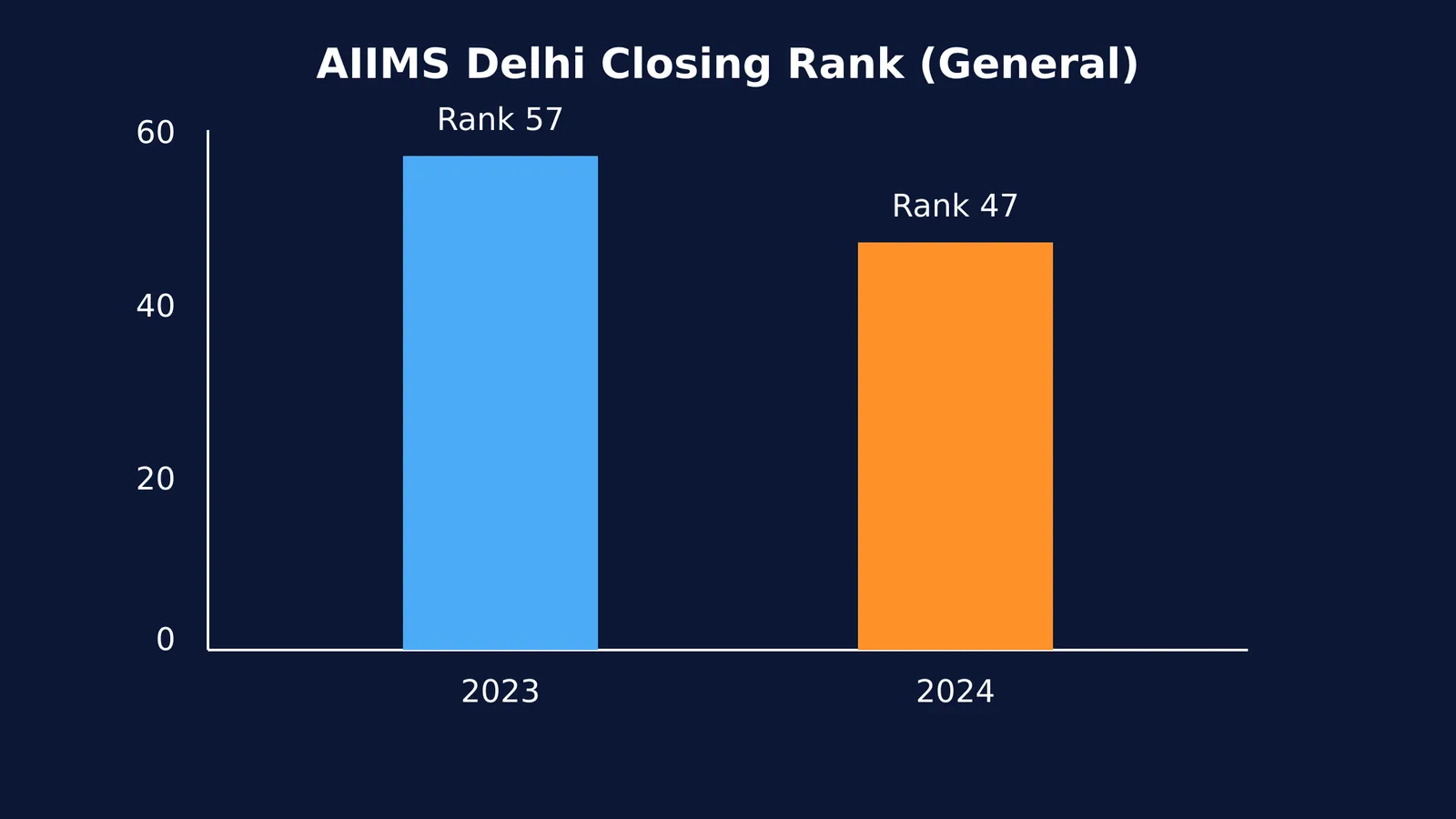
The cutoffs for these premier institutes are incredibly tight. In the 2024 counselling cycle, the closing rank for the General (Open) category in Round 1 at AIIMS New Delhi was an astonishing 47 (Source). In 2023, it was 57. This means that only the very highest scorers in the country—typically those scoring 715 or above out of 720—secure a seat at the flagship AIIMS campus.
JIPMER Puducherry and other prominent AIIMS campuses like those in Jodhpur and Bhopal are similarly competitive. These institutes often require a rank within the top 600, which still demands near-perfect scores due to the increasing volume of top performers.
For parents, these numbers provide a clear benchmark. A student must realistically aim for a top 600 national rank to have a comfortable chance at an established AIIMS or JIPMER campus. Understanding this can help shape a more focused and grounded approach to exam preparation.
How to discuss AIIMS cutoffs with your child?
When discussing this intense competition, keep the focus on growth rather than fear. The sheer numbers can easily overwhelm a student. Try using this framework when your child looks at the cutoff data:
Acknowledge the standard: "Closing at rank 47 means AIIMS Delhi is incredibly selective. It is a very high bar, and it is normal to feel intimidated by it."
Reframe the goal: "Instead of worrying about the top 50, let's look at your mock test scores today. Are you losing marks in physics calculations or biology recall?"
Set the next milestone: "Let's aim to consistently clear the 650-mark threshold first, which opens doors to excellent state government colleges, before stressing over the 710+ required for Delhi."
Normalize alternate paths: "Remember that where you do your MBBS does not define your entire career. Many great doctors come from state colleges and pursue their postgraduate degrees at AIIMS later."
By focusing on incremental progress rather than the final destination, parents can relieve unnecessary pressure.
Building the foundation for top ranks
Scoring in the top 500 nationally requires a flawless grasp of fundamentals across the entire syllabus—from physics problems like finding the distance in the nth second, to memorizing the formed elements of blood, or understanding the chemical differences between opioids, cannabinoids and coca alkaloids. If your child is struggling to break past a score plateau, they might need more than just answer keys.
This is where Fermi's AI tutor can help. The tutor teaches rather than answers: it holds a line of reasoning across a session, notices where a student is stuck, and decides whether to explain, ask, or show. It works out what the student knows and builds a plan for the session, so they sit down to a clear next step.
When they encounter a completely new or confusing topic, the Fermi Concept Library has every concept in physics, chemistry, biology, mathematics and computing, each with its own lesson and its place in the map.
By focusing on mastering concepts step-by-step rather than obsessing over the final rank, students can build the confidence needed to tackle NEET effectively and maximize their potential in the exam.


