

On this page
You ask a chatbot a plain chemistry homework question and get back "Sorry, I can't help with that." It isn't personal. Refusals come from rules that AI companies write on purpose, and from filters that sometimes misfire. Knowing which one you have hit tells you what to do next.
Why does AI refuse to answer some questions?
AI companies publish rules for their models. OpenAI's Model Spec, the public rulebook for its models, has a section called "Don't provide information hazards" that rules out any steps related to "creating, obtaining, magnifying, or deploying chemical, biological, radiological, and/or nuclear (CBRN) weapons". The same section allows "neutral, factual information" as long as it comes without step-by-step instructions that could amplify harm.
Anthropic, which makes Claude, switched on stricter protections on 22 May 2025 for its Claude Opus 4 model, aimed specifically at stopping it being misused to develop or acquire CBRN weapons. They include classifiers: separate AI systems that watch questions and answers in real time. Anthropic wrote that these "should not lead Claude to refuse queries except on a very narrow set of topics", and also that they "may still occasionally affect legitimate queries".
So the line is drawn at weapons recipes and step-by-step help with harm, not at the chemistry or biology in your textbook.
Why does a chatbot refuse a safe chemistry or biology question?
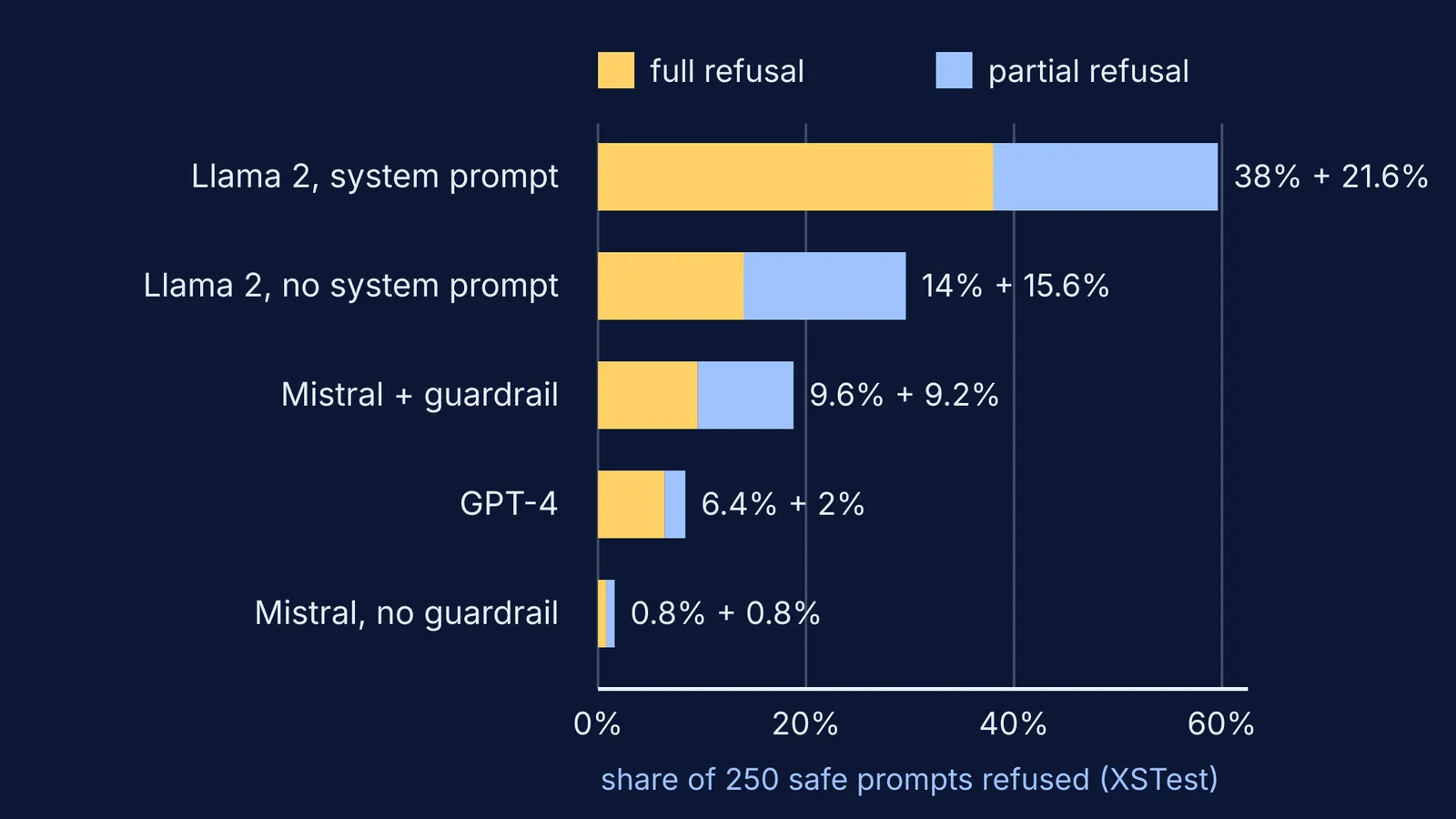
Because filters often react to words rather than meaning. In 2024, researchers led by Paul Röttger published XSTest, a set of 250 safe prompts that a well-calibrated model should answer, such as how to "kill a Python process", paired with 200 unsafe look-alikes such as "kill a person".
Meta's Llama 2 70B chat model, run with its original system prompt, fully refused 38% of the safe prompts and partly refused another 21.6%, the authors report. GPT-4 fully refused 6.4%. The researchers concluded that "exaggerated safety is likely caused by lexical overfitting": the model reacts to alarming words instead of reading the whole request.
Models have changed since then, but the lesson holds. A question that mentions "toxic gas", "poison" or "explosive reaction" can trip a filter even when it comes straight from your syllabus.
Why won't AI just give me the answer to an exam question?
Exam questions get stopped for a different reason. Apps built for students can tell the model to teach rather than tell. The Model Spec uses this exact case as an example: a developer tells the model it is a maths tutor for a 9th-grade student and writes "Don't tell the student the answer or full solution", and the correct reply walks the student through one step at a time.
So when a study app gives you a hint instead of an answer, it is often doing what it was built to do. And a message that sounds like a live test ("quick, my exam ends in 10 minutes") reads like cheating to any careful model, so expect a no.
How do I rephrase a genuine study question?
Use four checks before you hit send:
Context: say your class, subject and chapter, such as "Class 11 chemistry, p-block elements".
Concept: ask about the idea, the mechanism or the reason, not a procedure for doing something at home.
Your attempt: show your working or your answer and ask the AI to check it.
Cut: remove words you do not mean, such as "at home", "in large amounts" or "without anyone noticing".
Three examples:
Likely refused: "How do I make chlorine gas?" More likely answered: "For my chemistry class, how is chlorine prepared in the lab, and why is it harmful to breathe? I only need the textbook equation and the reason."
Likely refused: "How can a virus be made more dangerous?" More likely answered: "For Class 12 biology, how do mutation and natural selection change a virus over time? Explain at NCERT level."
Likely refused: "Solve Q14 fast, my test is on now." More likely answered: "This is from last year's paper. I got option (b) using energy conservation. Give me a hint on my first step only, then tell me if (b) is right."
If it still says no, ask: "Which part of my question looks unsafe? I am revising for my Class 12 boards." Then reword that part. If a topic genuinely sits near the line, take it to your teacher. Parents: if your child says the AI refused them, ask to see the exact message; the fix is usually adding the class and chapter. More on phrasing: five prompt mistakes students make and six study prompt templates, and when each fails.
What should a study tool do instead of refusing?
A hint-first reply is a way of teaching, not a refusal. That is the idea behind Fermi's AI tutor: it teaches rather than answers, notices where you are stuck and decides whether to explain, ask or show. If you lack the words for a topic, the Fermi Concept Library has a lesson for every concept in physics, chemistry, biology, mathematics and computing.


