

On this page
When you hit a roadblock on a tricky physics numerical or calculus problem, typing it into an AI chatbot feels like having an expert tutor at your elbow. Yet the way you ask determines what you actually learn. Dropping an assignment question into a prompt box usually produces a clean, polished answer that delivers immediate relief. However, when an AI does the thinking for you, that comfortable clarity rarely transfers to exam day.
Why does asking AI for direct answers hurt exam scores?
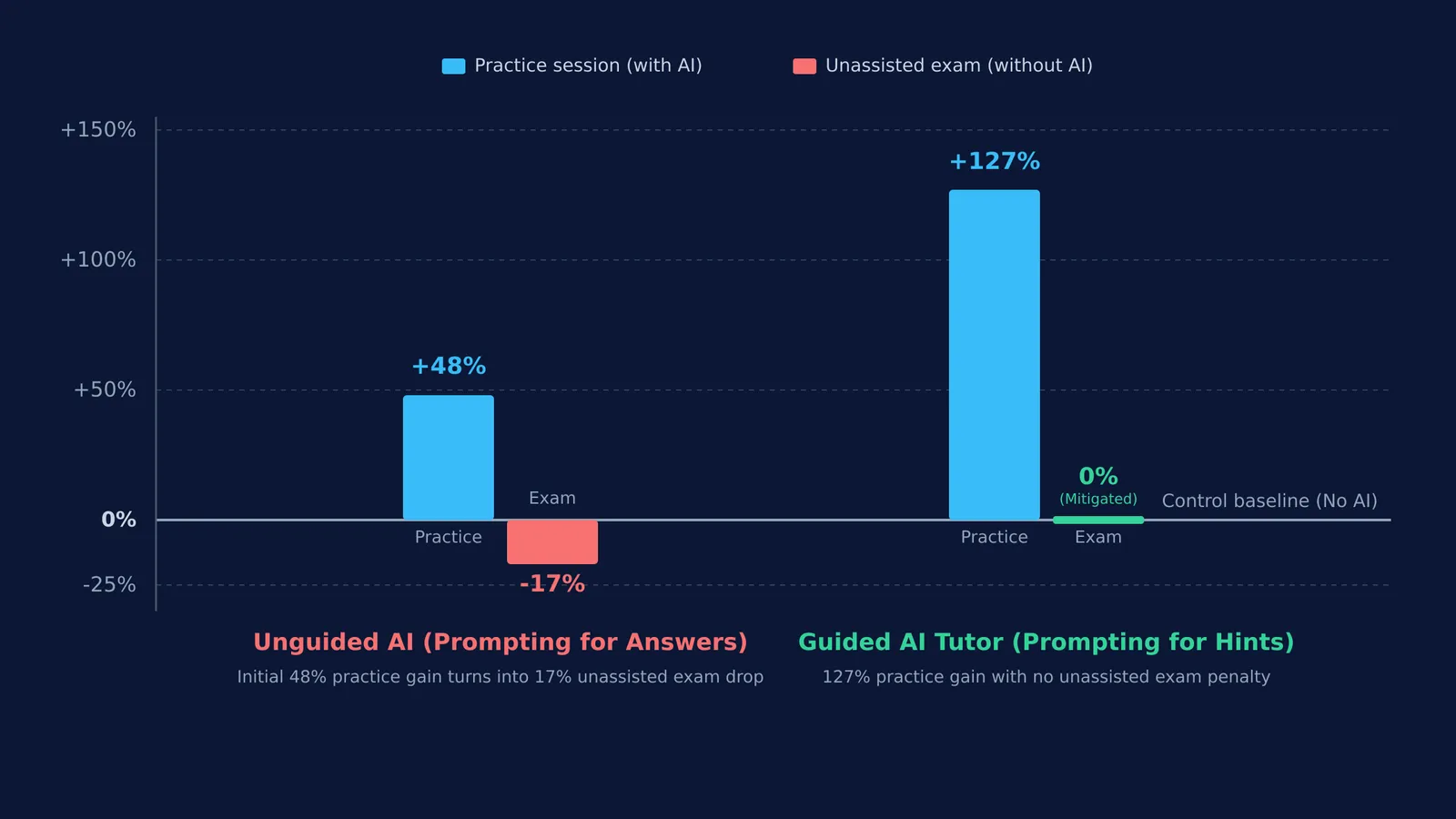
A large-scale randomized trial led by researchers at the University of Pennsylvania (PNAS, 2025) tracked nearly 1,000 high school mathematics students to measure how different AI prompting approaches affected learning. Students using standard GPT-4 as an open-ended solver scored 48% higher on practice problems than a control group using traditional textbooks. Yet when the researchers took the AI away and tested the students on unassisted exams, those same students scored 17% worse than peers who had never used AI.
The practice gains were an illusion. By prompting the AI for final answers, students bypassed the productive mental friction that cognitive scientists call the generation effect. When students instead worked with a guided tutor version programmed to offer hints and refuse direct answers, practice performance jumped by 127%, and the unassisted exam penalty was largely eliminated (PNAS, 2025).
This contrast confirms what developmental psychologist Sharon Nelson-Le Gall identified in her foundational framework on learning (Review of Research in Education, 1985). Nelson-Le Gall distinguished between executive help-seeking, where a learner asks someone else to complete the task, and instrumental help-seeking, where a learner requests targeted clues to maintain mastery. Prompting an AI for final answers is executive help-seeking: it completes homework quickly but creates cognitive dependency.
This is how Fermi's AI tutor teaches: rather than printing solutions, it holds a line of reasoning across a session, notices where a student is stuck, and decides whether to explain, ask or show. For students preparing for exams, recognizing how hints compare to complete solutions is the first step toward building genuine problem-solving stamina.
What are the five prompt habits that lead to poor AI help?
When students receive unhelpful, overly complex, or misleading AI responses, the issue almost always traces back to five recurring prompt habits:
Copy-pasting raw problem statements without curriculum context. In an analysis of engineering students using ChatGPT (Cogent Education, 2024), researchers found that 26% of students consistently relied on single copy-and-paste prompts, which produced the lowest response accuracy. Without knowing whether you are solving a Class 11 CBSE physics question using Cartesian sign conventions or a college-level problem requiring vector calculus, the AI guesses your syllabus level, often using methods you have not studied.
Asking for the final numerical answer. Typing "What is the answer to question 4?" forces the model into answer-dispenser mode. You receive a final number and steps, but your brain misses the opportunity to form retrieval pathways.
The kitchen-sink prompt. Packing theory, derivations, numerical calculations, and practice questions into one prompt overwhelms sequential reasoning. In the Cogent Education study (Cogent Education, 2024), breaking tasks into multi-question dialogues significantly improved model accuracy, and students using this iterative pattern achieved higher exam scores.
Hiding your attempt and where you stalled. If you do not share your initial equations, the AI cannot identify your underlying misconception. Instead of correcting your specific misunderstanding, it recites a generic textbook derivation.
Passive acceptance without verification. Language models predict language; they are not deterministic calculators. When you treat the first answer as infallible truth without testing boundary conditions or verifying units, you absorb subtle algebraic mistakes.
When working through multi-step numericals, the Fermi Problem Library provides worked problems with a step-by-step solver that explains the reasoning rather than printing an answer, preventing the habit of skipping directly to the final result.
How should students structure their prompts for STEM problems?
To turn an AI into an effective study partner, shift from executive help-seeking to instrumental help-seeking using a four-part prompt framework: Context, Attempt, Roadblock, and Expectation (CARE).
Context: State your grade level, syllabus, and conventions (such as Class 11 CBSE physics and Cartesian sign conventions).
Attempt: Share your initial equations, diagram setup, or calculations.
Roadblock: Explain exactly where your working stalled or why your result looks wrong.
Expectation: Request a guiding question or conceptual hint, instructing the model not to solve the problem.
Consider the difference in practice:
Ineffective prompt: "A 5 kg block rests on a 30° rough incline with friction coefficient 0.4. What is its acceleration?"
Effective CARE prompt: "I am solving a Class 11 physics problem on an inclined plane. My attempt: I resolved gravity into mg sin 30° down the incline (24.5 N for m = 5 kg) and mg cos 30° normal to the plane (42.4 N). Maximum static friction is 17.0 N for μ = 0.4. My roadblock: because downhill force exceeds static friction, the block accelerates, but no kinetic coefficient is given. Expectation: What assumption does NCERT make when only one coefficient is given? Give me a hint to set up the net force equation, but do not calculate the acceleration."
Adopting this conversational discipline prevents the pitfalls of chatbots that hand out answers rather than teaching. If you want deeper practice evaluating your own work, review our guide on getting useful AI feedback on step-by-step physics solutions.
The next time you open an AI chat, resist the urge to ask for the answer: share where you are stuck, ask for a hint, and let the model coach your thinking rather than replace it.


