

On this page
A chatbot answers your question. An AI agent goes further: it opens files, searches the web, runs code and keeps going until a task is done. Some study jobs are safe to hand over. Others quietly take away the practice that exams test.
What is an AI agent, in plain words?
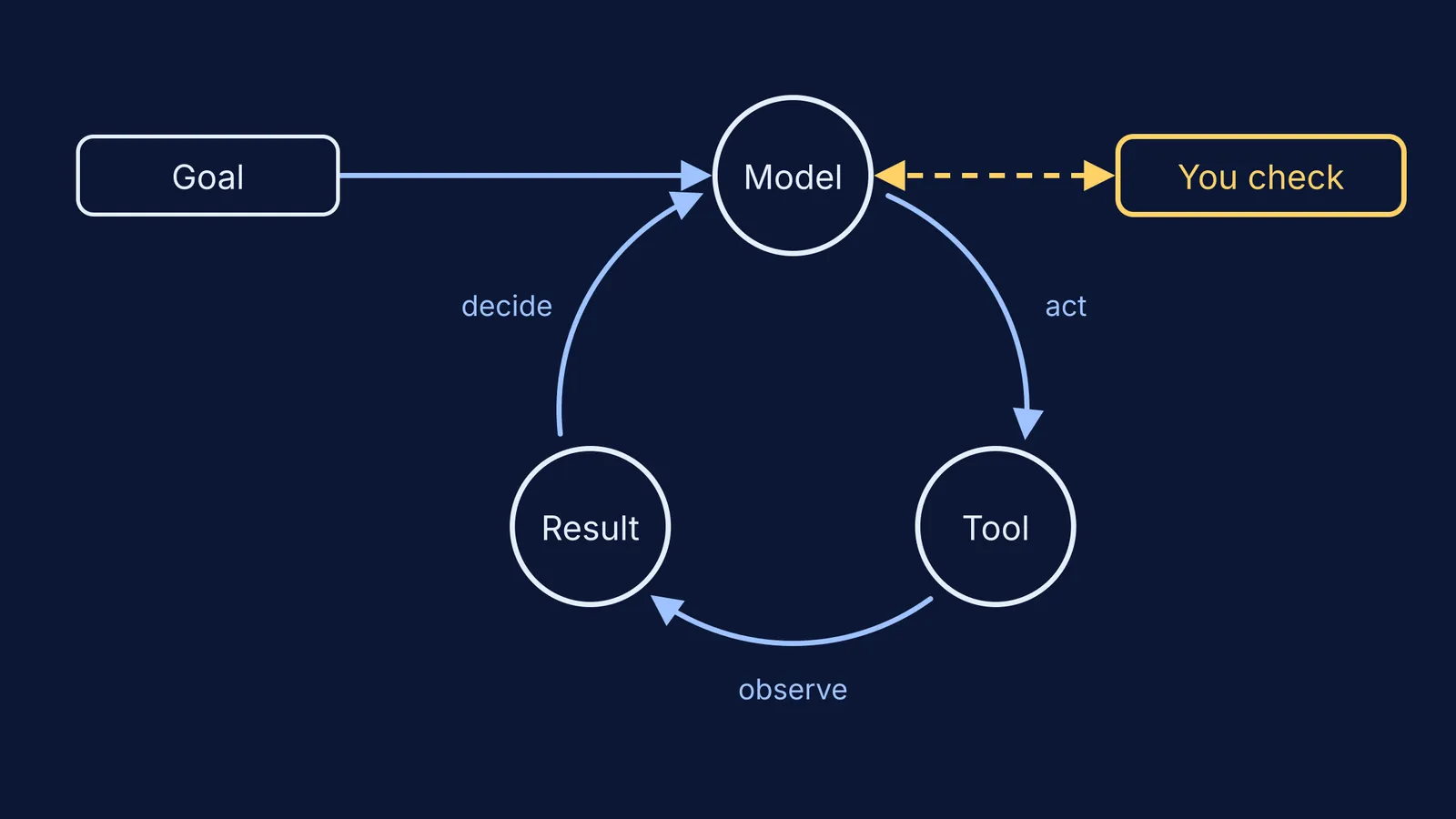
Anthropic, maker of the Claude models, defines agents as "systems where LLMs dynamically direct their own processes and tool usage, maintaining control over how they accomplish tasks" (Anthropic, Building effective agents). The same guide puts it more simply: agents are "typically just LLMs using tools based on environmental feedback in a loop."
You give a goal ("turn my chapter notes into a revision sheet"). The model picks a tool, such as opening a file or running a search, reads the result, decides the next step, and repeats until it thinks the job is done. A well-built agent can pause for your feedback at checkpoints or when it gets stuck.
The same guide warns that the autonomy of agents brings "the potential for compounding errors": one wrong step early on can carry through the steps after it.
How reliable are AI agents today?
Improving quickly, but not reliable enough to go unchecked. Researchers at METR measured AI models by the length of software task they can complete, timed by how long skilled professionals take (Kwa et al., arXiv, NeurIPS 2025). Frontier models of early 2025, such as Claude 3.7 Sonnet, could finish software tasks that take people about 50 minutes, but only about half the time. That task length has doubled roughly every seven months since 2019.
That is a coin-flip success rate, on software tasks. For anything that counts, such as formulas you will revise from, you still check the output. Long sessions add their own problems, covered in why AI forgets what you said earlier in a long chat.
Where does handing work to an AI cost you learning?
The clearest evidence comes from a field experiment in Turkey with nearly 1,000 high school maths students (Bastani et al., PNAS, 2025; study summary from Wharton). One group practised with a standard ChatGPT-style interface on GPT-4; another used a version designed to give hints rather than answers. During practice, grades rose 48% with the standard version and 127% with the hint-giving tutor, compared with students without access. But when access was taken away, students who had used the standard version scored 17% lower than students who never had it. The authors found students had used it as a "crutch", and that the hint-based design largely mitigated the loss.
In a classic memory study, students who took recall tests on a prose passage remembered substantially more of it two days and one week later than students who reread it (Roediger and Karpicke, Psychological Science, 2006); rereading won only on a test five minutes later. When an agent writes your summary or solves your problem, it does the recalling and the struggling for you, and those are the parts that build memory.
Which study tasks can you safely hand to an AI agent?
Sort every task into one of three piles.
Hand it over (logistics):
Collecting past papers and syllabus pages from official websites, then checking the links yourself
Turning your messy notes into a clean, formatted list
Building a revision timetable from your test dates
Do it together (checking):
Making practice questions, then verifying the answer key
Finding the first wrong line in your own working
Comparing your summary with the chapter to spot what you left out
Keep it for yourself (learning):
The first attempt at every problem
Recalling formulas and definitions from memory
Writing your own summary or explanation
Deciding what you are weakest at
For the middle pile, it helps to see how to use AI to understand mistakes, not get answers.
What does a good agent-assisted study evening look like?
Say you are in Class 12 with an electrostatics test on Friday.
Agent job. Ask it to pull every formula out of your notes into one list and match each to its exercise. Check a few against your NCERT textbook.
Your job. Close the list. Attempt a set of problems on paper, from memory.
Together. Paste your working for the ones you got wrong and say: "Do not give me the answer. Tell me which line is first wrong, and ask me one question that helps me fix it."
Your job again. Without looking, write the three ideas you will need on Friday.
If a wrong method is your usual problem, the Fermi Problem Library has a step-by-step solver that explains the reasoning rather than printing an answer. If you don't know where to start, Fermi's AI tutor works out what you already know and builds a plan for the session, then decides whether to explain, ask or show.
Parents choosing an app can use our five questions for judging what AI-powered means in edtech. Let the agent carry the chores, and keep the thinking for yourself.


