

On this page
After a weekly JEE Main or NEET-UG mock test, looking at a sea of red crosses can be overwhelming. Many students instinctively try to re-solve every missed question from the top, treating the paper as a massive to-do list. But treating a calculation slip the same way as a fundamental misunderstanding wastes precious study time and masks your true weaknesses.
To make your post-test review efficient, you need to sort your errors first. By categorising your mistakes, you can direct your energy exactly where it is needed, rather than blindly repeating questions you already know how to solve.
Why do we make careless mistakes?
It is tempting to look at a wrong answer, realise you knew the right formula, and brush it off as a "silly mistake". But true slips are rarer than you might think. A classic study of students' mathematical performance found that only 21% of test errors were genuinely "careless" mistakes where the student confidently knew how to obtain the correct answer (Clements, 1982).
The rest are not accidents. They are often conceptual gaps disguised as slips. For example, if you consistently miscalculate the average bond order from resonance because you count the total bonds incorrectly, that is a gap in understanding, not just a slip of the pen.
When you misapply a formula because you didn't check the conditions, or when you set up the free-body diagram incorrectly, your brain is applying a flawed internal logic. If you are consistently dropping marks on questions you "know", you are likely dealing with one of three distinct types of errors: careless slips, time-pressure mistakes, or conceptual gaps.
How should you sort your test errors?
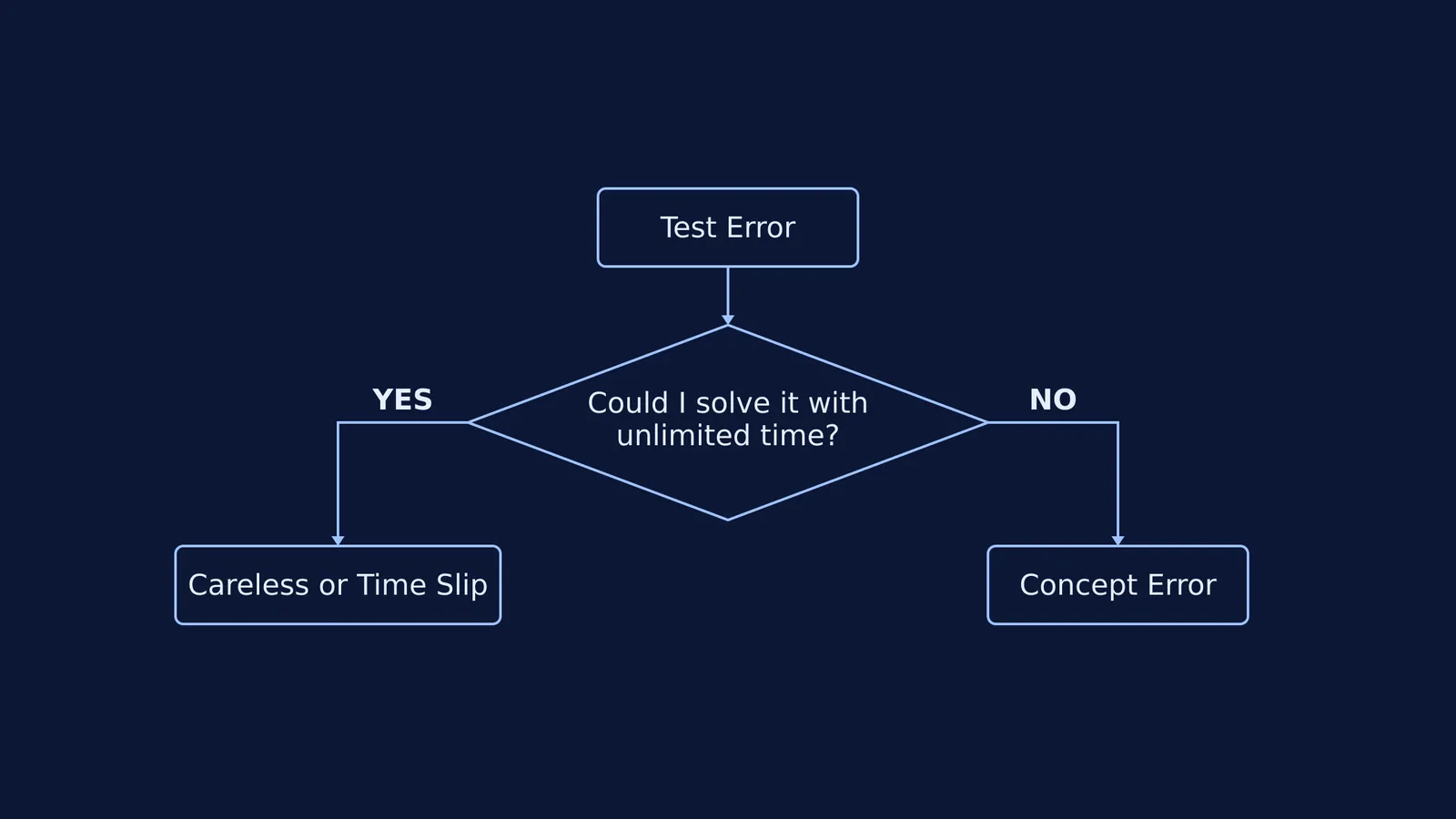
Before you open a textbook or boot up a study tool, take 15 minutes to sort your incorrect answers using a three-question diagnostic.
Your answer to that single question tells you which bucket the error belongs in.
Silly mistakes (The "Yes" Bucket): You knew the physics, you had enough time, but you wrote 2 + 3 = 6 or misread "incorrect" as "correct" in the options. The Fix: Do not study the concept again. Update your test strategy by adding a specific checking step, like underlining the word "NOT" in the question paper, or doing your rough work more neatly.
Time mistakes (The "Rushed" Bucket): You knew how to do it, but you panicked, skipped it, or guessed because you spent five minutes on a previous, harder question. The Fix: This is a pacing issue. Your review should focus on recognising question types faster and learning when to skip a tough problem, rather than relearning the chapter.
Conceptual errors (The "No" Bucket): You applied the wrong formula, you set up the equation backwards, or you simply stared at a blank page without a clue. The Fix: This is a true gap in your knowledge. This is the only bucket where you need to go back, rebuild your foundations, and relearn the material.
How to review weekly test mistakes with AI?
Once you have isolated your conceptual errors, you can bring them to an AI tutor. The biggest mistake students make with AI is pasting in their silly mistakes and asking for the right answer. Instead, use the AI strictly for the "No" bucket to investigate why your logic failed.
Fermi's AI tutor works out what you already know and builds a plan for the session. Rather than printing a final answer to copy, it teaches through the problem. It holds a line of reasoning across a session, writing on a board and drawing the figure to show you exactly where your logic broke down.
Here is a practical script for reviewing a conceptual error with the tutor:
"I got this question about the distance in the nth second wrong on my test. I tried to use v² = u² + 2as, but the answer key used a different formula. Can you help me understand why my approach doesn't work here?"
If your error shows you have forgotten the topic entirely, head to the Fermi Concept Library, where every concept in physics, chemistry, biology, mathematics and computing has its own lesson and its place in the map.
If you understand the theory but struggle to set up the math, practice in the Fermi Problem Library. It features worked problems with a step-by-step solver that explains the reasoning, so you sit down to a clear next step instead of a blank page.
By filtering out the careless and time-based errors first, you stop wasting energy on things you already know. You turn your test review from a frustrating chore into a targeted, high-impact study session.


