

On this page
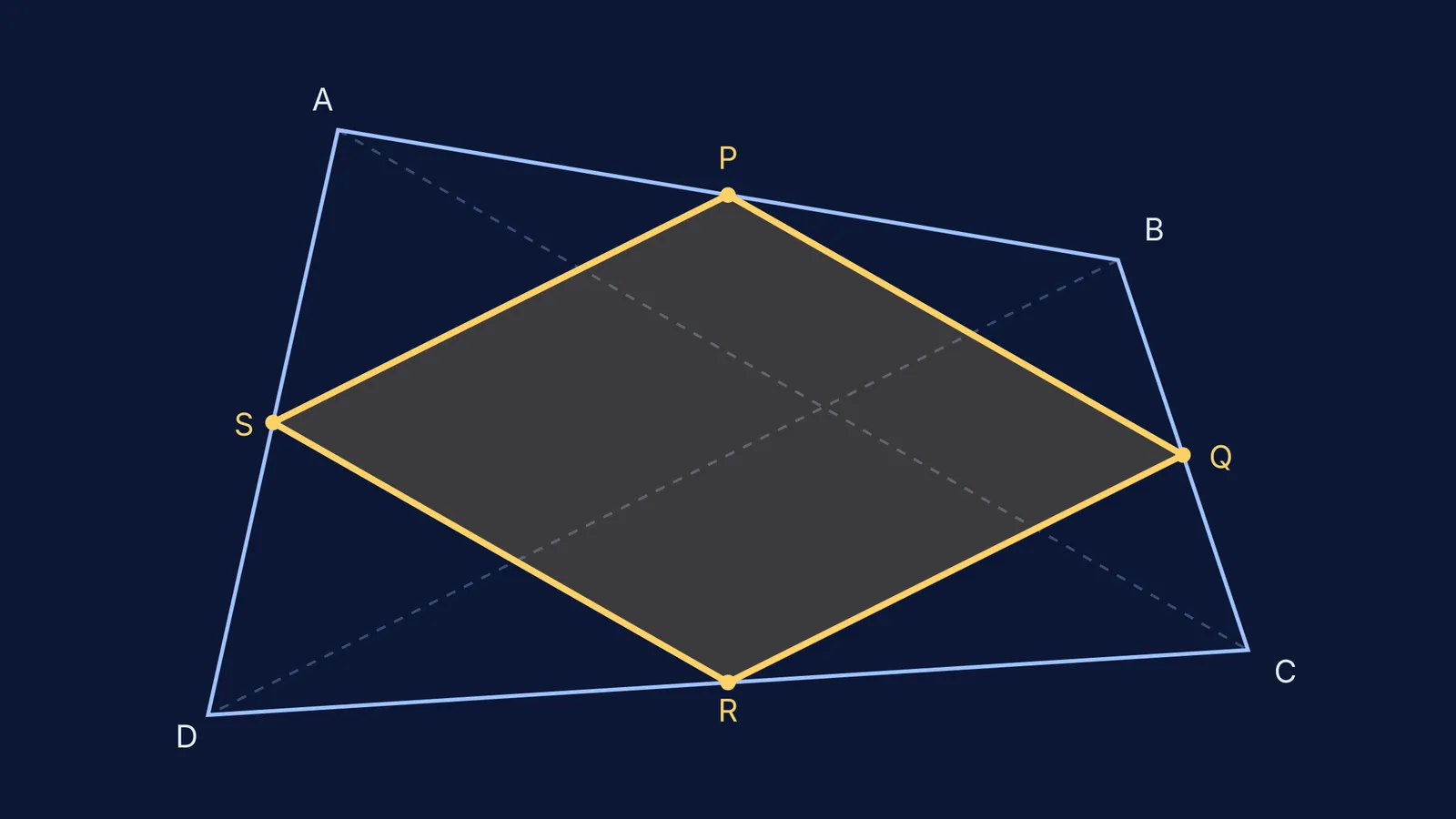
If you draw an arbitrary four-sided shape on a piece of paper and connect the midpoints of its adjacent sides, you will always get a perfect parallelogram. This surprising geometric truth is called Varignon's theorem.
The theorem is named after Pierre Varignon, a French mathematician whose proof was published in 1731, after his death. It applies to any quadrilateral—whether it is convex (all corners pointing outwards), concave (like a dart), or even a shape twisted in three dimensions.
What is Varignon's theorem?
Varignon's theorem states that the midpoints of the sides of any quadrilateral form the vertices of a parallelogram. This inner shape is known as the Varignon parallelogram.
Beyond just its shape, the Varignon parallelogram has two strict mathematical properties, according to Wolfram MathWorld:
Area: The area of the Varignon parallelogram is exactly half the area of the original quadrilateral, provided the original shape does not intersect itself.
Perimeter: The perimeter of the Varignon parallelogram equals the sum of the lengths of the two diagonals of the original quadrilateral.
Why does joining midpoints of any quadrilateral give a parallelogram?
The proof of Varignon's theorem relies on a simpler idea taught in high school geometry: the Triangle Midsegment Theorem.
Imagine a quadrilateral ABCD. If you draw a diagonal line connecting corners A and C, you split the shape into two triangles: ABC and ADC.
Look at triangle ABC. The line segment joining the midpoints of sides AB and BC forms a "midsegment". By the midpoint theorem, this line is parallel to the diagonal AC and exactly half its length.
Now look at triangle ADC. The line segment joining the midpoints of sides AD and DC is another midsegment. It is also parallel to the diagonal AC and half its length.
Since both of these new midpoint segments are parallel to the same diagonal and equal in length to each other, they form a parallelogram.
If you are struggling with geometric proofs and visualizing how shapes behave, Fermi's AI tutor can help by walking you through the steps. You can interact with similar geometry scenarios in the Fermi Simulation Lab, dragging the vertices of a quadrilateral and watching the midpoints instantly recalculate to keep the parallelogram intact.
How do you prove it with vector maths?
The theorem is also an excellent chance to practise using position vectors, much like finding collinear points with vectors or calculating the area of a triangle using determinants.
If the four corners of a quadrilateral are given by position vectors a, b, c and d, the midpoints of the four sides are:
p = (a + b) / 2
q = (b + c) / 2
r = (c + d) / 2
s = (d + a) / 2
To prove it is a parallelogram, we check if opposite sides are equal and parallel by finding the vector connecting the points. The side from p to q is the vector q − p: q − p = (b + c) / 2 − (a + b) / 2 = (c − a) / 2
The opposite side from s to r is the vector r − s: r − s = (c + d) / 2 − (d + a) / 2 = (c − a) / 2
Because q − p equals r − s, the opposite sides are parallel and equal in length. Therefore, the shape is a parallelogram.
How can you test the theorem yourself?
The best way to understand Varignon's theorem is to see it fail, or rather, to try to make it fail.
Draw the most irregular four-sided shape you can imagine on a sheet of graph paper.
Measure each side with a ruler and mark the exact midpoint.
Connect those four dots in order.
You will find that opposite sides are always parallel.


