On this page
Your teacher says "don't use Wikipedia", yet it comes up first for almost every science search. Used well, Wikipedia is a map to better sources. Used badly, it is a place to copy a sentence nobody has checked.
How accurate is Wikipedia on science topics?
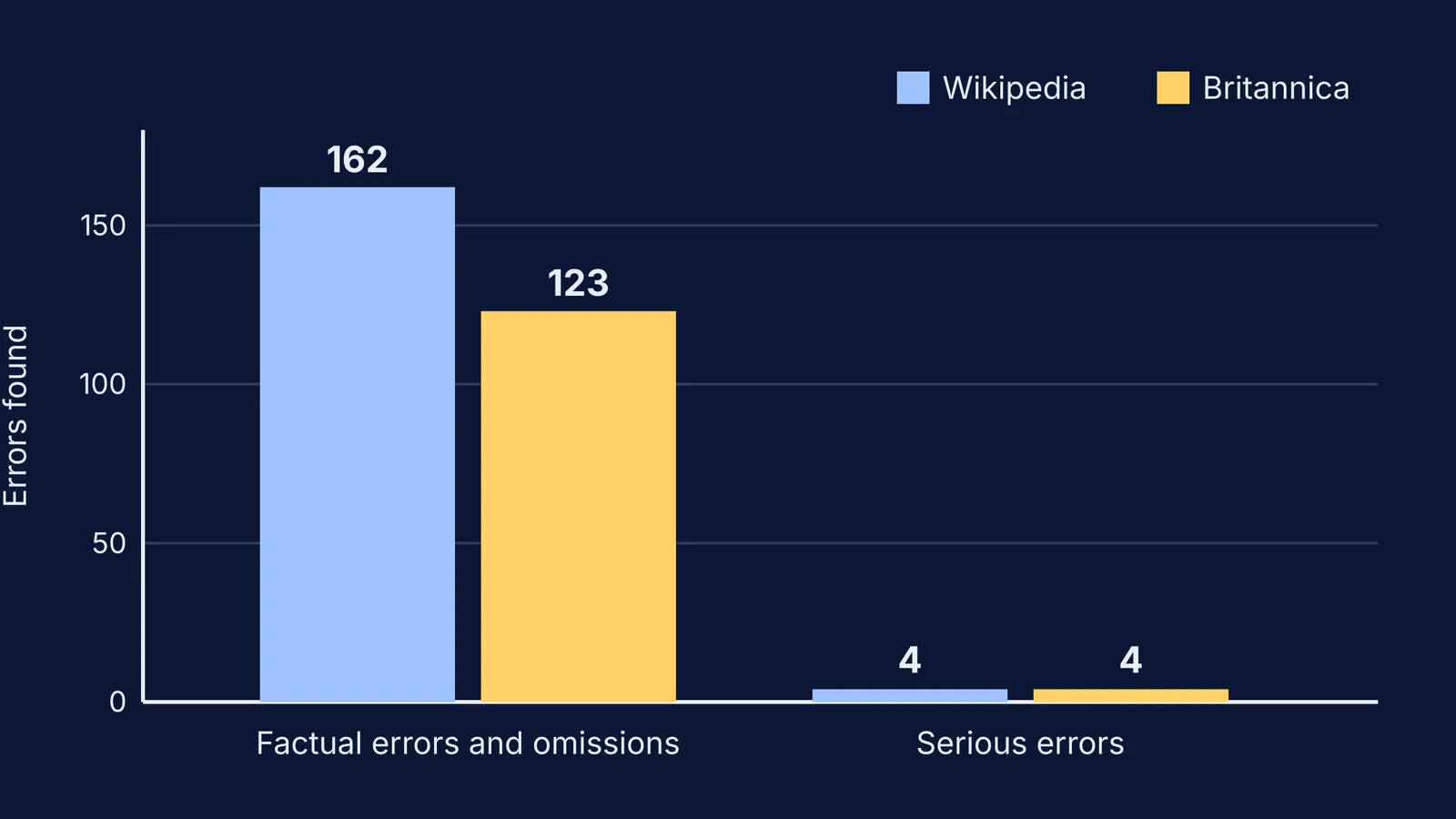
The test people quote most is old. In 2005 the journal Nature had experts review 42 pairs of science articles from Wikipedia and Encyclopaedia Britannica (Nature, Giles 2005; ABC Science report). The reviewers found eight serious errors, four in each encyclopaedia, and 162 factual errors, omissions or misleading statements in Wikipedia against 123 in Britannica.
A 2014 study in PLoS ONE compared Wikipedia's drug information with standard pharmacology textbooks and found it 99.7% accurate but 83.8% complete (Kräenbring et al., 2014). That is the pattern to remember: what is on the page is usually right, but things can be missing.
Wikipedia agrees that you should not cite it. Its own guideline says "Wikipedia articles (and Wikipedia mirrors) in themselves are not reliable sources for any purpose" (Wikipedia: Reliable sources). The same page says academic and peer-reviewed publications and textbooks "are usually the most reliable sources".
Quality also varies from page to page. Featured articles, Wikipedia's highest quality grade, made up about one in every 1,030 English Wikipedia articles when we checked in October 2026 (Wikipedia: Featured articles).
How do you check a Wikipedia science article?
Do this for each fact you plan to use:
Read the reference. Click the small number after the sentence and open that source. A textbook, journal paper or university page is a good sign; a blog, or no number at all, means the sentence is unconfirmed. A [citation needed] tag means an editor has flagged the claim as needing a reliable source (Template: Citation needed).
Open the Talk tab. Talk pages are where editors discuss how to improve the article (Help: Talk pages). Search it for the fact you want; an argument there is a warning. The banner at the top usually shows a quality grade, from Stub ("very basic description of the topic") up to GA and FA (Wikipedia: Content assessment).
Open View history. Each line shows the date, the editor, the size change and an edit summary, and "prev" shows exactly what changed in that edit (Help: Page history). If your sentence was added recently, or the page shows a run of edits being undone, check it somewhere else before you use it.
Cite the source, not Wikipedia. Wikipedia's advice to students is direct: you "should not cite Wikipedia itself, but the source provided" (Wikipedia: Academic use).
The same habit works for chatbot answers. Our guide to checking references when AI makes up sources walks through it.
A worked example: one homework fact
Say your Class 11 homework asks you to define specific heat capacity and give its SI unit, and Wikipedia comes up first.
Find the definition. If it has no footnote, look further down the page for the same point with a reference.
Open the reference. A university physics textbook is a real source.
Open your own textbook's chapter on thermal properties and check that the wording, symbol and unit (J kg⁻¹ K⁻¹) match what your class uses.
Write the definition in your own words and name your textbook as the source.
If a reference leads to a journal paper, here is how to read a scientific paper as a school student.
When should you use a textbook instead of Wikipedia?
Go straight to the textbook when:
the answer must match your syllabus: definitions, laws, sign conventions in optics, units and symbols
you need a derivation step by step, since encyclopedia articles can skip steps or use university notation
you are meeting a topic for the first time, since a textbook builds ideas in order
two sources disagree and you need the version your teacher will accept
Wikipedia is useful for the history of a discovery, a quick overview, finding books and papers, and seeing how topics connect. To get more from the textbook itself, try reading a science textbook actively.
Sometimes the gap is an idea, not a fact: you have read three sources and still don't see why. The Fermi Concept Library has a lesson for every concept in physics, chemistry, biology, mathematics and computing. Fermi's AI tutor can work out what you already know and build a plan for the session.
What should parents say about Wikipedia homework?
Rather than banning it, ask about the checking:
"Which reference did that sentence come from? Show me."
"Does it say the same thing as your textbook?"
"How would you write that in your own words?"
Tonight, pick one fact from your homework and run the four checks on it.