

On this page
Every time you eat a piece of chocolate or sip a sweet drink, a silent chemical reaction begins on your teeth. Within minutes, the environment inside your mouth shifts from a safe, neutral state to an acidic danger zone.
Understanding this cycle—and measuring exactly how long it takes to recover—is the key to protecting your enamel. It also perfectly illustrates how chemical equilibria work in real biological systems, showing why the timing of your snacks is just as important as what you eat.
What is the critical pH for tooth decay?
Your mouth usually rests at a pH close to neutral. However, the plaque on your teeth is full of bacteria. When you eat fermentable carbohydrates, especially free sugars, these bacteria feed on the sugar and excrete lactic acid as a waste product.
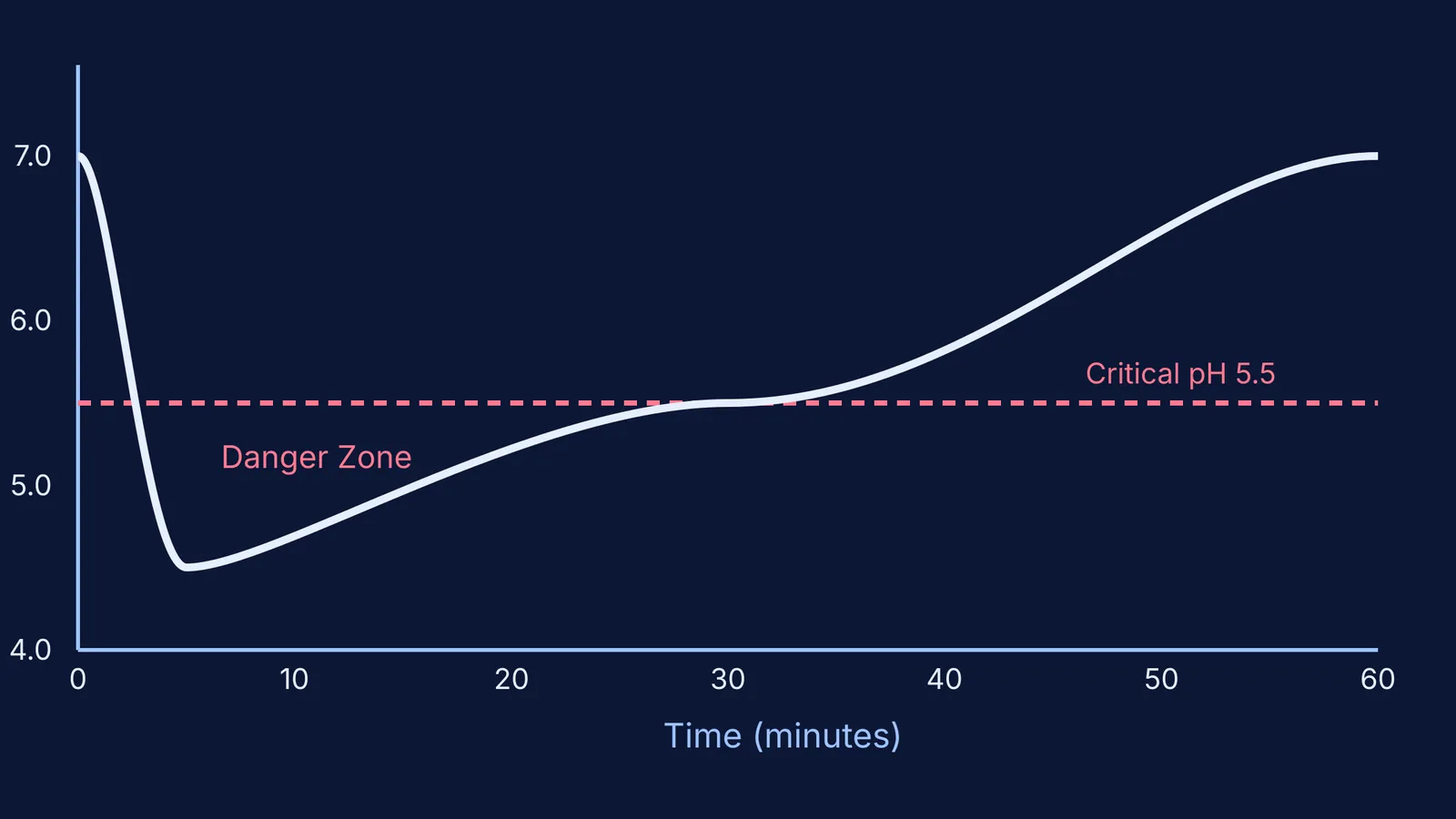
Because of this rapid acid production, the pH of your mouth plunges. The critical pH for tooth enamel is 5.5 (Wikipedia). When the pH drops below this specific threshold, the enamel begins to dissolve. This process is called demineralisation, where the tooth loses vital calcium and phosphate ions into the surrounding fluid.
The damage caused by this recurring acid exposure is well documented. The World Health Organization (WHO) strongly recommends reducing daily free sugar intake to less than 10% of total energy intake, and conditionally recommends reducing it below 5% specifically to minimize the lifetime risk of dental caries (WHO).
How long does mouth pH take to recover?
The graph showing this sudden pH drop and the subsequent slow recovery is called the Stephan Curve (Wikipedia).
Once sugar hits your teeth, the pH plummets rapidly. After this steep drop, your mouth relies entirely on saliva to wash away food particles and act as a chemical buffer to neutralise the acid.
It typically takes 30 to 60 minutes for the pH in your mouth to recover and rise back above the critical 5.5 mark (Wikipedia). During that entire window, your teeth are actively dissolving. Saliva acts as a natural buffer because it contains bicarbonate ions that react with the excess hydrogen ions, slowly pushing the equilibrium back toward a neutral pH.
If you want to understand how buffering systems resist these sudden shifts and maintain balance, the Fermi Simulation Lab provides interactive simulations for ideas that are easier to see than to read. You can see how adding an acid shifts the balance. (You can also review the foundational concepts of indicators and neutralization in our Class 10 guide to acids, bases and salts or dive deeper into the chemistry in pH of very dilute acid).
Why does frequent snacking matter?
The Stephan Curve explains a crucial piece of dental hygiene: the frequency of eating sugar is far more destructive than the total amount eaten at one time.
If you eat a large piece of cake in one sitting, your mouth pH drops into the danger zone, stays there for up to 60 minutes, and then recovers (Wikipedia). Your teeth face one distinct acid attack.
However, if you take that same piece of cake and slowly snack on it over three hours, taking a small bite every 20 minutes, your saliva never gets the chance to buffer the acid completely. Each new bite introduces fresh sugar for the bacteria, restarting the acid production and driving the pH back down. Instead of a single 60-minute demineralisation window, your enamel remains below pH 5.5 continuously for hours, leading to severe decay (Wikipedia).
A simple plan for healthy snacking
You do not have to give up sugar entirely to protect your teeth. You simply need to manage the chemistry and give your saliva enough time to do its job. Here is how to adapt your habits:
Bundle your sweets: Eat sugary foods during or immediately after a main meal. The heavy saliva flow generated by chewing a full meal will help clear the sugar much faster than eating a sweet on its own.
Beware the slow sip: Do not nurse a sugary drink over a long study session. Drink it quickly, then switch to plain water to let your mouth recover.
Stimulate saliva flow: If you cannot brush, chew sugar-free gum containing xylitol after a snack. The physical act of chewing stimulates alkaline saliva, which speeds up the recovery curve and washes away acid.
Rinse with plain water: Swishing plain water around your mouth immediately after eating dilutes the acid and helps dislodge sugars before the bacteria can break them down.


