

On this page
An exit ticket is one or two questions students answer in the last few minutes of a lesson. It tells you, by the next morning, who understood today's idea and who left with a wrong one. AI drafts these in seconds, but needs a precise brief, and you still need to check every option.
Why should an exit ticket target one misconception?
A question that tests one idea gives you an answer you can act on. If each wrong option matches one specific wrong belief, the letter a student picks tells you what they think.
Those wrong options are called distractors: incorrect options designed to target common errors or misconceptions among real students, as the NAACL 2024 study by Feng and colleagues defines them.
The quiz helps students too. In Roediger and Karpicke's 2006 experiments, students who took recall tests remembered prose passages better a week later than students who restudied, even though restudying made them feel more confident.
India's National Education Policy 2020 (paragraph 4.34) says school assessment should become "more regular and formative", with assessment primarily for learning.
How do teachers use AI to make exit ticket questions?
Give the AI the misconception, not just the topic. "Make an exit ticket on Newton's first law" gets you a definition question. A brief like this gets you a diagnostic one. Copy it and change the bracketed parts:
"I teach [Class 9 physics]. Today's lesson: [Newton's first law]."
"Write one multiple-choice question a student can answer in under two minutes."
"The correct option must show [no net force means constant velocity]."
"Write exactly two wrong options. Option B is what a student who believes [a moving object carries a force that runs out] would choose. Option C is what a student who believes [an object with no force on it must slow down] would choose."
"Add the line: Explain your choice in one sentence."
"For each option, tell me in one line which belief it reveals."
The misconceptions should come from your own marking, not from the AI. In Bitew and colleagues' 2023 evaluation, teachers rated on average 53% of the distractors from a ChatGPT-based method high-quality, meaning usable as is. The Feng et al. study found LLMs could write some mathematically valid maths distractors but were less adept at anticipating the errors real students make. So you name the misconception; the AI does the wording. Our post on using AI to find student misconceptions before you teach covers building that list.
A worked example: one puck, three beliefs
Here is the kind of question that brief can produce, once edited:
"A hockey puck slides across smooth, frictionless ice after the stick stops touching it. Which is true while it slides?"
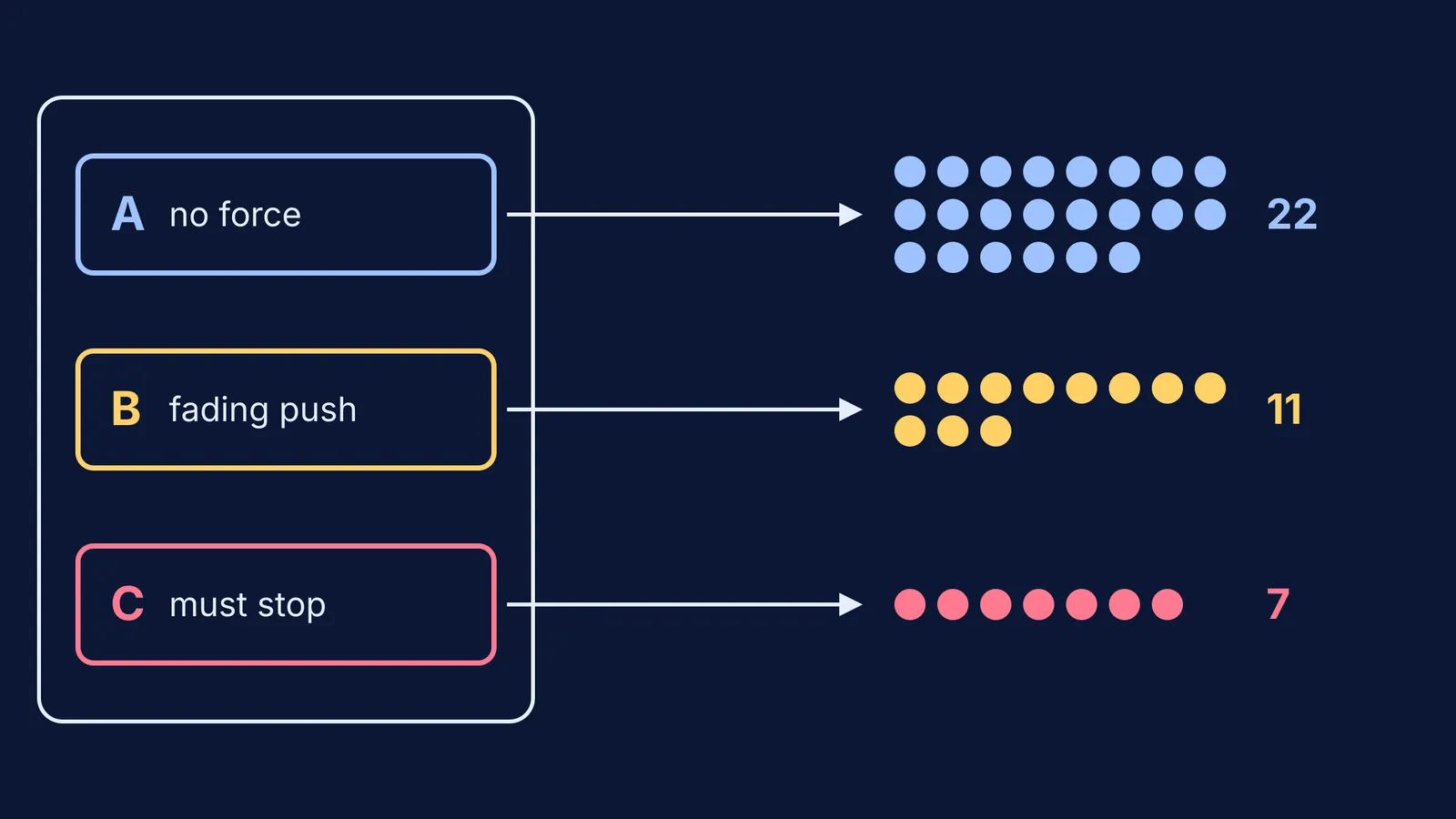
A. No horizontal force acts on it, and it keeps moving at the same speed.
B. The force from the stick keeps pushing it, getting weaker until it stops.
C. No horizontal force acts on it, so it slows down and stops.
Suppose 40 students answer: 22 choose A, 11 choose B and 7 choose C. (These numbers are made up to show the method.) Read the one-sentence explanations too: a student who picks A but writes "because the push is still inside it" belongs with group B.
How do you group students from exit ticket answers?
Sort the slips into three piles the same evening. Then plan the first 15 minutes of the next class:
Group A (understood): a harder problem on the same idea, such as the puck reaching a rough patch. They explain it to each other.
Group B (fading push): predict, then watch, a toy car rolling on a smooth floor. Ask where the "stored force" would go on a force diagram.
Group C (must stop): compare the same slide on carpet, a tiled floor and ice. What changes, and what would happen with no friction at all?
Then bring everyone back for a fresh question on the same misconception. If a group still splits, that is tomorrow's exit ticket.
For groups B and C, seeing the motion helps. The Fermi Simulation Lab has interactive simulations for ideas that are easier to see than to read, and students who want to go over it at home can use Fermi's AI tutor, which checks understanding as it goes.
What should you check before using AI-made questions?
Before you print, check:
Exactly one option is correct. AI sometimes writes a distractor that is also right; our guide to checking the answer keys of AI-made MCQs shows how to catch this.
Each wrong option matches one belief you have seen in your class.
It can be answered in two minutes without a calculator.
The language suits your students, in English or Hindi as you teach.
No clue gives the answer away, such as one longer option or the words "always" and "never".
The same rule of one item, one target helps when you build a question paper from a blueprint.
Start small: one question at the end of one lesson this week, and three piles on your desk the next morning.


